By the Corex Vitality™ Research Team · Last checked 14 November 2026 · Sources listed below
For laboratory research use only. Not for human or veterinary use. This guide is for laboratories moving research peptides between sites, or sending them by courier. It is not advice on personal travel, and it is not legal advice. Check official guidance and your carrier’s rules before you ship.
Quick summary
- Ship lyophilised (freeze-dried) material where you can. Dry peptides are much more stable than solutions, and short room-temperature transit is often used [1–4].
- If the material is in solution, or the batch documents require a cold chain, use insulated packaging and cold packs. Do not press frozen packs against vials.
- Label the package as laboratory research material. Include the batch number, a copy of the certificate of analysis (COA) and the words for laboratory research use only.
- UK freight imports need a customs declaration. Do not describe research peptides as licensed medicines.
- On arrival, check the seals, the temperature record, the labels and the COA before the vials go into storage.
Searches such as “travelling with peptides UK” or “how to transport peptides” often lead to pages about personal travel. This article is for a different job: moving research peptides from lab to lab, or by courier. Research peptides sold for laboratory work are not licensed medicines. Pack and declare them as laboratory materials. For storage on arrival, see our lyophilised peptide storage guide. For batch paperwork, see the Learning Hub.
1. What this page covers (and what it does not)
This page covers stability in transit, insulated packaging, labelling and COAs, UK customs declarations for laboratory materials, temperature logging, and checks on arrival. It does not cover carrying peptides as a personal item or packing them with medicines. Those topics belong to licensed medicines and travel-health rules, which are a different legal framework. If an authorised member of a research establishment accompanies laboratory materials, that is still an institutional shipment (see section 5).
2. Lyophilised versus reconstituted: stability and temperature
Lyophilised means freeze-dried. Water is removed under vacuum so the peptide is left as a dry cake or powder. Water drives most peptide breakdown, including hydrolysis and oxidation of sensitive residues, so a dry solid is far more stable than the same molecule in solution [2, 3].
Manufacturer handling guidance, and reviews of freeze-dried protein and peptide formulations, point in the same direction [1–4]:
- Unopened lyophilised vials are usually kept tightly closed at −20 °C or colder for longer storage. A laboratory fridge at 2–8 °C is often acceptable for a short period. Short room-temperature transit of dry material is widely treated as normal, unless the batch documents say otherwise [1, 4].
- Reconstituted solutions are much more fragile. If a solution must be moved, keep the journey short, hold a cool, steady temperature, and avoid freeze–thaw cycles. Ice crystals concentrate the peptide and can damage it [2, 3].
- Where you can, ship the vial dry and reconstitute it at the destination laboratory.
Always follow the storage statement on the COA or product documents for that batch. Longer, lipidated research peptides, such as retatrutide, can have different handling notes from short lyophilised sequences.
If the destination laboratory will reconstitute the material, our bacteriostatic water (BAC water) page explains the preserved diluent used in some in-vitro work. Ship any liquid in leak-proof inner packaging, separate from dry vials, and only if the carrier accepts it.
3. Packaging: insulation, cold packs and dry ice
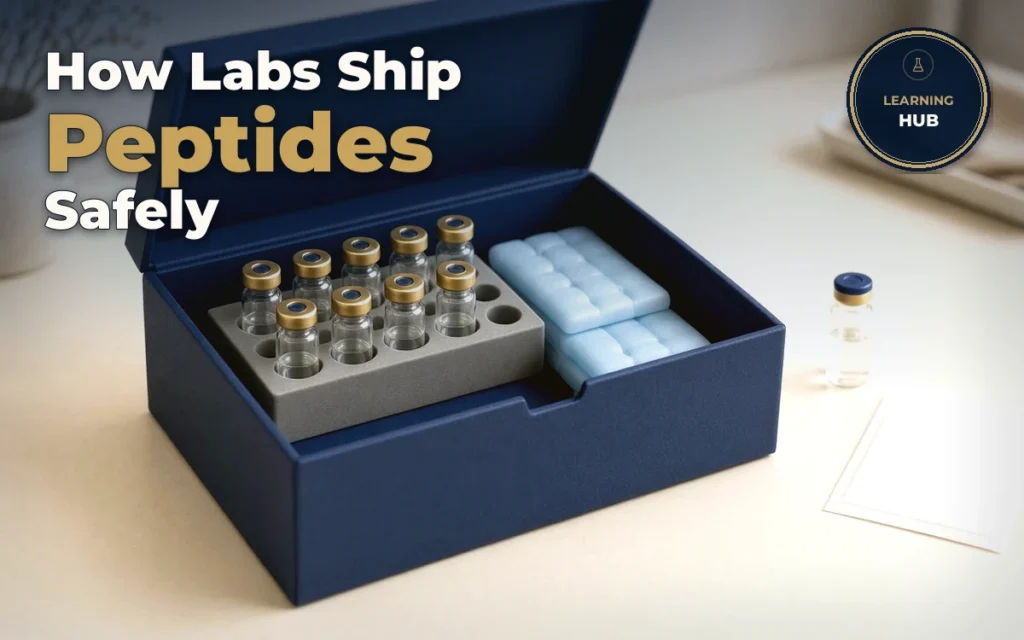
For dry vials on a short journey, a rigid outer box, cushioning and a tamper-evident seal may be enough. Protect vials from crushing, moisture and strong light.
For a cool chain, use a purpose-made insulated shipper and pre-condition the cold packs. Do not press a frozen pack directly against a vial: that can freeze a solution locally or crack glass. Put vials in the middle of the box, with a thin foam layer. If you send a liquid, use a leak-proof primary container and a leak-proof secondary pack, with enough absorbent material to take up the full volume if a vial breaks.
Royal Mail and the Post Office list dry ice and frozen water, including packs of ice, as prohibited in the mail, in the UK and internationally [5]. Ordinary post is a poor choice for chilled or frozen laboratory packages. Use a courier that accepts insulated packaging and publishes its rules for cold packs.
Dry ice (solid carbon dioxide, UN 1845) is a dangerous good when used as a refrigerant. IATA Packing Instruction 954 requires packaging that can release carbon dioxide gas so pressure does not build up, plus marks for “UN 1845”, “Carbon dioxide, solid” or “Dry ice”, the net weight of dry ice, and a Class 9 label [6]. Tell the courier you are using dry ice. Do not put dry ice in a tightly sealed container, and do not use it in ordinary post.
Do not label a research peptide parcel as an “exempt human specimen” or as UN 3373 (Category B biological substance) unless the contents really are that class of material. Those IATA and ICAO rules are for patient specimens and infectious substances, not for ordinary synthetic peptide reagents [7].
4. Labelling and documents
The outer package should carry the shipper and receiving laboratory (with a contact number), a description such as “Lyophilised research peptides for laboratory use only”, the words For laboratory research use only. Not for human or veterinary use, the batch number matching the vial labels, any refrigerant marks, and orientation arrows if the contents are liquid.
Inside the box, include a packing list (compound, vial size, quantity, batch number), a copy of the certificate of analysis shown as issued, a commercial invoice describing the goods as research materials, and any safety data sheet the receiving laboratory needs.
The batch number links a vial to its COA. Our guide to batch numbers and lot traceability explains how to read that code, and the batch verification page is where a Corex Vitality™ report number can be checked. Do not describe the goods as a licensed medicine or a personal import of medication. That description would be inaccurate for research-use-only peptides and can cause the parcel to be held.
5. Customs declarations for laboratory materials
Goods imported into the UK as freight need an import declaration. HMRC’s guidance on making a full import declaration covers the usual details: a GB EORI number, the commodity code, the customs value, and the consignee and consignor [8]. Many laboratories use a customs agent. Describe the goods as laboratory research peptides or chemical research materials, and include the invoice, packing list and COA.
HMRC also publishes reliefs that some research establishments can claim, for example on certain listed substances for non-commercial research, or on goods imported only for testing [9, 10]. The lists and conditions are tight, and private establishments usually need prior approval from the National Imports Reliefs Unit (NIRU). Do not assume a research peptide automatically qualifies.
If an authorised member of a research establishment accompanies laboratory materials in baggage, HMRC says the goods must be declared at the Customs Red Channel or Red Point, with a written document from the responsible person [9]. That is an official process for an establishment, not a personal travel concession.
6. Temperature logging
A temperature logger is useful whenever the batch documents require a stated range, or when the material is in solution. Place the probe with the vials, not against a frozen pack, and start it before the box is closed. Keep the file with the batch records. If the logger uses a lithium battery, check the courier’s rules [5].
7. What to check on arrival
- Outer condition. Note any crushing, wetting or a broken seal.
- Temperature record. Download the logger. If the agreed range was not held, quarantine the vials until the receiving scientist decides whether the batch can still be used in the intended assay.
- Identity and documents. Match the compound name, quantity and batch number to the packing list, labels and COA. File the paperwork and, where it applies, confirm the report number on the verification page.
- Storage. Let closed lyophilised vials reach room temperature in a dry place before opening, then store them as the documents say, usually −20 °C or colder [1, 4].
- Appearance. A dry cake or a sparse powder can both be normal. Appearance alone does not prove identity, purity or quantity — the COA does.
Frequently asked questions
Can research peptides go in the ordinary post?
Often the limit is temperature control. Royal Mail and the Post Office prohibit dry ice and frozen water, including packs of ice, in the mail [5]. For a chilled package, use a courier that accepts that packaging. For dry vials at ambient temperature, still pack them so they cannot break.
Are research peptides “exempt human specimens”?
Usually, no. Those IATA rules apply to certain patient specimens and infectious substances, not to ordinary synthetic peptide reagents [7]. Use the classification that actually fits the contents.
Should the customs declaration say these are medicines?
No. Describe them as laboratory materials, and include the research-use-only wording, the batch number and the COA.
Key takeaways
- This guide is for laboratory-to-laboratory transport, not personal travel.
- Ship lyophilised material where you can, and reconstitute it at the destination laboratory.
- Dry ice and frozen ice packs cannot go in ordinary UK mail. Use a courier and, for dry ice, follow IATA Packing Instruction 954 [5, 6].
- Label the package as research-use-only and keep the COA and batch number with the vials. Check them against the verification page.
- UK freight imports need a customs declaration. Any duty relief has tight HMRC rules [8–10].
- See also the Learning Hub, batch numbers and storage and reconstitution.
Sources
Official guidance and peer-reviewed papers used for this article. Each web page was checked on 14 November 2026. Summaries describe laboratory practice, transport rules and chemistry only. This page is not legal advice. Corex Vitality™ is not affiliated with the cited authors, journals or authorities.
- Bachem. Handling and Storage Guidelines for Peptides. Bachem Knowledge Center (paraphrased; also cited in our storage guide). bachem.com/knowledge-center/handling-and-storage-guidelines-for-peptides
- Rational design of stable lyophilized protein formulations: some practical advice. Carpenter JF, Pikal MJ, Chang BS, Randolph TW. Pharmaceutical Research. 1997;14(8):969–975. PMID: 9279875 · DOI: 10.1023/a:1012180707283
Practical advice on why water removal by freeze-drying improves storage stability, and on keeping dry formulations cold and dry.
- Lyophilization and development of solid protein pharmaceuticals. Wang W. International Journal of Pharmaceutics. 2000;203(1–2):1–60. PMID: 10967427 · DOI: 10.1016/s0378-5173(00)00423-3
Review of freeze-drying and the main routes of breakdown in the solid state and in solution.
- Stability of protein pharmaceuticals: an update. Manning MC, Chou DK, Murphy BM, Payne RW, Katayama DS. Pharmaceutical Research. 2010;27(4):544–575. PMID: 20143256 · DOI: 10.1007/s11095-009-0045-6
Update on chemical and physical instability of proteins and peptides, including the effect of temperature and moisture.
- Post Office / Royal Mail. Prohibited and restricted items (dry ice; frozen water, including packs of ice; lithium batteries; Category B biological substances). Checked 14 November 2026. postoffice.co.uk/mail/what-can-i-send
- IATA. Packing Instruction 954 for UN 1845, Carbon dioxide, solid (dry ice): vented packaging, “UN 1845” and “Dry ice” or “Carbon dioxide, solid” marks, net weight, and a Class 9 label. See IATA’s dry-ice acceptance checklist. IATA dry-ice form (PDF)
- IATA Dangerous Goods Regulations (Section 3.6.2) and ICAO Technical Instructions: classification of infectious substances, patient specimens and exemptions. These rules apply only when the contents meet that classification. IATA Infectious Substances Shipping Regulations
- HM Revenue & Customs. Making a full import declaration. gov.uk/guidance/making-a-full-import-declaration
- HM Revenue & Customs. Pay no import duty and VAT on substances for biological and chemical research (relief conditions, NIRU approval, freight, post and baggage declared at the Red Channel). Checked 14 November 2026. The listed substances are specific; eligibility should not be assumed. gov.uk/guidance/pay-no-import-duty-and-vat-on-substances-for-biological-and-chemical-research
- HM Revenue & Customs. Pay no import duties or VAT on importing goods for testing (separate relief; NIRU approval required). gov.uk/guidance/pay-no-import-duties-or-vat-on-importing-goods-for-testing
Free guide
How to read a COA
Get it by email, plus our research updates. No spam, unsubscribe any time.