For in-vitro laboratory research use only. Not for human or veterinary use.
A peptide is a short chain of amino acids joined together by peptide bonds. This guide explains the chemistry in plain English: how the bonds form, how peptides differ from proteins, and how research peptides are made, tested and documented. For more introductory guides, visit our Knowledge hub.
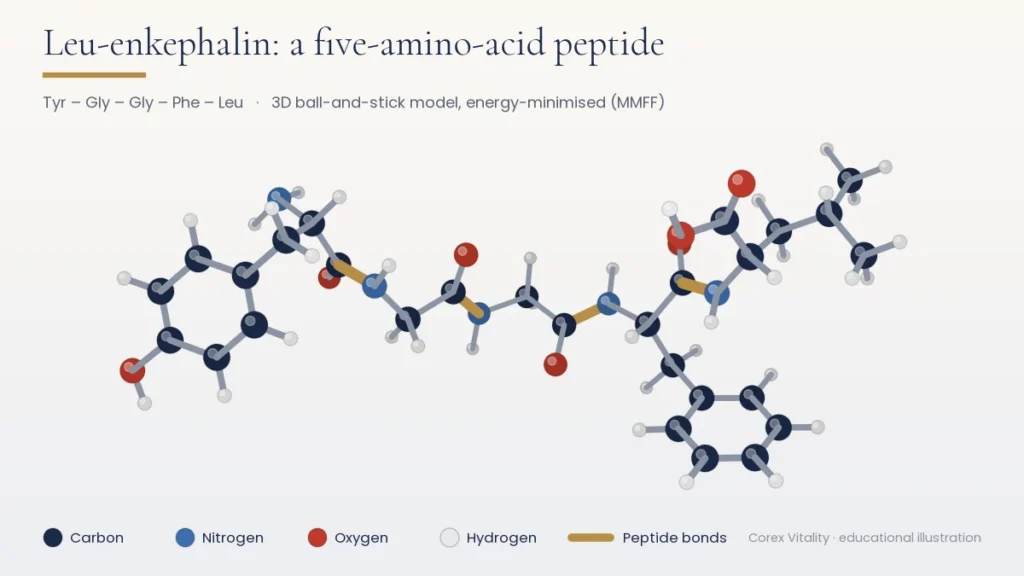
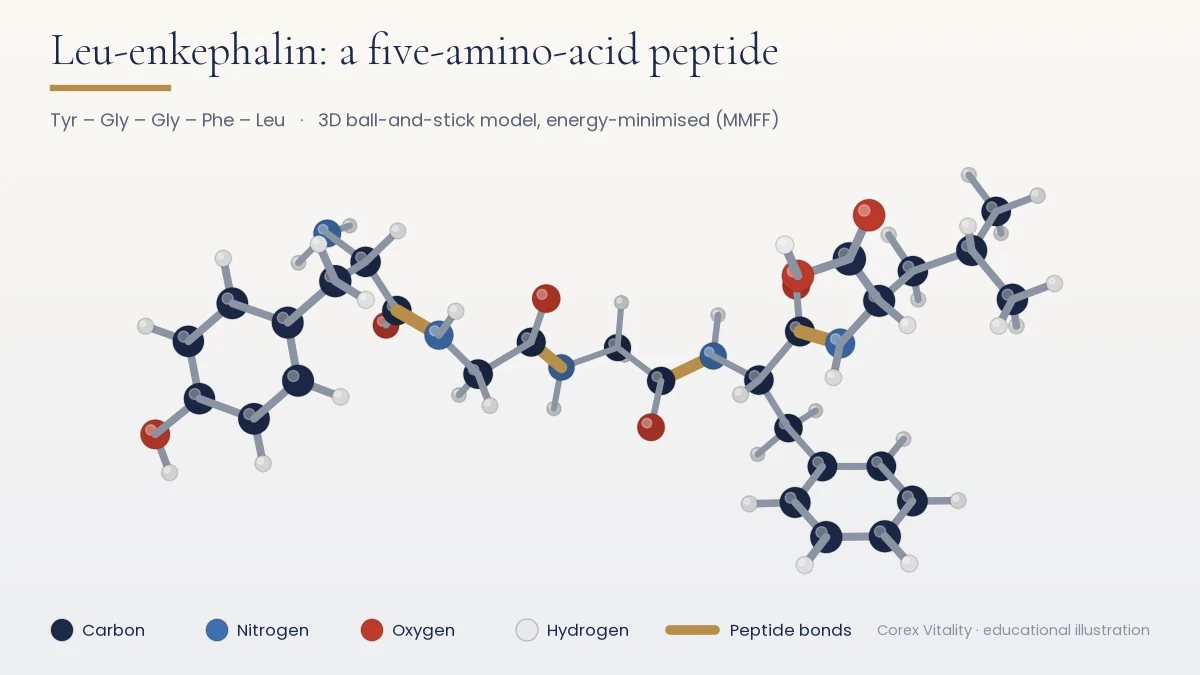
A five-amino-acid peptide in 3D: carbon (navy), nitrogen (blue), oxygen (red) and hydrogen (white), with the peptide bonds shown in gold.
What is a peptide?
The US National Human Genome Research Institute defines a peptide as a short chain of amino acids, typically 2 to 50, linked by peptide bonds (NHGRI glossary). Peptides are named by length: a dipeptide has two amino acids, a tripeptide three, a pentapeptide five. The molecule in the image above, Leu-enkephalin, is a naturally occurring pentapeptide with the sequence Tyr-Gly-Gly-Phe-Leu.
What makes one peptide different from another is its sequence: which amino acids are present and in what order. The same amino acids in a different order make a different compound.
Amino acids and the peptide bond
Amino acids are the building blocks. Each one has a central carbon atom carrying an amino group (–NH2), a carboxyl group (–COOH), a hydrogen atom and a side chain, often written as “R”. Around twenty standard amino acids are used to build proteins in living cells.
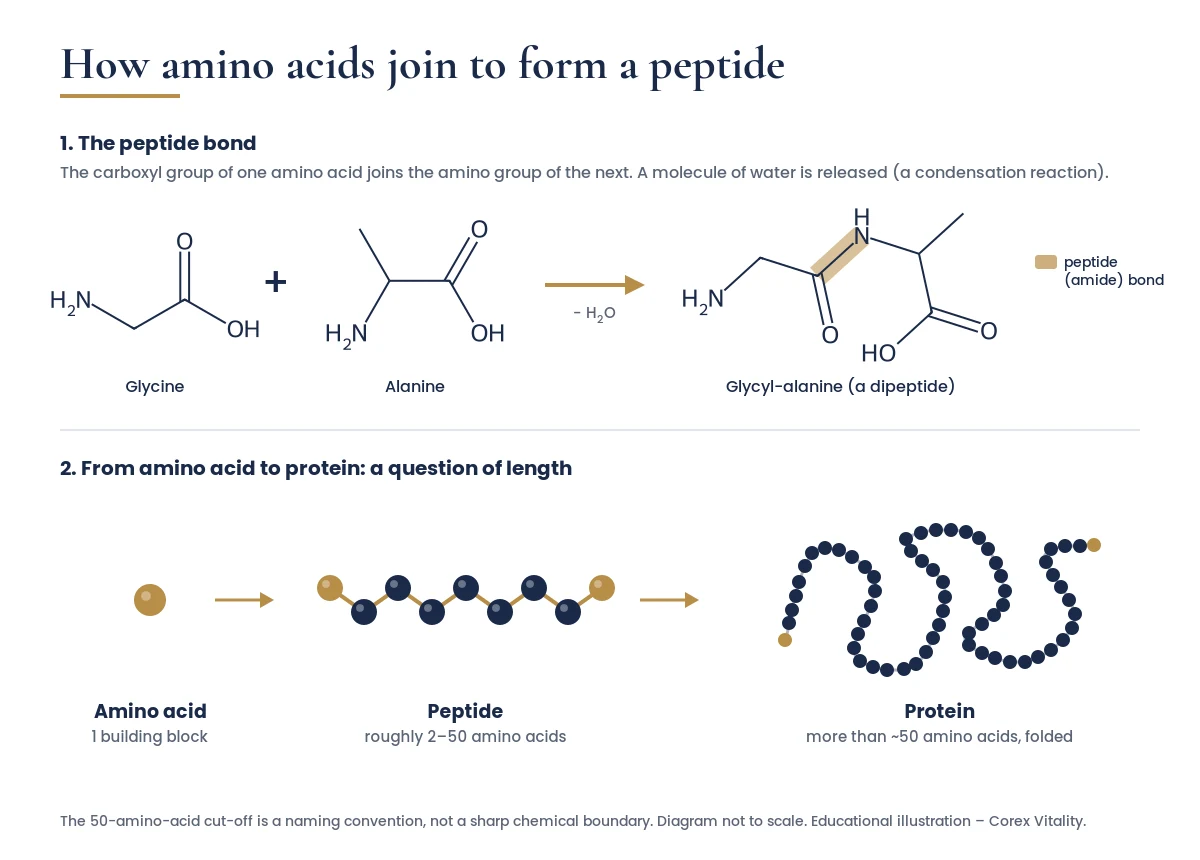
A peptide bond forms when the carboxyl group of one amino acid reacts with the amino group of the next. A molecule of water is released, so chemists call this a condensation reaction. The new carbon–nitrogen link is an amide bond, known in this context as a peptide bond (Britannica). Repeating the reaction builds a backbone of repeating –N–C–C(=O)– units.
Amino acids link through peptide bonds, releasing a water molecule each time. Chains of roughly 2–50 amino acids are usually called peptides; longer, folded chains are proteins.
Every peptide chain has two distinct ends. The N-terminus carries the free amino group and the C-terminus carries the free carboxyl group. By convention, sequences are written from the N-terminus to the C-terminus, so “Tyr-Gly-Gly-Phe-Leu” starts with tyrosine at the amino end.
Peptide vs protein
Peptides and proteins are made the same way, from amino acids joined by peptide bonds. The difference is mainly size, and the dividing line is a convention rather than a strict rule. A common working definition is that chains of up to about 50 amino acids are peptides, while longer chains are polypeptides or proteins. Britannica notes that the distinction between a polypeptide and a protein is “imprecise and largely academic”.
In practice, longer chains usually fold into stable three-dimensional shapes, while short peptides are small enough to be made entirely by chemical synthesis.
Natural, synthetic and analogue peptides
Peptides can be grouped by where their sequence comes from:
Naturally occurring peptides are sequences found in living organisms, such as glutathione (three amino acids) or Leu-enkephalin (five).
Synthetic peptides are made in the laboratory. A synthetic peptide can copy a natural sequence exactly, or it can be a sequence designed or derived for research. For example, BPC-157 is a synthetic chain of 15 amino acids.
Analogues are peptides whose structure has been deliberately modified compared with a parent sequence. Examples include swapping an amino acid, using mirror-image (D-) amino acids, capping either end (acetylation or amidation) or cyclisation. Each change creates a distinct compound with its own molecular mass.
Some research products combine two peptides in one listing, for example TB-500 with BPC-157. In that case the documentation should identify each component and its amount.
Regulation depends on how a product is presented and supplied, not on the word “peptide”. In the UK, the MHRA publishes guidance on how it decides whether a product is a medicine (GOV.UK: Borderline products). The research peptides in our shop are research chemicals supplied for laboratory use only. They are not medicines, food or supplements.
How peptides are made
Most research peptides are made by solid-phase peptide synthesis (SPPS), a method developed by Robert Bruce Merrifield, who received the 1984 Nobel Prize in Chemistry for it (NobelPrize.org). The first amino acid is anchored to tiny insoluble resin beads. The chain is then built one amino acid at a time. Each new amino acid carries a temporary protecting group (usually Fmoc or Boc) so it joins in only one place; the group is removed and the cycle repeats, with excess reagents washed away between steps.
The finished chain is cleaved from the resin and purified, usually by preparative HPLC, to remove incomplete sequences.
Finally, the purified peptide is usually lyophilised (freeze-dried). The frozen solution is placed under vacuum so the ice turns straight to vapour, leaving a dry powder or “cake” in the vial. A lyophilised peptide is generally much more stable than the same peptide in solution, which is why research peptides are usually supplied this way.
How peptide purity is tested
Two analytical techniques do most of the work. You can see published batch results for each listed product on our COA and verification page.
High-performance liquid chromatography (HPLC) separates the components of a sample on a packed column, usually reversed-phase with UV detection. The peptide bond absorbs UV light at low wavelengths (around 210–220 nm), so every peptide-containing component shows up as a peak on the chromatogram. Purity is reported as the area of the main peak as a percentage of the total peak area.
Mass spectrometry (MS) measures the mass of the molecules in the sample. Comparing the observed mass with the theoretical mass of the sequence confirms the peptide’s identity. HPLC answers “how pure is it?”; MS answers “is it the right molecule?”.
A certificate of analysis (COA) is the laboratory’s report on a specific batch. Look for:
Product name and amount: the peptide and the quantity per vial (for example 10 mg).
Batch or report number: this ties the certificate to a particular production lot.
Laboratory, test date and method: usually HPLC, sometimes with MS.
Purity result: given as a percentage, often with the measurement uncertainty.
Identity: an observed mass compared with the theoretical mass, where MS is reported.
Other tests: depending on the test, a certificate may also report results such as heavy metals, endotoxin or sterility.
Published Corex Vitality™ batches are tested by third-party laboratories, and you can search and download each listed certificate on our COA and verification page. On each product page, the View Lab COA button opens the published certificates for that compound; where your size has no COA of its own, the COA shown is for another batch size.
Storage basics for research vials
General laboratory principles:
Lyophilised (powder) vials: for longer storage, keep unopened vials tightly closed in a freezer at −20 °C or colder, dry and away from light. A laboratory fridge (2–8 °C) is fine for vials you plan to open soon, and room-temperature transit is normal for dry peptides. Let a cold vial reach room temperature before opening, ideally in a desiccator, so condensation does not form; work quickly and reseal tightly.
Reconstituted (in solution): once a peptide is dissolved it is much less stable than the dry powder. Make up only what you need. Split any solution you keep into labelled, dated single-use portions (aliquots), freeze them at −20 °C or colder and thaw each aliquot only once; avoid repeated freeze–thaw cycles. Sequences containing Cys, Met or Trp oxidise easily, and Asn or Gln shorten shelf life in solution. (General guidance paraphrased from Bachem’s handling and storage guidelines.)
Always follow the product documentation and your institution’s own safety and handling procedures.
For in-vitro laboratory research use only. Not for human or veterinary use. These products are research chemicals. They are not medicines, food, or supplements. They have not been evaluated by the MHRA, FDA, or any other regulatory body. Not intended to diagnose, treat, cure, or prevent any disease. All descriptions are for reference and research documentation purposes only.
Get new Learning Hub articles and stock updates. No spam. Unsubscribe any time.
Manage Consent
To provide the best experiences, we use technologies like cookies to store and/or access device information. Consenting to these technologies will allow us to process data such as browsing behaviour or unique IDs on this site. Not consenting or withdrawing consent may adversely affect certain features and functions.
Functional
Always active
The technical storage or access is strictly necessary for the legitimate purpose of enabling the use of a specific service explicitly requested by the subscriber or user, or for the sole purpose of carrying out the transmission of a communication over an electronic communications network.
Preferences
The technical storage or access is necessary for the legitimate purpose of storing preferences that are not requested by the subscriber or user.
Statistics
The technical storage or access that is used exclusively for statistical purposes.The technical storage or access that is used exclusively for anonymous statistical purposes. Without a subpoena, voluntary compliance on the part of your Internet Service Provider, or additional records from a third party, information stored or retrieved for this purpose alone cannot usually be used to identify you.
Marketing
The technical storage or access is required to create user profiles to send advertising, or to track the user on a website or across several websites for similar marketing purposes.
Ex-vivo rat Achilles tendon explant and cultured tendon fibroblast study demonstrating concentration-dependent acceleration of cellular migration, culture-dish spreading, H2O2 stress survival, and FAK–paxillin phosphorylation.
cDNA microarray, RT-qPCR, and Western blot study in isolated rat Achilles tendon fibroblasts showing concentration- and time-dependent upregulation of growth hormone receptor expression and downstream JAK2 phosphorylation.
Biochemical study showing that the actin-sequestering peptide Fx and thymosin beta 4 are the same molecule, and describing how it binds actin monomers.
In-vitro endothelial cell adhesion, migration, tube-formation, and chick aortic-ring sprouting study demonstrating that the conserved central 7-amino-acid G-actin-binding motif (LKKTETQ) reproduces the angiogenic signalling of full-length thymosin β4.
Embryonic and postnatal cardiomyocyte culture and biochemical study showing that the G-actin-sequestering polypeptide thymosin β4 forms a functional PINCH–integrin-linked kinase (ILK) complex that activates protein kinase B (Akt) signalling.
Foundational biochemical and structure-function study demonstrating that the histidyl-lysyl tripeptide chelates copper(II) in equimolar coordination and facilitates cellular copper transport in cultured hepatoma cells.
In-vitro fibroblast culture study showing picomolar-to-nanomolar (10^-12 to 10^-9 M) stimulation of collagen biosynthesis by the GHK–Cu(II) coordination complex independent of cell-number changes.
Radiolabelled [3H]-glucosamine and [35S]-sulfate incorporation assay in cultured human fibroblasts demonstrating biphasic stimulation of extracellular dermatan sulfate and cell-layer heparan sulfate synthesis at 10^-9 to 10^-8 M GHK-Cu.
X-ray crystallographic structural study resolving the high-affinity square-pyramidal copper(II) coordination sphere formed by the N-terminal GHK tripeptide motif in recombinant fusion proteins.
Structure-activity relationship study detailing the Aib8 substitution for DPP-4 enzymatic stability and Lys26 C18 fatty-diacid acylation with a γGlu-2xOEG linker for reversible serum albumin binding and high GLP-1R potency.
Liquid chromatography–high-resolution mass spectrometry (LC-HRMS) preformulation study mapping aqueous peptide bond hydrolysis, deamidation, and buffer-dependent stability profiles of semaglutide across pH and thermal conditions.
1.5-microsecond conventional molecular dynamics (cMD) and MM-GBSA free-energy simulation characterising non-covalent binding of the C18 diacid chain of semaglutide across fatty-acid binding pockets on serum albumin.
Two-dimensional 1H-NMR spectroscopy and distance-geometry structural determination of the biologically active 29-amino-acid N-terminal domain of growth hormone-releasing factor, identifying two α-helical regions.
Analytical review of synthetic GHRH(1-29) analogues including CJC-1295 and sermorelin, covering solid-phase sequence modifications, proteolytic cleavage pathways, and high-resolution mass spectrometry identification.
Validation of a nano-LC–quadrupole/Orbitrap high-resolution mass spectrometry workflow for separating and quantifying intact GHRH(1-29) analogues and their N-terminal enzymatic fragments.
Foundational receptor-pharmacology characterisation of the synthetic pentapeptide ipamorelin (Aib-His-D-2-Nal-D-Phe-Lys-NH2) in primary rat pituitary cells and in-vivo models, demonstrating high GHSR-1a selectivity without ACTH or cortisol elevation.
Medicinal chemistry and structure-activity relationship study of ipamorelin pentapeptide analogues evaluating N-methylated backbones and aromatic side-chain conformations in rat pituitary cell assays.
Pre-clinical rodent study quantifying concentration-dependent longitudinal bone growth rate and somatotroph hormone release following administration of the selective pentapeptide secretagogue ipamorelin.
Dual-energy X-ray absorptiometry (DXA) and peripheral quantitative computed tomography (pQCT) study in rodent models examining cortical and cancellous bone mineral content under GHSR-1a agonist stimulation.
Research-grade peptides supplied exclusively for in-vitro laboratory research, supported by third-party HPLC testing and transparent batch documentation. Not for human or veterinary use.
By entering this website, you confirm that you are 18 years of age or older, are visiting exclusively for in-vitro laboratory research, and agree to our Terms & Conditions and Privacy Policy.