Peptide Impurities Explained: Deletions, Oxidation & Other Related Substances
Peptide Impurities Explained: Deletions, Oxidation & Other Related Substances
For in-vitro laboratory research use only. Not for human or veterinary use.
Quick summary
A purity figure such as 99% tells you the target peptide’s share of what the HPLC detector saw. The small remainder is mostly peptide-related impurities: molecules that look very like the target but are not quite the same.
Some come from synthesis (missing, extra or still-capped amino acids). Others form slowly afterwards through degradation, such as oxidation and deamidation.
Each type changes the molecule’s mass in a typical way, which is how mass spectrometry helps identify it. Some, like racemisation, do not change the mass at all.
Published studies show that impurities can alter in-vitro results, so batch records and certificates are worth checking before every experiment.
Our guide to HPLC purity vs net peptide content explained what a purity percentage measures. This article looks at the other side of that number: what the remaining fraction of peaks usually is, where it comes from, and how laboratories tell the different types apart.
1. What counts as an “impurity”?
In peptide chemistry, an impurity is anything in the sample that is not the exact target molecule. The most important group is peptide-related impurities, sometimes called related substances. These are close cousins of the target: the same chain with one amino acid missing, one extra, or one chemically altered.
They matter because they are hard to separate and can behave a little like the target in an assay. A review by D’Hondt et al. (2014) noted that such impurities can influence early functionality studies and lead to wrong conclusions. Water and counter-ions are also present in a peptide powder, but they are not peptides and are covered in our counter-ions guide.
2. Impurities that come from synthesis
Most research peptides are made by solid-phase peptide synthesis (SPPS): the chain is built one amino acid at a time on a tiny resin bead (see our Science page). In the common Fmoc method, every amino acid arrives with temporary chemical “caps”, called protecting groups, that stop it reacting in the wrong place. Each cycle removes one cap, adds the next amino acid, then repeats (Behrendt et al., 2016). Every step works very well, but not perfectly, and over dozens of cycles small slips add up.
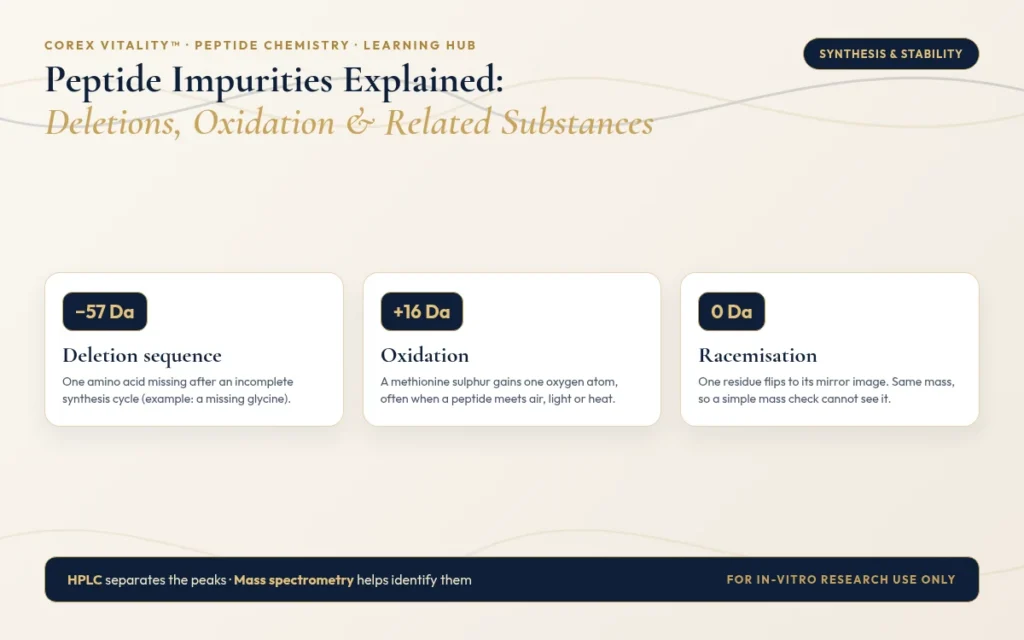
Deletion sequences: the chain is missing one amino acid because a cap was not fully removed or a coupling step did not complete. In a study of research-grade peptides, Verbeke et al. (2015) found that most of the related impurities they detected were missing one or more amino acids.
Insertion sequences: an extra copy of an amino acid, linked to excess reagent (D’Hondt et al., 2014).
Truncated sequences: chains that stopped growing part-way. Many protocols deliberately “cap” these with an acetyl group so they are easier to remove during purification.
Protecting-group adducts: a side-chain cap that was never removed, leaving a heavier molecule (for example, about +56 Da for a leftover tert-butyl group). A dalton (Da) is the unit used for molecular mass.
Racemisation: amino acids are “left-handed” (L-form) in nature. During synthesis a residue can flip to its mirror image (D-form). The result has exactly the same mass, so it is invisible to a simple mass check.
Aspartimide formation: aspartic acid can fold back on itself to form a ring, especially next to glycine. This side reaction is a well-known challenge in Fmoc chemistry (Behrendt et al., 2016).
Common impurity types and their typical mass change, with a simplified HPLC trace. Small peaks either side of the main peak are what the purity percentage leaves out.
3. Impurities that form over time
Even a well-made peptide slowly changes if it meets water, oxygen, heat or light. These degradation products are one reason peptides are supplied freeze-dried and stored cold and dry (see our reconstitution and storage guide).
Oxidation: the sulphur atom in methionine (and, in other ways, cysteine and tryptophan) picks up oxygen. One extra oxygen adds about +16 Da.
Deamidation: the side chain of asparagine (or, more slowly, glutamine) loses its amide group and becomes an acid, adding about +1 Da. Geiger and Clarke (1987) showed that in the test peptide Val-Tyr-Pro-Asn-Gly-Ala, held at 37 °C and pH 7.4, this happened with a half-life of only 1.4 days. It went through a ring-shaped intermediate called a succinimide and produced a mixture of normal and “iso” forms, plus mirror-image versions.
Sequence matters: in the same study, swapping the glycine after asparagine for a bulkier leucine or proline slowed degradation 33- to 50-fold, and using aspartic acid instead of asparagine slowed ring formation 34-fold.
Dimers and aggregates: two or more chains can stick or bond together, producing larger species (D’Hondt et al., 2014).
4. How laboratories detect them
HPLC: separating the peaks
High-performance liquid chromatography (HPLC) pushes the sample through a packed column. Slightly different molecules travel at slightly different speeds and reach the detector at different times. A UV detector set near 214 nm, where the peptide bond absorbs light, draws each one as a peak. Purity is the main peak’s area as a share of all peak areas. If an impurity travels at the same speed as the target (it co-elutes), it hides inside the main peak.
Mass spectrometry: weighing the molecules
Mass spectrometry (MS) measures molecular mass very precisely. Because each impurity type shifts the mass in a typical way (−57 Da for a missing glycine, +16 Da for oxidation), MS paired with HPLC (LC-MS) can suggest what each small peak is. De Spiegeleer et al. (2008) used this approach to compare samples of the same research peptide from five manufacturers. One product was a different peptide entirely, and two-thirds of the others fell below 95% purity and/or had individual impurities above 1%. For a walkthrough of both methods, see Laboratory Testing Explained.
5. What this means for your records
Read the purity figure for what it is: the main peak’s share at the stated wavelength, not a full list of contents.
Check which tests were run: most certificates in the Corex Vitality™ COA directory report HPLC purity; the MOTS-c 10mg certificate also includes LC-MS data. Our COA verification guide explains how to confirm a report with the laboratory.
Match batch numbers: record the batch or report number with every experiment, so any unexpected result can be traced.
Store with degradation in mind: keep vials cold, dry, sealed and away from light, as these conditions slow oxidation and deamidation.
Key takeaways
Peptide-related impurities are near-copies of the target peptide, not random contaminants.
Synthesis produces deletions, insertions, truncations, leftover protecting groups and racemised residues.
Storage conditions drive slow changes such as oxidation, deamidation and aggregation.
HPLC separates and measures peaks; mass spectrometry helps work out what each one is, except for same-mass changes.
The peer-reviewed papers below were used for the chemistry in this article. Each entry was checked against PubMed. Summaries describe laboratory and analytical findings only. Corex Vitality™ is not affiliated with the cited authors, journals or institutions.
Related impurities in peptide medicines. D'Hondt M, Bracke N, Taevernier L, Gevaert B, Verbeke F, Wynendaele E, De Spiegeleer B. J Pharm Biomed Anal. 2014;101:2-30. PMID: 25044089 · DOI: 10.1016/j.jpba.2014.06.012 Structured review of peptide-related impurities from solid-phase synthesis and degradation (deletions, insertions, racemisation, protecting-group adducts, oxidation, aggregates and counter-ions) and their effect on early in-vitro functionality studies.
Advances in Fmoc solid-phase peptide synthesis. Behrendt R, White P, Offer J. J Pept Sci. 2016;22(1):4-27. PMID: 26785684 · DOI: 10.1002/psc.2836 Review of Fmoc solid-phase peptide synthesis chemistry, including protecting-group strategy and side reactions such as aspartimide formation that generate synthesis-related impurities.
Deamidation, isomerization, and racemization at asparaginyl and aspartyl residues in peptides. Succinimide-linked reactions that contribute to protein degradation. Geiger T, Clarke S. J Biol Chem. 1987;262(2):785-94. PMID: 3805008 In-vitro kinetic study of synthetic model peptides showing succinimide-mediated deamidation, isomerisation and racemisation at asparagine and aspartic acid residues, and how neighbouring residues change the rate.
Impurity profiling quality control testing of synthetic peptides using liquid chromatography-photodiode array-fluorescence and liquid chromatography-electrospray ionization-mass spectrometry: the obestatin case. De Spiegeleer B, Vergote V, Pezeshki A, Peremans K, Burvenich C. Anal Biochem. 2008;376(2):229-34. PMID: 18342612 · DOI: 10.1016/j.ab.2008.02.014 Analytical study using LC with photodiode-array/fluorescence detection and LC-ESI-MS to profile identity and related impurities in research samples of one synthetic peptide from five manufacturers.
Quality evaluation of synthetic quorum sensing peptides used in R&D. Verbeke F, Wynendaele E, Braet S, D'Hondt M, De Spiegeleer B. J Pharm Anal. 2015;5(3):169-181. PMID: 29403929 · DOI: 10.1016/j.jpha.2014.12.002 Analytical quality-control study of synthetic quorum sensing peptides used in research, characterising purity and the nature of related impurities, most of which lacked one or more amino acids.
All Corex Vitality™ products are supplied strictly for in-vitro laboratory research use only. Not for human or veterinary use. No information here describes use in humans or animals.
Research you can verify.
Corex Vitality™ Research Updates
Get new Learning Hub articles and stock updates. No spam. Unsubscribe any time.
Manage Consent
To provide the best experiences, we use technologies like cookies to store and/or access device information. Consenting to these technologies will allow us to process data such as browsing behaviour or unique IDs on this site. Not consenting or withdrawing consent may adversely affect certain features and functions.
Functional
Always active
The technical storage or access is strictly necessary for the legitimate purpose of enabling the use of a specific service explicitly requested by the subscriber or user, or for the sole purpose of carrying out the transmission of a communication over an electronic communications network.
Preferences
The technical storage or access is necessary for the legitimate purpose of storing preferences that are not requested by the subscriber or user.
Statistics
The technical storage or access that is used exclusively for statistical purposes.The technical storage or access that is used exclusively for anonymous statistical purposes. Without a subpoena, voluntary compliance on the part of your Internet Service Provider, or additional records from a third party, information stored or retrieved for this purpose alone cannot usually be used to identify you.
Marketing
The technical storage or access is required to create user profiles to send advertising, or to track the user on a website or across several websites for similar marketing purposes.
Research-grade peptides supplied exclusively for in-vitro laboratory research, supported by third-party HPLC testing and transparent batch documentation. Not for human or veterinary use.
By entering this website, you confirm that you are 18 years of age or older, are visiting exclusively for in-vitro laboratory research, and agree to our Terms & Conditions and Privacy Policy.