Peptide Counter-Ions Explained: TFA vs Acetate vs Hydrochloride
Peptide Counter-Ions Explained: TFA vs Acetate vs Hydrochloride
For in-vitro laboratory research use only. Not for human or veterinary use.
Quick summary
Most synthetic peptides are supplied as salts: the positively charged peptide is paired with a small negative ion called a counter-ion.
The three you will meet most often are trifluoroacetate (TFA), acetate and chloride (hydrochloride, HCl).
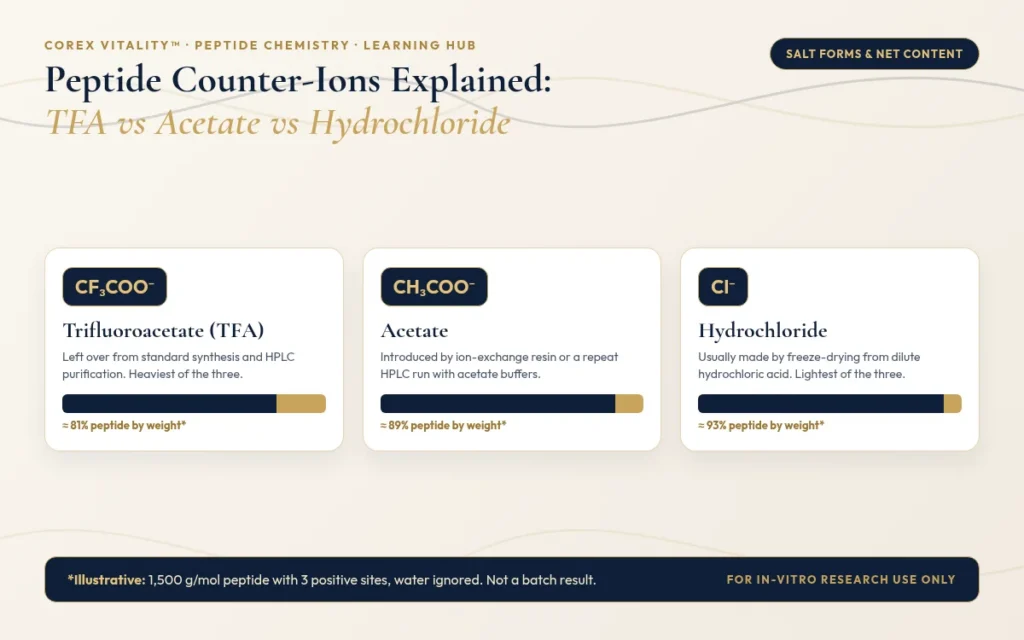
TFA is left over from standard synthesis and HPLC purification. Freeze-drying removes the loose acid, but not the portion bound to the peptide.
Counter-ions add weight, are invisible to the HPLC purity figure, and can matter in sensitive cell-culture and infrared work.
Laboratories can swap one counter-ion for another, and measure how much is present, using well-established methods.
Our guide to HPLC purity vs net peptide content mentioned that part of every peptide powder is not peptide at all, but counter-ions and water. This article picks up that thread. It explains what a counter-ion is, where it comes from, why the type matters for in-vitro work, and what to look for on a certificate.
1. What is a counter-ion?
A peptide is a short chain of amino acids joined by peptide bonds (see What Are Peptides?). Some parts of that chain carry an electrical charge in acidic conditions. The free amino group at the start of the chain (the N-terminus) and the side chains of the basic amino acids arginine, lysine and histidine pick up a proton (a hydrogen ion) and become positively charged.
Matter has to balance its charges overall, so each positive site pairs with a negative ion. That partner is the counter-ion, and the peptide plus its counter-ions is a salt, in the same way that table salt is sodium paired with chloride. A peptide with many basic residues carries more counter-ions than one with few.
Each positive site on the chain pairs with one counter-ion. Heavier counter-ions take up a bigger share of the powder’s weight.
2. Where trifluoroacetate comes from
Most research peptides are built by solid-phase peptide synthesis (SPPS), a method first described by Merrifield in 1963, in which the chain is grown one amino acid at a time on a tiny resin bead. In the widely used Fmoc approach, the finished chain is cut free from the bead with concentrated trifluoroacetic acid. The crude peptide is then purified by reversed-phase HPLC, where about 0.1% trifluoroacetic acid is usually added to the liquid to give sharp peaks (see our Science page).
Freeze-drying (lyophilisation) removes water and most of the free, volatile acid. It does not remove the trifluoroacetate that is held as a salt on the positive sites. That is why peptides made this way are typically isolated as TFA salts unless an extra exchange step is added (Sikora et al., 2020; Bachem).
3. The three common salt forms at a glance
Salt form
Parent acid and approx. pKa*
Acid mass added per positive site
Where you usually see it
Trifluoroacetate (TFA)
Trifluoroacetic acid, about 0.5
114.02 g/mol
Default result of Fmoc SPPS and HPLC purification
Acetate
Acetic acid, about 4.8
60.05 g/mol
After an exchange step; the most widely used salt form for commercially manufactured peptides (Sikora et al., 2020)
Hydrochloride (chloride)
Hydrochloric acid, about −7
36.46 g/mol
After exchange, often by freeze-drying from dilute HCl; recommended by Cornish et al. (1999) for cell-culture work
*pKa is a measure of acid strength: the lower the number, the stronger the acid. Values from Sikora et al. (2020).
4. Why the counter-ion matters in the lab
It changes how much peptide is in the vial
Counter-ions are not seen by the UV detector used for HPLC purity, so a 99% pure peptide is not 99% peptide by weight. In the illustrative example above, the same peptide is roughly 81% peptide by weight as a TFA salt but roughly 93% as a hydrochloride, before water is even counted. This is one reason net peptide content usually sits well below 100%, and why our reconstitution and storage guide points to net content when working out true concentrations.
It can affect sensitive in-vitro assays
In cultured bone and cartilage cells, Cornish et al. (1999) found that trifluoroacetate at very low concentrations reduced cell numbers, and that TFA salts of three test peptides gave consistently lower proliferation readings than the hydrochloride salts. Sikora et al. (2018) compared acetate, hydrochloride and TFA versions of five antimicrobial peptides and found real differences between salts, though with no single pattern across peptides. The practical lesson is that counter-ion type is an experimental variable worth recording.
It can interfere with some analytical methods
Trifluoroacetate has a strong infrared absorption band near 1673 cm−1. That overlaps the amide I band, the signal researchers use to study a peptide’s folded shape (secondary structure) by infrared spectroscopy (Andrushchenko et al., 2007).
5. How laboratories swap and measure counter-ions
Exchange to chloride: the peptide is freeze-dried from dilute hydrochloric acid, often more than once. Because HCl is a much stronger acid, chloride displaces trifluoroacetate. Andrushchenko et al. found 2–10 mM HCl removed essentially all TFA from their test peptide without changing its structure, whereas higher concentrations could.
Exchange to acetate: acetic acid is too weak to displace TFA by simple freeze-drying, so laboratories use an ion-exchange resin (a bead that swaps one ion for another) or a repeat HPLC run with an acetate-based mobile phase (Roux et al., 2008).
Measuring what is there:ion chromatography is the first-choice method for measuring counter-ion content. ¹⁹F NMR, which detects fluorine atoms, picks up TFA as a distinctive single signal near −75 ppm, and infrared spectroscopy can track TFA removal (Sikora et al., 2020; Roux et al., 2008).
6. What to look for on a certificate
Salt form: a certificate may state it in the product name, for example “acetate” or “TFA salt”. Not every certificate does.
Counter-ion content: sometimes reported as a percentage, often measured by ion chromatography.
Net peptide content and water content: these, together with purity, tell you how much target peptide a weighed amount of powder holds.
Batch number: always match it to the certificate on our verification page. If you need the salt form for your records and it is not shown, contact us with your batch number.
A counter-ion is the negative partner that balances each positive site on a peptide.
TFA is the usual counter-ion after standard synthesis and purification; acetate and chloride come from extra exchange steps.
Counter-ions add weight that HPLC purity does not show, so they lower net peptide content.
In sensitive cell-culture and infrared work, the salt form is a variable to note in your methods.
Record the batch number and salt form alongside every experiment in your lab notebook. Browse our research peptides and check each batch’s certificate before you start.
All Corex Vitality™ products are supplied strictly for in-vitro laboratory research use only and are not for human or veterinary use. Nothing in this article is medical advice, and no information here describes use in humans or animals.
Research you can verify.
Corex Vitality™ Research Updates
Get new Learning Hub articles and stock updates. No spam. Unsubscribe any time.
Manage Consent
To provide the best experiences, we use technologies like cookies to store and/or access device information. Consenting to these technologies will allow us to process data such as browsing behaviour or unique IDs on this site. Not consenting or withdrawing consent may adversely affect certain features and functions.
Functional
Always active
The technical storage or access is strictly necessary for the legitimate purpose of enabling the use of a specific service explicitly requested by the subscriber or user, or for the sole purpose of carrying out the transmission of a communication over an electronic communications network.
Preferences
The technical storage or access is necessary for the legitimate purpose of storing preferences that are not requested by the subscriber or user.
Statistics
The technical storage or access that is used exclusively for statistical purposes.The technical storage or access that is used exclusively for anonymous statistical purposes. Without a subpoena, voluntary compliance on the part of your Internet Service Provider, or additional records from a third party, information stored or retrieved for this purpose alone cannot usually be used to identify you.
Marketing
The technical storage or access is required to create user profiles to send advertising, or to track the user on a website or across several websites for similar marketing purposes.
Research-grade peptides supplied exclusively for in-vitro laboratory research, supported by third-party HPLC testing and transparent batch documentation. Not for human or veterinary use.
By entering this website, you confirm that you are 18 years of age or older, are visiting exclusively for in-vitro laboratory research, and agree to our Terms & Conditions and Privacy Policy.