For in-vitro laboratory research use only. Not for human or veterinary use.
Quick summary
GLP-1R, GIPR, and GCGR are closely related Class B1 (secretin-family) G-protein-coupled receptors (GPCRs) activated by peptide hormones that share conserved N-terminal alpha-helical motifs.
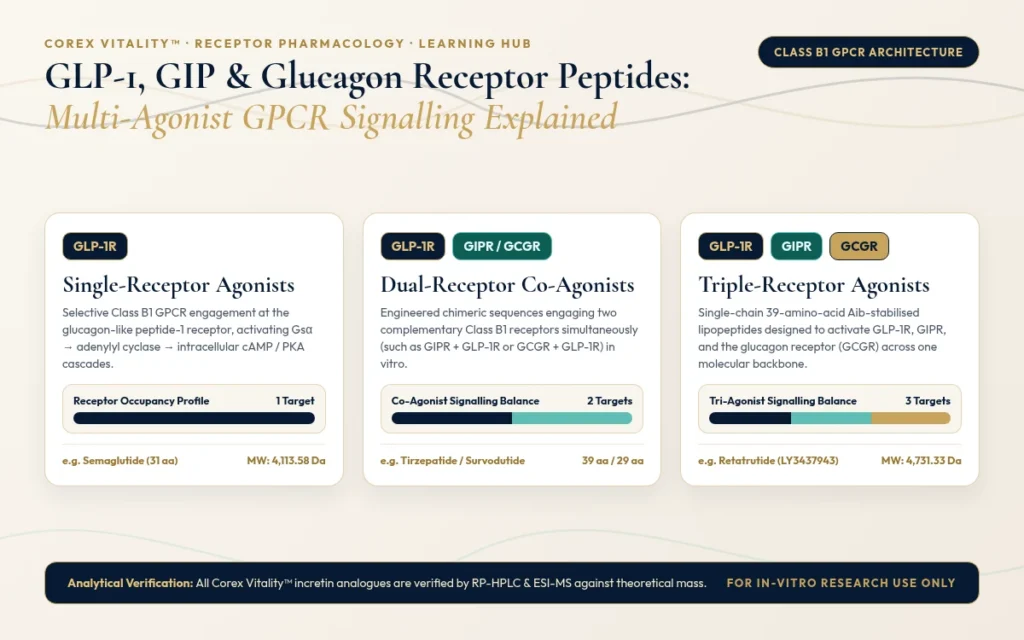
Single-receptor agonists (such as Semaglutide and Liraglutide) selectively target GLP-1R, whereas dual agonists engage either GLP-1R + GIPR (Tirzepatide) or GLP-1R + GCGR (Survodutide, Mazdutide).
Triple-receptor agonists (such as Retatrutide) are chimeric single-chain peptides engineered to activate GLP-1R, GIPR, and GCGR simultaneously with balanced receptor potency ratios.
Synthetic research analogues incorporate non-canonical amino acids like Aib (aminoisobutyric acid) at position 2 to resist DPP-4 proteolysis, paired with C18 or C20 fatty diacid side chains for albumin binding.
Published Corex Vitality™ COAs for these compounds report reversed-phase HPLC purity and quantity (view batch COAs).
Over the past decade of metabolic and endocrine laboratory research, synthetic peptide design has progressed from single-target hormone analogues to unimolecular multi-receptor agonists—single peptide chains engineered to bind two or three distinct G-protein-coupled receptors at once. Understanding how these compounds differ at the molecular level requires looking at the Class B1 GPCR superfamily, intracellular cyclic AMP (cAMP) signalling, and the structural chemistry used to stabilise these sequences.
1. The Class B1 GPCR triad: GLP-1R, GIPR, and GCGR
The glucagon-like peptide-1 receptor (GLP-1R), glucose-dependent insulinotropic polypeptide receptor (GIPR), and glucagon receptor (GCGR) all belong to the Class B1 (secretin) family of seven-transmembrane GPCRs. Structural biology studies using cryo-electron microscopy (cryo-EM) have shown that all three receptors share a conserved two-domain “two-step” binding mechanism:
Extracellular Domain (ECD) Capture: The C-terminal alpha-helical segment of the peptide ligand docks into the hydrophobic groove of the receptor’s large N-terminal extracellular domain, orienting the peptide.
Transmembrane Core Activation: The peptide’s N-terminal residues (positions 1 to 7) insert deep into the seven-transmembrane (7TM) bundle, triggering an outward shift of transmembrane helix 6 (TM6) and coupling to heterotrimeric Gαs proteins.
Once Gαs is activated, it stimulates membrane-bound adenylyl cyclase (AC) to convert ATP into cyclic adenosine monophosphate (cAMP), activating protein kinase A (PKA) and EPAC (exchange protein directly activated by cAMP) signalling cascades in in-vitro cellular reporter assays.
2. How single, dual, and triple receptor agonists are engineered
Because native GLP-1(7–36), GIP(1–42), and glucagon(1–29) share approximately 35% to 50% sequence homology—especially in their N-terminal helices—medicinal chemists can construct chimeric single-chain peptides that present recognition residues to more than one receptor subtype:
Single Agonists (GLP-1R): Analogues such as Semaglutide retain high sequence identity (~94%) to native GLP-1 while substituting position 8 (Ala8 → Aib8) to block cleavage by dipeptidyl peptidase-4 (DPP-4) and attaching a C18 fatty diacid chain at Lys26 via a hydrophilic γGlu-2xOEG spacer.
Dual GLP-1R / GIPR Co-Agonists:Tirzepatide is a 39-amino-acid linear peptide built primarily on a human GIP backbone blended with GLP-1 recognition residues and a C-terminal exendin-4-like C-terminal extension (P-S-S-G-A-P-P-P-S-NH2), acylated with a C20 eicosanedioic acid moiety at Lys20. In cell-based receptor signalling studies, it acts as a full agonist at GIPR and a biased cAMP agonist at GLP-1R with reduced β-arrestin recruitment.
Dual GLP-1R / GCGR Co-Agonists: Compounds such as Survodutide and Mazdutide start from the 29-amino-acid oxyntomodulin/glucagon scaffold and introduce targeted substitutions that preserve glucagon receptor (GCGR) binding while adding potent GLP-1R activation.
Triple GLP-1R / GIPR / GCGR Agonists:Retatrutide (LY3437943) is a 39-amino-acid single-chain peptide engineered from a GIP-like scaffold that incorporates three non-coded amino acid residues—Aib at positions 2 and 20 and α-methyl-L-leucine (αMeL) at position 13—alongside a C20 fatty diacid linker at Lys17. These precise side-chain contacts allow a single molecule to activate GIPR, GLP-1R, and GCGR simultaneously in preclinical receptor assays.
3. Structural & analytical comparison of metabolic research peptides
The table below compares key molecular and analytical specifications across the principal single, dual, and triple receptor research peptides covered in the Corex Vitality™ Section 1 Video Reference Library:
Mammalian oxyntomodulin analogue with fatty-acid side chain
4,562.06 g/mol
CagriSema
Dual Pathway (AMY1/3R / CTR + GLP-1R)
32 aa + 31 aa
Co-formulation of Cagrilintide (C20-acylated amylin analogue, disulfide C2–C7) + Semaglutide
4,409.0 + 4,113.6 g/mol
4. Why RP-HPLC and Mass Spectrometry are both essential for lipidated agonists
Multi-agonist peptides carrying C18 or C20 fatty diacid chains behave differently on an analytical column than short, hydrophilic peptides. The long hydrocarbon tail increases retention time on C18 stationary phases, requiring carefully optimised acetonitrile/water gradients and column temperatures to separate the target lipopeptide from closely eluting synthesis by-products (such as single-amino-acid deletion sequences or un-acylated backbone chains).
Reversed-Phase HPLC (RP-HPLC) at 214 nm / 220 nm: quantifies chromatographic purity (≥98%–99%+) by measuring the integrated peak area of the main lipopeptide relative to any related peptide impurities.
Electrospray Ionisation Mass Spectrometry (ESI-MS): confirms molecular identity by detecting the multiply charged ion envelope (such as [M+3H]3+, [M+4H]4+, and [M+5H]5+) and deconvoluting it to the exact molecular weight—immediately distinguishing, for example, Retatrutide (~4,731.3 Da) from Tirzepatide (~4,813.5 Da) or Semaglutide (~4,113.6 Da).
Finan, B., Ma, T., Ottaway, N., Müller, T. D., Habegger, K. M., Heppner, K. M., … & DiMarchi, R. D. (2015). A monomeric peptide triagonist modulates metabolic homeostasis in rodent models. Nature Medicine, 21(1), 27–36. https://doi.org/10.1038/nm.3761
Coskun, T., Sloop, K. W., Loghin, C., Alsina-Fernandez, J., Urva, S., Bokvist, K. B., … & Gimeno, R. E. (2018). LY3298176, a novel dual GIP and GLP-1 receptor agonist for glycaemic receptor signalling: From discovery to preclinical and receptor proof of concept. Molecular Metabolism, 18, 3–14. https://doi.org/10.1016/j.molmet.2018.09.009
Coskun, T., Urva, S., Roell, W. C., Qu, H., Loghin, C., Moyers, J. S., … & Haupt, A. (2022). LY3437943, a novel triple glucagon, GIP, and GLP-1 receptor agonist for glycemic and metabolic signalling: From discovery to preclinical and receptor proof of concept. Cell Metabolism, 34(9), 1234–1247. https://doi.org/10.1016/j.cmet.2022.07.013
Willard, F. S., Douros, J. D., Gabe, M. B., Showalter, A. D., Wainscott, D. B., Suter, T. M., … & Sloop, K. W. (2020). Tirzepatide is an imbalanced and biased dual GIP and GLP-1 receptor agonist. JCI Insight, 5(17), e140532. https://doi.org/10.1172/jci.insight.140532
Lau, J., Bloch, P., Schäffer, L., Pettersson, I., Spetzler, J., Kofoed, J., … & Kruse, T. (2015). Discovery of the once-weekly glucagon-like peptide-1 (GLP-1) analogue semaglutide. Journal of Medicinal Chemistry, 58(18), 7370–7380. https://doi.org/10.1021/acs.jmedchem.5b00726
Zhao, F., Zhou, Q., Cong, Z.,abe, K., Dai, A., Xu, H. E., & Wang, M. W. (2022). Structural insights into multiplexed pharmacological actions of tirzepatide and peptide 20 at the GIP, GLP-1 or glucagon receptors. Nature Communications, 13(1), 1057. https://doi.org/10.1038/s41467-022-28683-0
Research Use Notice: All Corex Vitality™ compounds are supplied strictly for in-vitro laboratory research use only and are not for human or veterinary use.
Get new Learning Hub articles and stock updates. No spam. Unsubscribe any time.
Manage Consent
To provide the best experiences, we use technologies like cookies to store and/or access device information. Consenting to these technologies will allow us to process data such as browsing behaviour or unique IDs on this site. Not consenting or withdrawing consent may adversely affect certain features and functions.
Functional
Always active
The technical storage or access is strictly necessary for the legitimate purpose of enabling the use of a specific service explicitly requested by the subscriber or user, or for the sole purpose of carrying out the transmission of a communication over an electronic communications network.
Preferences
The technical storage or access is necessary for the legitimate purpose of storing preferences that are not requested by the subscriber or user.
Statistics
The technical storage or access that is used exclusively for statistical purposes.The technical storage or access that is used exclusively for anonymous statistical purposes. Without a subpoena, voluntary compliance on the part of your Internet Service Provider, or additional records from a third party, information stored or retrieved for this purpose alone cannot usually be used to identify you.
Marketing
The technical storage or access is required to create user profiles to send advertising, or to track the user on a website or across several websites for similar marketing purposes.
Cryo-EM structural determination of retatrutide bound to GLP-1R, GIPR, and GCGR in complex with heterotrimeric Gs proteins, mapping the N-terminal transmembrane recognition contacts underlying triple Class B1 GPCR agonism.
Ex-vivo pharmacological assay in isolated murine atrial preparations characterizing GCGR-, GIPR-, and GLP-1R-coupled adenylyl cyclase, intracellular cAMP, and protein kinase A (PKA) signalling pathways.
Analytical validation of a C18 reversed-phase liquid chromatography–high-resolution mass spectrometry (LC-HRMS) method resolving single, dual, and triple receptor agonist peptides with sub-ppm mass accuracy and MS/MS fragment confirmation.
In-vitro receptor signalling and occupancy study demonstrating full GIPR agonism and biased GLP-1R signalling favouring cyclic AMP (cAMP) generation over β-arrestin recruitment and receptor internalisation.
Cryo-electron microscopy structure determination of tirzepatide bound to GIPR and GLP-1R, defining the near-atomic extracellular and transmembrane receptor-ligand interactions governing dual incretin agonism.
Cryo-EM and molecular dynamics analysis demonstrating how the C20 fatty-diacid acylation moiety and chimeric peptide sequence govern GIPR and GLP-1R receptor activation and reduced GLP-1R desensitisation.
Cellular and murine receptor-signalling study showing that long-acting GIPR agonism modulates intracellular insulin-receptor cascade cooperativity, glucose transport, glycerol conversion, and lipolytic flux in cultured adipocytes.
Structure-activity relationship study detailing the Aib8 substitution for DPP-4 enzymatic stability and Lys26 C18 fatty-diacid acylation with a γGlu-2xOEG linker for reversible serum albumin binding and high GLP-1R potency.
Liquid chromatography–high-resolution mass spectrometry (LC-HRMS) preformulation study mapping aqueous peptide bond hydrolysis, deamidation, and buffer-dependent stability profiles of semaglutide across pH and thermal conditions.
1.5-microsecond conventional molecular dynamics (cMD) and MM-GBSA free-energy simulation characterising non-covalent binding of the C18 diacid chain of semaglutide across fatty-acid binding pockets on serum albumin.
Medicinal chemistry design and structural optimisation of cagrilintide (AM833), detailing proline substitutions that prevent amyloid fibril formation alongside N-terminal C20 fatty-diacid lipidation for albumin binding.
Pre-clinical murine and hepatocyte study demonstrating that dual GLP-1R/GCGR agonism by mazdutide downregulates PERK–eIF2α–ATF4 endoplasmic reticulum stress signalling and modulates hepatic lipid-oxidation gene networks.
Translational receptor-signalling review comparing balanced and biased GLP-1R/GCGR dual agonists including mazdutide and survodutide across cardiomyocyte, hepatic, and vascular adenylyl cyclase/cAMP pathways.
Mechanistic cellular and murine study demonstrating that tubular glucagon receptor (GCGR) activation by dual GLP-1R/GCGR agonists engages vacuolar H+-ATPase (V-ATPase) assembly and autophagic flux.
Receptor pharmacology and target-engagement profiling of survodutide (BI 456906), characterizing balanced sub-nanomolar GCGR and GLP-1R potency, C18 diacid albumin binding, and plasma amino-acid/glucagon pharmacodynamic biomarkers.
Fluorescence-labelled peptide biodistribution and whole-brain 3D light-sheet c-Fos imaging study in mice mapping survodutide binding across circumventricular organs (area postrema, median eminence) and parabrachial nuclei.
Research-grade peptides supplied exclusively for in-vitro laboratory research, supported by third-party HPLC testing and transparent batch documentation. Not for human or veterinary use.
By entering this website, you confirm that you are 18 years of age or older, are visiting exclusively for in-vitro laboratory research, and agree to our Terms & Conditions and Privacy Policy.