About Retatrutide
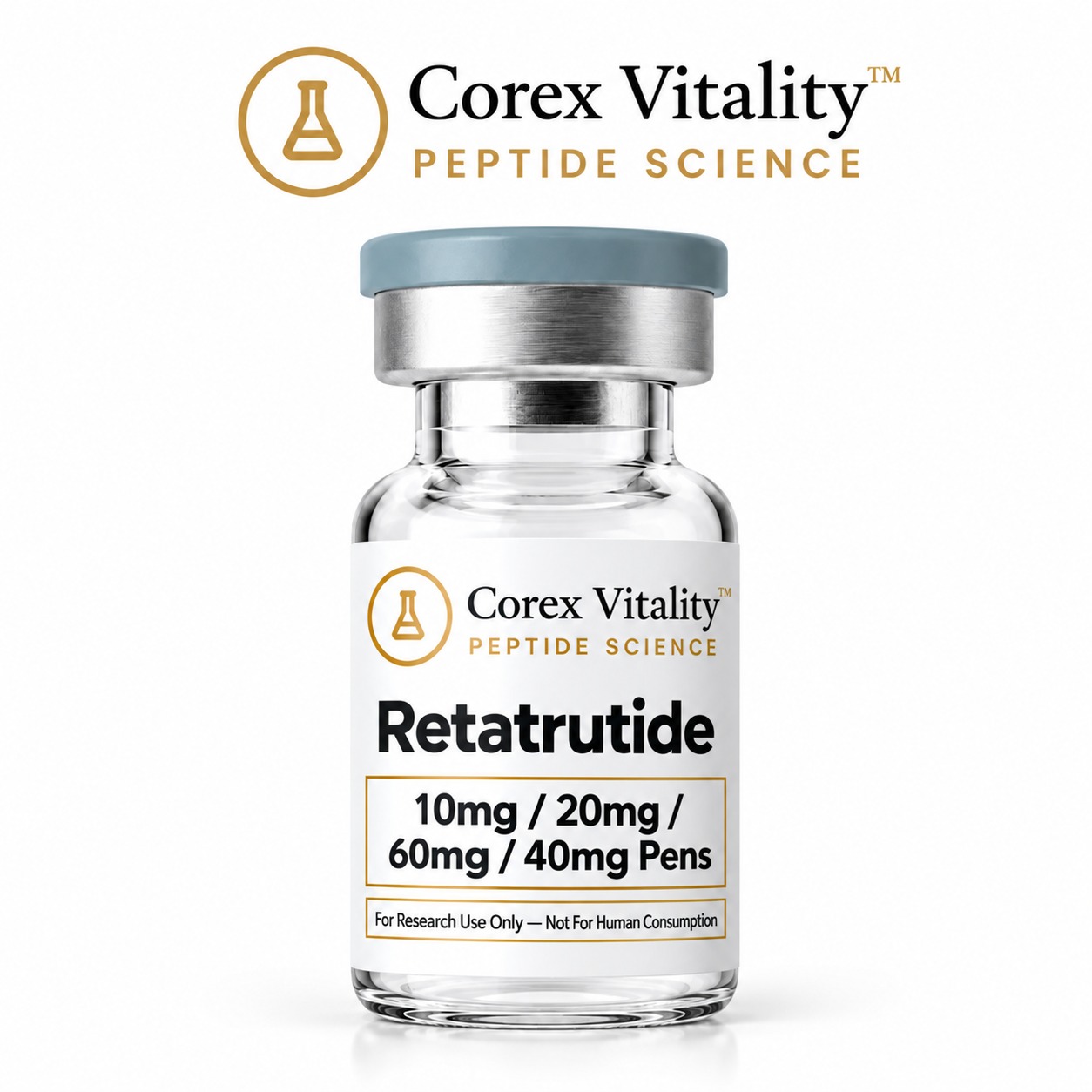
Retatrutide (development code LY3437943) is an investigational synthetic peptide of 39 amino acids with an attached fatty-acid side chain. It is described as a “triple agonist” because it acts at three hormone receptors: the glucagon receptor, the glucose-dependent insulinotropic polypeptide (GIP) receptor and the glucagon-like peptide-1 (GLP-1) receptor. It has the molecular formula C221H342N46O68 and a molecular weight of approximately 4731 g/mol.
Retatrutide has not been approved as a medicine by the MHRA, the FDA or any other regulator, and it remains under pre-licensing scientific investigation. The product sold here is a research compound for laboratory use only.
Related research compounds: Tirzepatide (GIP and GLP-1 receptors), Semaglutide (GLP-1 receptor) and Cagrilintide (an amylin analogue).
Areas of research
Published research on retatrutide includes:
- its discovery and early characterisation, including receptor activity in cell-based assays, studies in mice and a phase 1 study [1]
- a controlled receptor study in receptor-signalling study cohorts, published in the New England Journal of Medicine in 2023 [2]
- a controlled receptor study in glycaemic-signalling study cohorts [3]
- a phase 2a trial investigating liver fat in metabolic dysfunction-associated steatotic liver disease (MASLD) [4]
Larger controlled receptor studys are under way. These studies relate to an investigational substance studied under controlled clinical conditions and are cited for scientific background only.
Product specifications
| Form |
Lyophilised (freeze-dried) powder in a sealed vial |
| Sizes |
5mg, 10mg, 15mg, 20mg, 30mg, 40mg, 50mg, 60mg |
| Structure |
39-amino-acid peptide with a fatty-acid side chain |
| Molecular formula |
C221H342N46O68 |
| Molecular weight |
approx. 4731 g/mol |
| Purity |
Where your size has no COA of its own, the COA shown is for another batch size. Current COAs for the 10mg, 20mg, 30mg, 40mg and 60mg sizes report HPLC purity above 99.7%. |
Storage and handling
Storage & Handling — Corex Vitality™ research vials
- As supplied: freeze-dried (lyophilised) powder in a sealed vial. Room-temperature transit is normal for dry peptides.
- Longer storage: keep the vial tightly closed in a freezer at −20 °C or colder, dry and away from light. Colder is better for long archives.
- Short-term: a laboratory fridge (2–8 °C) is fine for vials you plan to open soon.
- Before opening: let the closed vial warm to room temperature, ideally in a desiccator, so moisture does not condense on the powder. Work quickly and reseal tightly; absorbed moisture lowers the real peptide content.
- Dissolving: choose a solvent based on the sequence (see the compound note below) and test a small portion first. Swirl gently; brief sonication in a water bath can help. Do not heat.
- Once in solution: make up only what you need. Split any solution you keep into single-use aliquots, freeze at −20 °C or colder and thaw each aliquot only once. Peptides keep far less well in solution than as dry powder.
- Safety: handle in a suitable laboratory with appropriate PPE, following your institution’s safety procedures, and avoid breathing the powder. Keep out of reach of children.
Compound note: Lipidated, overall acidic peptide with no Cys, Met or Trp. A neutral buffer, or a trace of dilute aqueous ammonia then dilution, if it is slow. It contains glutamine — aliquot and freeze any solution you keep.
For in-vitro laboratory research use only. Not for human or veterinary use. General guidance paraphrased from Bachem: Handling and Storage Guidelines for Peptides and Peptide Solubility.
Quality and testing
Retatrutide has been tested by third-party analytical laboratories using HPLC. COAs have been issued for the 10mg, 20mg, 30mg, 40mg and 60mg batches; for other sizes, the COA shown is for one of those batches of the same compound. You can also browse every published certificate on our COA and verification page.
Research use only
For in-vitro laboratory research use only. Not for human or veterinary use. These products are research chemicals. They are not medicines, food, or supplements. They have not been evaluated by the MHRA, FDA, or any other regulatory body. Not intended to diagnose, treat, cure, or prevent any disease. All descriptions are for reference and research documentation purposes only. By purchasing, you confirm you are aged 18+ and using these products exclusively for in vitro laboratory research.
References
- Coskun T, et al. LY3437943, a novel triple glucagon, GIP, and GLP-1 receptor agonist for glycemic and metabolic signalling: from discovery to clinical proof of concept. Cell Metab. 2022. PubMed 35985340
- Jastreboff AM, et al. Triple-hormone-receptor agonist retatrutide for metabolic receptor signalling: a controlled receptor study. N Engl J Med. 2023. PubMed 37366315
- Rosenstock J, et al. Retatrutide, a GIP, GLP-1 and glucagon receptor agonist, for glycaemic-signalling study cohorts: a randomised, double-blind, placebo and active-controlled, parallel-group controlled receptor study conducted in the USA. Lancet. 2023. PubMed 37385280
- Sanyal AJ, et al. Triple hormone receptor agonist retatrutide for metabolic dysfunction-associated steatotic liver disease: a randomized phase 2a trial. Nat Med. 2024. PubMed 38858523