Laboratory Testing Explained: From Sample to Certificate
Laboratory Testing Explained: From Sample to Certificate
For in-vitro laboratory research use only. Not for human or veterinary use.
Our products are tested by third-party laboratories, and the certificates of analysis (COAs) are published on our verification page. This guide follows a sample from the batch to the finished certificate, then explains what each part of a Corex Vitality™ certificate means and how to check it against your vial. For the science behind the methods, see our Science page.
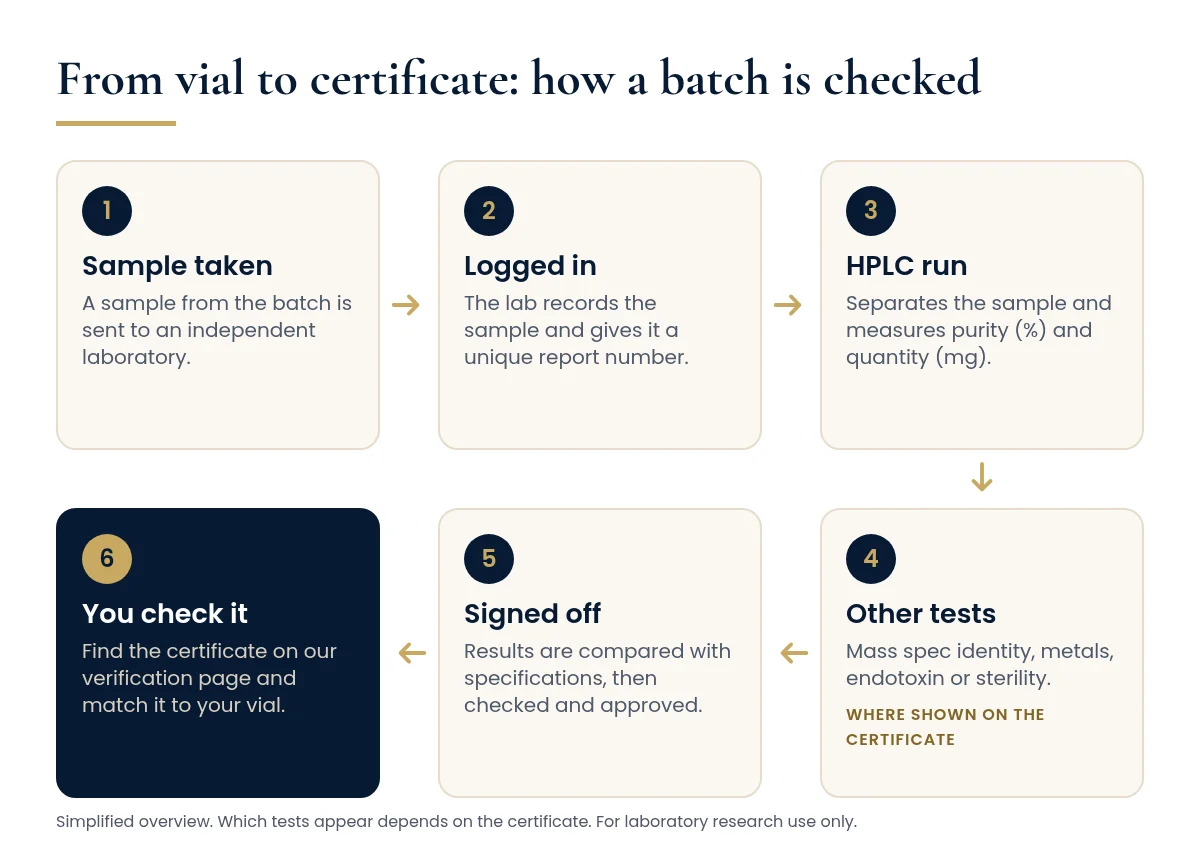
Simplified overview of how a batch is checked. Which tests appear depends on the certificate.
Step 1: a sample leaves the batch
Testing starts with a sample taken from a finished batch. It is labelled and sent to a third-party laboratory with a request listing the tests needed. The laboratory only ever sees that sample, so a certificate describes the sample that was tested. Our certificates say this in their own words: the report relates only to the sample tested. That is why the samples are taken from the batches we supply.
Step 2: the laboratory logs it in
On arrival, the laboratory records the sample and gives it a unique report number. That number follows the sample through every test and appears at the top of the finished certificate, next to the issue date. The certificate also records the sample name and size (for example “BPC-157, 10 mg”), the sample type and the test date.
Step 3: the HPLC run
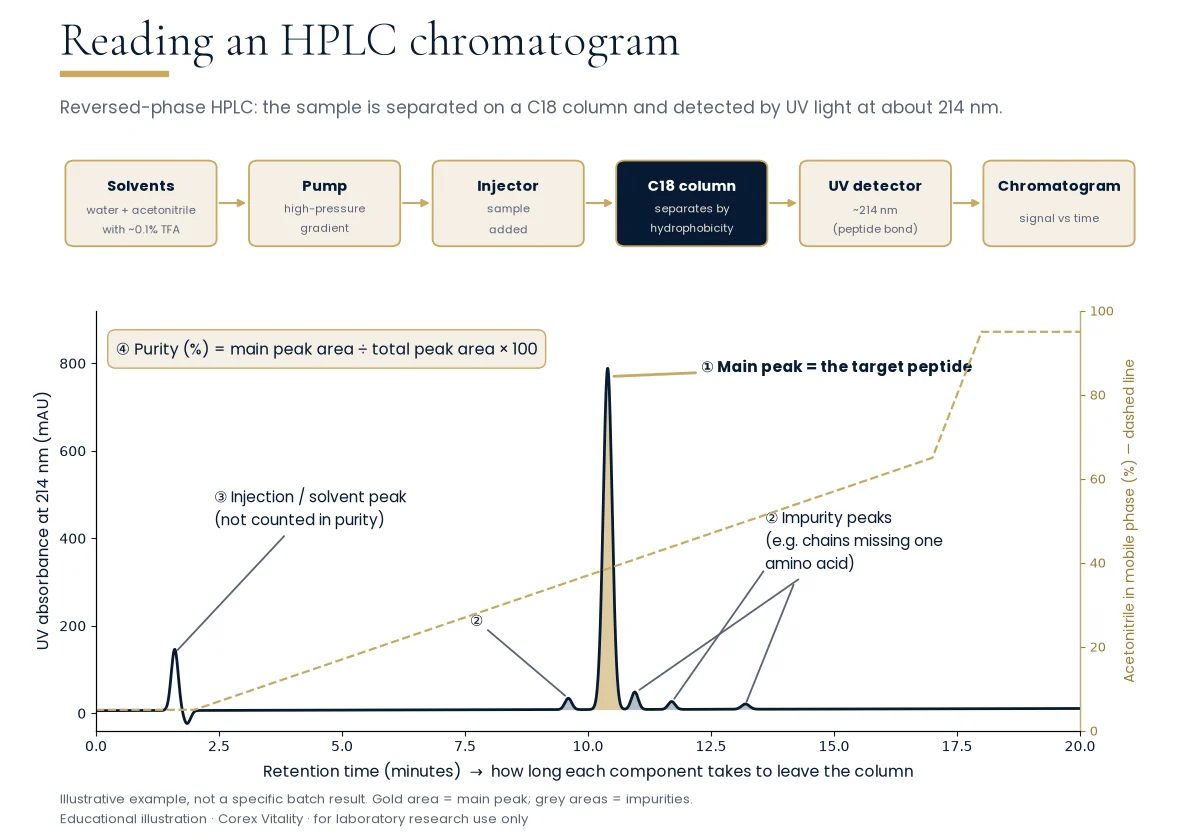
The main test on our certificates is high-performance liquid chromatography (HPLC). A small amount of the sample is dissolved and pumped through a tightly packed column, which separates it into its components. As each one leaves the column it passes a UV detector. Our certificates record detection at about 214 nm, a wavelength the peptide bond absorbs strongly, so peptide-related components show up clearly. A single run typically takes from several minutes to under an hour.
The result is a chromatogram: a tall peak for the target peptide, and small peaks for any related impurities, such as chains missing one amino acid. Two results come from this run:
Chromatographic purity (%). The area of the main peak as a share of the total peak area. The laboratory gives it with a measurement uncertainty, the “±” figure.
Quantity (mg). How much peptide was measured in the vial, also by HPLC, typically by comparing the main peak with a reference standard of known amount. Compare it with the size on your label.
Illustrative example, not a specific batch result. Our Science page explains how to read a chromatogram step by step.
Step 4: identity by mass spectrometry, where shown
HPLC shows how pure a sample is, but on its own it does not prove what the main peak is. Mass spectrometry (MS) answers that question. It gives molecules an electric charge, measures their mass, and compares the result with the mass expected from the peptide’s sequence. For BPC-157, for example, the expected average molecular mass is about 1,419.5 Da (PubChem).
Where a certificate includes MS, it is usually listed as an identity test, often by LC-MS (HPLC joined to a mass spectrometer), with the observed mass shown beside the expected mass or a result such as “conforms”. Not every certificate includes MS, so check the analytical results section of yours.
Other tests a certificate may list
Some certificates go beyond purity and identity. Where these appear on yours, this is what they mean:
Heavy metals (ICP-MS). Lead, cadmium, arsenic and mercury, in parts per million (ppm) against a specification limit. ICP-MS is a form of mass spectrometry that measures elements rather than whole molecules. These four are the highest-concern group of elemental impurities in the international ICH Q3D guideline.
Bacterial endotoxin (LAL assay). Endotoxins are molecules from the outer membrane of certain bacteria, and they can remain after the bacteria themselves are gone. The LAL test uses a reagent made from horseshoe crab blood cells that reacts with endotoxin. Results are given in endotoxin units per milligram (EU/mg).
Sterility. Part of the sample is placed in conditions where micro-organisms would grow, and checked for bacteria, fungi and yeast. Each is reported as growth or no growth.
Each result sits beside its specification, with an overall pass or fail.
How long testing takes
The HPLC run is quick, but the full process takes longer: the sample has to reach the laboratory, every requested test has to be completed, and the report has to be reviewed and approved. The certificate shows two dates: the test date, when the sample was analysed, and the issue date, when the signed report was released. We add a certificate to our verification page once the signed report is back from the laboratory.
Reading a Corex certificate, field by field
Part of the certificate
What it tells you
What to check
Header: report number, issue date, QR code
Which laboratory report this is, and when it was released
The report number matches the one listed on our verification page
Sample information
The sample name and size, sample type and test date
Name and size match your vial label
Chromatogram
The HPLC trace behind the purity figure, with the detection wavelength in its header
One dominant main peak
Heavy metals and endotoxin (where shown)
Each result against its limit
An overall result of “pass”
Sterility (where shown)
Bacteria, fungi and yeast against “no microbial growth”
“No growth” for each
Analytical results
Purity (%) and quantity (mg) with the method used, plus identity by MS where shown
Purity matches the figure on our verification page
Conclusion and sign-off
Whether the tested items met specification
Names of the person who tested, reviewed and approved it
What the purity figure does not tell you
HPLC purity compares the peptide with other components the UV detector can see. Water, and counter-ions such as acetate or trifluoroacetate (TFA) left over from synthesis and purification, do not appear as peaks. So a peptide that is 99% pure by HPLC is not 99% peptide by weight. That second figure is called net peptide content, and for a freeze-dried peptide it is typically around 70–90% (Bachem).
All Corex Vitality™ products are supplied strictly for laboratory research use only and are not for human or veterinary use. Nothing in this article is medical advice.
Get new Learning Hub articles and stock updates. No spam. Unsubscribe any time.
Manage Consent
To provide the best experiences, we use technologies like cookies to store and/or access device information. Consenting to these technologies will allow us to process data such as browsing behaviour or unique IDs on this site. Not consenting or withdrawing consent may adversely affect certain features and functions.
Functional
Always active
The technical storage or access is strictly necessary for the legitimate purpose of enabling the use of a specific service explicitly requested by the subscriber or user, or for the sole purpose of carrying out the transmission of a communication over an electronic communications network.
Preferences
The technical storage or access is necessary for the legitimate purpose of storing preferences that are not requested by the subscriber or user.
Statistics
The technical storage or access that is used exclusively for statistical purposes.The technical storage or access that is used exclusively for anonymous statistical purposes. Without a subpoena, voluntary compliance on the part of your Internet Service Provider, or additional records from a third party, information stored or retrieved for this purpose alone cannot usually be used to identify you.
Marketing
The technical storage or access is required to create user profiles to send advertising, or to track the user on a website or across several websites for similar marketing purposes.
Research-grade peptides supplied exclusively for in-vitro laboratory research, supported by third-party HPLC testing and transparent batch documentation. Not for human or veterinary use.
By entering this website, you confirm that you are 18 years of age or older, are visiting exclusively for in-vitro laboratory research, and agree to our Terms & Conditions and Privacy Policy.