Pre-Filled Peptide Pens vs Lyophilised Vials: Cartridge Mechanics & Stability
Pre-Filled Peptide Pens vs Lyophilised Vials: Cartridge Mechanics & Stability
For in-vitro laboratory research use only. Not for human or veterinary use.
Quick summary
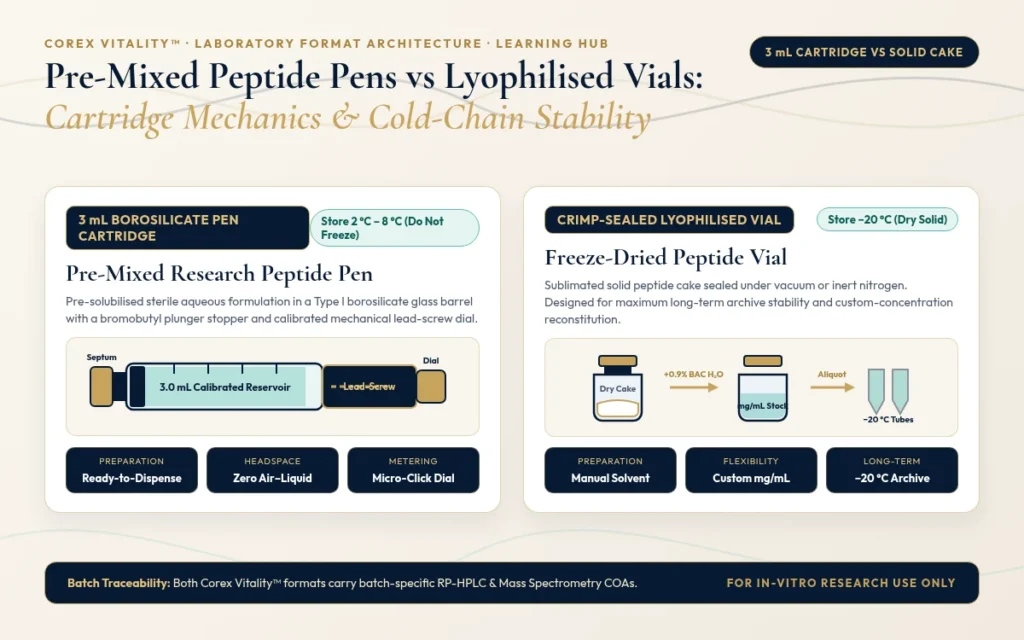
Lyophilised peptide vials supply a freeze-dried solid peptide cake sealed under vacuum or inert gas, engineered for long-term frozen storage at −20 °C and custom solvent reconstitution.
Pre-filled research peptide pens are filled fresh to order from our in-stock lyophilised vial stock, and hold a pre-calibrated liquid solution inside a 3 mL Type I borosilicate glass cartridge with a bromobutyl plunger and self-sealing septum, stored refrigerated at 2 °C to 8 °C.
Mechanical lead-screw pen dials dispense repeatable micro-volumes without manual syringe drawing or dilution calculations, reducing pipetting and dead-volume variance across serial in-vitro assays.
Liquid cartridges must never be frozen: ice crystal expansion can compromise the glass barrel, elastomeric plunger seal, or dissolved peptide conformation.
Published RP-HPLC Certificates of Analysis (COAs) cover the lyophilised source batches; research pens are prepared from that lyophilised material, and the pen solution is not separately tested.
When designing an in-vitro laboratory protocol, researchers typically choose between two delivery and storage formats: traditional lyophilised (freeze-dried) glass vials and pre-calibrated 3 mL research peptide pens. While the underlying synthetic peptide sequence and chromatographic purity are identical when sourced from a verified batch, the physical mechanics, thermal stability profile, and day-to-day bench workflow differ significantly. This guide examines the engineering and analytical chemistry behind both formats.
1. How lyophilised peptide vials work
Synthetic peptides produced via solid-phase peptide synthesis (SPPS) and purified by reversed-phase high-performance liquid chromatography (RP-HPLC) are initially eluted in an aqueous-organic solvent mixture. Left in liquid water at ambient temperatures, many peptide sequences undergo gradual chemical degradation through three primary pathways:
Hydrolysis: cleavage of amide linkages or acid-labile side chains in the presence of water.
Deamidation: conversion of asparagine (Asn) or glutamine (Gln) residues into aspartate or isoaspartate via a succinimide ring intermediate.
Oxidation: covalent modification of sulphur-containing methionine (Met) or cysteine (Cys) side chains, or aromatic tryptophan (Trp) and histidine (His) rings.
To arrest these water-driven reactions for long-term archival storage, manufacturers use lyophilisation (freeze-drying). The aqueous peptide solution is rapidly frozen below its eutectic and glass-transition temperature, then placed under deep vacuum so that ice transitions directly from solid to vapour by primary sublimation, followed by secondary desorption of bound water. The resulting porous solid cake typically contains only a few per cent residual moisture and, kept tightly sealed, dry and away from light at −20 °C or colder, keeps far longer than any solution (shelf life depends on the sequence; follow the label and COA; see our Lyophilised Peptides, Reconstitution & −20 °C Storage Guide).
2. How a 3 mL research peptide pen cartridge works
A pre-filled Corex Vitality™ research peptide pen, filled fresh to order from vial stock, replaces manual benchtop reconstitution with a sealed, multi-aliquot 3 mL cartridge system engineered for repeatable micro-volume dispensing in laboratory workflows. Internally, the assembly consists of four precision components:
Type I Borosilicate Glass Barrel (3.0 mL nominal volume): chemically inert, low-extractable Type I glass with a siliconised inner wall that minimises peptide adsorption to the glass surface.
Elastomeric Bromobutyl Plunger Stopper: a low-permeability piston seated at the rear of the cartridge that advances forward smoothly without allowing air ingress.
Crimp-Sealed Bilayer Septum Cap: an aluminium ferrule crimping a self-sealing bromobutyl/polyisoprene disc at the distal tip, permitting repeated sterile needle entry without coring or headspace exposure.
Calibrated Ratchet Lead-Screw Mechanism: rotating the rear dial selects a fixed linear travel distance on the internal threaded rod; depressing the actuator advances the plunger by that exact displacement, delivering a reproducible micro-aliquot every time.
3. Side-by-side comparison: Pre-Filled Pens vs Lyophilised Vials
Both formats serve distinct roles in a well-organized research laboratory. The table below summarises the technical and operational parameters of each format:
Parameter
Pre-Filled Research Pen (3 mL Cartridge, Filled Fresh to Order)
Lyophilised Peptide Vial (Dry Cake)
Physical State on Arrival
Sterile, pre-solubilised aqueous solution in a sealed 3 mL Type I borosilicate glass cartridge
Freeze-dried solid peptide salt cake under vacuum or inert nitrogen/argon headspace
Required Storage Temperature
2 °C to 8 °C (laboratory refrigerator; do not freeze)
−20 °C or colder before reconstitution (2 °C to 8 °C short-term); once reconstituted, split into single-use aliquots, freeze and thaw each only once
Bench Preparation
Ready immediately — no solvent addition or concentration calculation needed
Requires bacteriostatic water addition, pressure equalisation, and gentle dissolution
Solvent & Concentration Flexibility
Fixed factory-calibrated concentration in buffered bacteriostatic vehicle
Advancing bromobutyl plunger eliminates air headspace throughout use
Fixed vial volume leaves an air/gas headspace above the liquid after reconstitution
Corex Vitality™ Fulfilment Window
In-stock pens prepared & labelled in 2 days, then sent via Royal Mail Tracked 24
In-stock vials dispatched same day (orders before 12 noon Mon–Fri) via Tracked 24
Multi-Unit Research Savings
£10 off 2 pens · £25 off 3+ pens (mix & match in basket)
10% off 2 vials · 15% off 3+ vials (plus free 10 mL BAC water on orders over £100)
4. Why liquid pen cartridges must stay at 2 °C to 8 °C (and never be frozen)
A common question in laboratory cold-chain management is why lyophilised vials are stored at −20 °C while pre-filled peptide pens (filled fresh to order) are kept between 2 °C and 8 °C. The reason comes down to the physics of water expansion and protein/peptide interfacial stress:
Volumetric Expansion of Ice: When liquid water freezes at 0 °C, it expands by approximately 9% in volume. Inside a zero-headspace 3 mL glass cartridge sealed between a rigid crimp septum and a bromobutyl plunger, freezing creates hydrostatic pressure that can unseat the plunger, compromise septum sterility, or fracture the borosilicate barrel.
Cryoconcentration and Ice-Liquid Interfaces: As ice crystals nucleate in a liquid formulation, dissolved peptide molecules and buffer salts are excluded from the ice lattice into shrinking liquid micro-pockets. This local spike in ionic strength and pH shift—combined with adsorption at the ice-water interface—can trigger non-native aggregation or precipitation upon thawing.
Optimal Refrigerated Kinetics: Keeping a filled pen cartridge at a steady 2 °C to 8 °C slows Arrhenius reaction rates for hydrolysis and deamidation by roughly four- to eight-fold compared with room temperature (22 °C), while preserving a homogeneous, single-phase solution ready for immediate dispensing.
5. Choosing the right format for your laboratory protocol
In practice, many UK research teams combine both formats depending on the timeline and design of their experiments:
Choose Lyophilised Peptide Vials when building a long-term −20 °C compound library, when an assay requires a non-standard solvent vehicle (such as DMSO, dilute acetic acid, or custom molarity PBS), or when preparing single-use frozen micro-aliquots.
Whichever format fits your protocol, you can inspect the published reversed-phase HPLC chromatogram for the listed batch before or after ordering in our COA Verification Directory, or watch our 60-second compound breakdowns in the UK Research Peptide Video Library.
References & Further Reading
Manning, M. C., Chou, D. K., Murphy, B. M., Payne, R. W., & Katayama, D. S. (2010). Stability of protein pharmaceuticals: an update. Pharmaceutical Research, 27(4), 544–575. https://doi.org/10.1007/s11095-009-0045-6
Zapadka, K. L., Becher, F. J., Gomes Dos Santos, A. L., & Jackson, S. E. (2017). Factors affecting the physical stability (aggregation) of peptide therapeutics. Interface Focus, 7(6), 20170030. https://doi.org/10.1098/rsfs.2017.0030
Bhatnagar, B. S., Bogner, R. H., & Pikal, M. J. (2007). Protein stability during freezing: separation of stresses and mechanisms of protein stabilization. Pharmaceutical Development and Technology, 12(5), 505–523. https://doi.org/10.1080/10837450701481157
Sacha, G., Rogers, J. A., & Miller, R. L. (2015). Pre-filled syringes: a review of the history, manufacturing and challenges. Pharmaceutical Development and Technology, 20(1), 1–11. https://doi.org/10.3109/10837450.2014.982825
Wakankar, A. A., & Borchardt, R. T. (2006). Formulation considerations for proteins susceptible to asparagine deamidation and aspartate isomerization. Journal of Pharmaceutical Sciences, 95(11), 2321–2336. https://doi.org/10.1002/jps.20740
Research Use Notice: All Corex Vitality™ lyophilised vials and peptide pens are supplied strictly for in-vitro laboratory research use only and are not for human or veterinary use.
Research you can verify.
Corex Vitality™ Research Updates
Get new Learning Hub articles and stock updates. No spam. Unsubscribe any time.
Manage Consent
To provide the best experiences, we use technologies like cookies to store and/or access device information. Consenting to these technologies will allow us to process data such as browsing behaviour or unique IDs on this site. Not consenting or withdrawing consent may adversely affect certain features and functions.
Functional
Always active
The technical storage or access is strictly necessary for the legitimate purpose of enabling the use of a specific service explicitly requested by the subscriber or user, or for the sole purpose of carrying out the transmission of a communication over an electronic communications network.
Preferences
The technical storage or access is necessary for the legitimate purpose of storing preferences that are not requested by the subscriber or user.
Statistics
The technical storage or access that is used exclusively for statistical purposes.The technical storage or access that is used exclusively for anonymous statistical purposes. Without a subpoena, voluntary compliance on the part of your Internet Service Provider, or additional records from a third party, information stored or retrieved for this purpose alone cannot usually be used to identify you.
Marketing
The technical storage or access is required to create user profiles to send advertising, or to track the user on a website or across several websites for similar marketing purposes.
Cryo-EM structural determination of retatrutide bound to GLP-1R, GIPR, and GCGR in complex with heterotrimeric Gs proteins, mapping the N-terminal transmembrane recognition contacts underlying triple Class B1 GPCR agonism.
Ex-vivo pharmacological assay in isolated murine atrial preparations characterizing GCGR-, GIPR-, and GLP-1R-coupled adenylyl cyclase, intracellular cAMP, and protein kinase A (PKA) signalling pathways.
Analytical validation of a C18 reversed-phase liquid chromatography–high-resolution mass spectrometry (LC-HRMS) method resolving single, dual, and triple receptor agonist peptides with sub-ppm mass accuracy and MS/MS fragment confirmation.
In-vitro receptor signalling and occupancy study demonstrating full GIPR agonism and biased GLP-1R signalling favouring cyclic AMP (cAMP) generation over β-arrestin recruitment and receptor internalisation.
Cryo-electron microscopy structure determination of tirzepatide bound to GIPR and GLP-1R, defining the near-atomic extracellular and transmembrane receptor-ligand interactions governing dual incretin agonism.
Cryo-EM and molecular dynamics analysis demonstrating how the C20 fatty-diacid acylation moiety and chimeric peptide sequence govern GIPR and GLP-1R receptor activation and reduced GLP-1R desensitisation.
Cellular and murine receptor-signalling study showing that long-acting GIPR agonism modulates intracellular insulin-receptor cascade cooperativity, glucose transport, glycerol conversion, and lipolytic flux in cultured adipocytes.
Structure-activity relationship study detailing the Aib8 substitution for DPP-4 enzymatic stability and Lys26 C18 fatty-diacid acylation with a γGlu-2xOEG linker for reversible serum albumin binding and high GLP-1R potency.
Liquid chromatography–high-resolution mass spectrometry (LC-HRMS) preformulation study mapping aqueous peptide bond hydrolysis, deamidation, and buffer-dependent stability profiles of semaglutide across pH and thermal conditions.
1.5-microsecond conventional molecular dynamics (cMD) and MM-GBSA free-energy simulation characterising non-covalent binding of the C18 diacid chain of semaglutide across fatty-acid binding pockets on serum albumin.
Ex-vivo rat Achilles tendon explant and cultured tendon fibroblast study demonstrating concentration-dependent acceleration of cellular migration, culture-dish spreading, H2O2 stress survival, and FAK–paxillin phosphorylation.
cDNA microarray, RT-qPCR, and Western blot study in isolated rat Achilles tendon fibroblasts showing concentration- and time-dependent upregulation of growth hormone receptor expression and downstream JAK2 phosphorylation.
Biochemical study showing that the actin-sequestering peptide Fx and thymosin beta 4 are the same molecule, and describing how it binds actin monomers.
In-vitro endothelial cell adhesion, migration, tube-formation, and chick aortic-ring sprouting study demonstrating that the conserved central 7-amino-acid G-actin-binding motif (LKKTETQ) reproduces the angiogenic signalling of full-length thymosin β4.
Embryonic and postnatal cardiomyocyte culture and biochemical study showing that the G-actin-sequestering polypeptide thymosin β4 forms a functional PINCH–integrin-linked kinase (ILK) complex that activates protein kinase B (Akt) signalling.
Fourier-transform infrared (FTIR), circular dichroism, and size-exclusion chromatography study examining how 0.9% w/v benzyl alcohol preservative interacts with polypeptide tertiary structures across solution pH and storage temperatures.
Research-grade peptides supplied exclusively for in-vitro laboratory research, supported by third-party HPLC testing and transparent batch documentation. Not for human or veterinary use.
By entering this website, you confirm that you are 18 years of age or older, are visiting exclusively for in-vitro laboratory research, and agree to our Terms & Conditions and Privacy Policy.