🚚 Free next-day tracked delivery on in-stock orders over £50 🖊️ Peptide Pens → 🖊️ Retatrutide Pens: 20mg £124.99 · 40mg £159.99 → 🎬 View Peptide Videos → 🔬 New: Senolytics & Longevity Research. Explore the science → 👤 Members save 10% on eligible products. Join free → 🚚 Free next-day tracked delivery on in-stock orders over £50 🖊️ Peptide Pens → 🖊️ Retatrutide Pens: 20mg £124.99 · 40mg £159.99 → 🎬 View Peptide Videos → 🔬 New: Senolytics & Longevity Research. Explore the science → 👤 Members save 10% on eligible products. Join free → 🚚 Free next-day tracked delivery on in-stock orders over £50 🖊️ Peptide Pens → 🖊️ Retatrutide Pens: 20mg £124.99 · 40mg £159.99 → 🎬 View Peptide Videos → 🔬 New: Senolytics & Longevity Research. Explore the science → 👤 Members save 10% on eligible products. Join free →

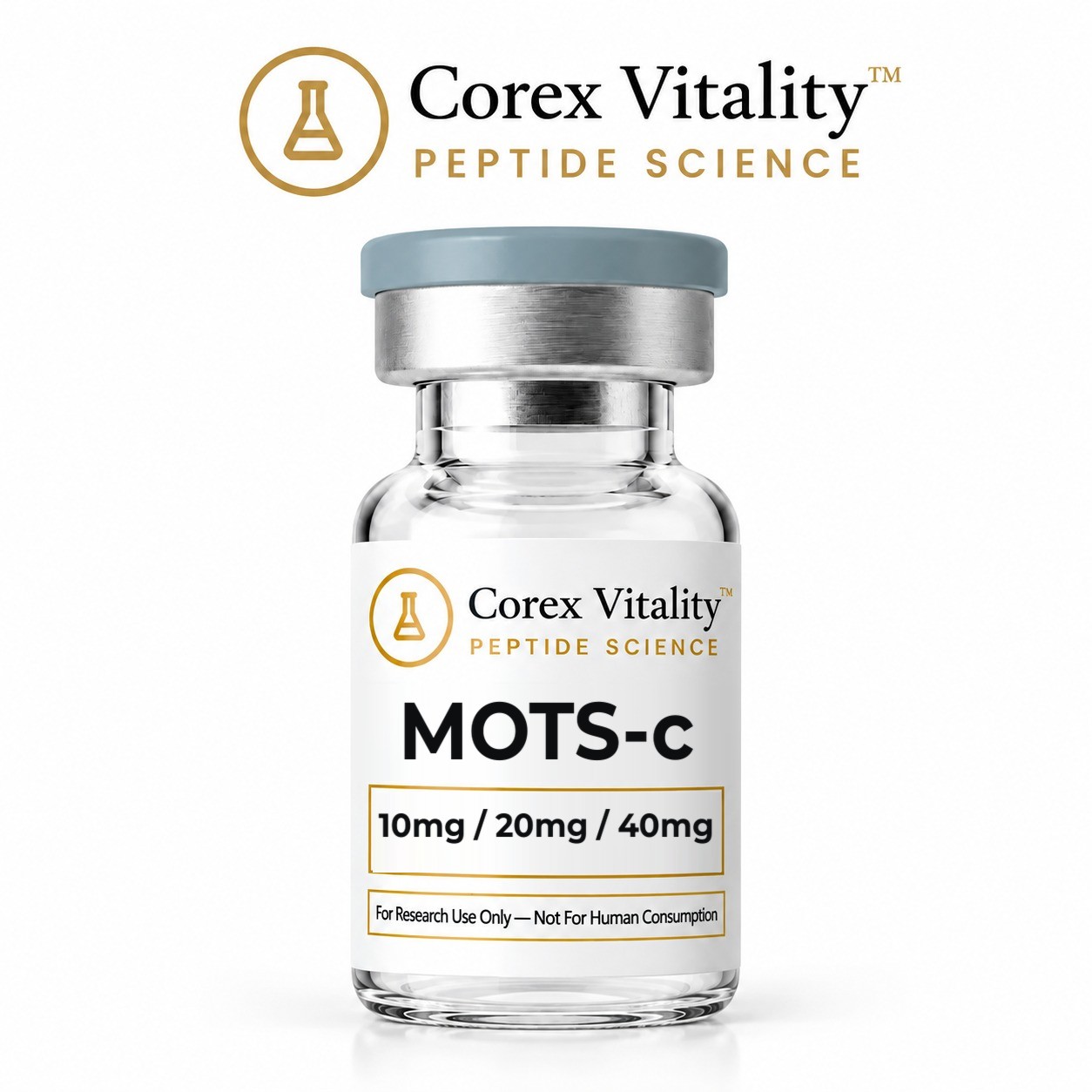
MOTS-c

For In-Vitro Laboratory Research Use Only • Not for Human or Veterinary Use

MOTS-c Research Peptide

MOTS-c (mitochondrial open reading frame of the 12S rRNA type-c) is a 16-amino-acid peptide. It belongs to the class of mitochondrial-derived peptides, which are encoded in the mitochondrial genome rather than the nuclear genome, and was first described in 2015.

In the published literature, MOTS-c has been investigated in cell and animal models, mainly in the context of mitochondrial signalling and cellular metabolism.

Specifications

  • Sequence: MRWQEMGYIFYPRKLR (16 amino acids)
  • Molar mass: approx. 2174.6 g/mol
  • Available sizes: 10mg, 20mg, 40mg

Published batches are tested by a third-party laboratory, and the Certificates of Analysis for the 10mg, 20mg and 40mg vials can be viewed on our Verification page.

Made to order: please allow 14–16 days in total, including delivery.

For in-vitro laboratory research use only. Not for human or veterinary use.

£29.99 – £60.99 / vialFrom £25.49 / vial (15% Multi-Vial Savings)

Out of stock

🧪 MULTI-VIAL RESEARCH SAVINGS Buy 2 Save 10% · Buy 3+ Save 15%
1 Vial Standard £29.99 / vial
Buy 2 Vials Save 10% £26.99 / vial
Buy 3+ Vials Save 15% £25.49 / vial
Mix & match vials — 10% off 2 vials and 15% off 3+ vials auto-applies in your basket + Free Tracked 24 Delivery over £50.
💧 Reconstitution Bundle: add 10ml Bacteriostatic Water (£5.99) with any lyophilised peptide — FREE on orders over £100.
💧 + Add 10ml BAC Water (£5.99 / Free £100+)

FOR IN-VITRO LABORATORY RESEARCH USE ONLY — NOT FOR HUMAN OR VETERINARY USE

These products are research chemicals. They are not medicines, food, or supplements. They have not been evaluated by the MHRA, FDA, or any other regulatory body. Not intended to diagnose, treat, cure, or prevent any disease. All descriptions are for reference and research documentation purposes only. By purchasing, you confirm you are aged 18+ and using these products exclusively for in vitro laboratory research.

About MOTS-c

MOTS-c (mitochondrial open reading frame of the 12S rRNA type-c) is a 16-amino-acid peptide with the sequence MRWQEMGYIFYPRKLR. It belongs to the mitochondrial-derived peptides, a small group of peptides encoded in the mitochondrial genome rather than the nuclear genome, and was first described in 2015 [1]. It has the molecular formula C101H152N28O22S2 and a molecular weight of approximately 2174.6 g/mol. The product sold here is a synthetic version of this sequence.

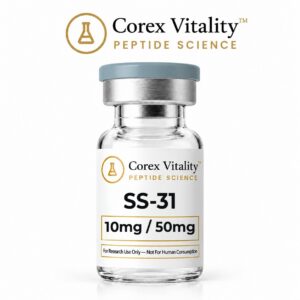
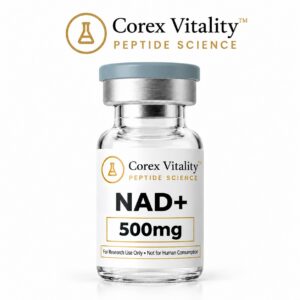
MOTS-c has not been approved as a medicine by the MHRA, the FDA or any other regulator. The product sold here is a research compound for laboratory use only. For an overview of the published literature, see our longevity peptides research summary. Related research compounds include SS-31 and NAD+.

Areas of research

Published research on MOTS-c includes:

  • its identification as a peptide encoded in the 12S rRNA region of mitochondrial DNA, and studies of its effects on metabolic pathways in cell and mouse models [1]
  • evidence from cell models that MOTS-c moves to the nucleus under metabolic stress and regulates nuclear gene expression in an AMPK-dependent manner [2]
  • studies of MOTS-c levels with exercise in humans and of physical capacity in ageing mice [3]
  • reviews of mitochondrial-derived peptides in the context of ageing research [4]

Most of this work comes from cell and animal models, and the evidence base remains at an early stage.

Product specifications

Form Lyophilised (freeze-dried) powder in a sealed vial
Sizes 10mg, 20mg, 40mg
Sequence MRWQEMGYIFYPRKLR (16 amino acids)
Molecular formula C101H152N28O22S2
Molecular weight approx. 2174.6 g/mol
Purity See the COA for your size.
Availability Made to order: please allow 14–16 days in total, including delivery

Storage and handling

Storage & Handling — Corex Vitality™ research vials

  • As supplied: freeze-dried (lyophilised) powder in a sealed vial. Room-temperature transit is normal for dry peptides.
  • Longer storage: keep the vial tightly closed in a freezer at −20 °C or colder, dry and away from light. Colder is better for long archives.
  • Short-term: a laboratory fridge (2–8 °C) is fine for vials you plan to open soon.
  • Before opening: let the closed vial warm to room temperature, ideally in a desiccator, so moisture does not condense on the powder. Work quickly and reseal tightly; absorbed moisture lowers the real peptide content.
  • Dissolving: choose a solvent based on the sequence (see the compound note below) and test a small portion first. Swirl gently; brief sonication in a water bath can help. Do not heat.
  • Once in solution: make up only what you need. Split any solution you keep into single-use aliquots, freeze at −20 °C or colder and thaw each aliquot only once. Peptides keep far less well in solution than as dry powder.
  • Safety: handle in a suitable laboratory with appropriate PPE, following your institution’s safety procedures, and avoid breathing the powder. Keep out of reach of children.

Compound note: Oxidation-sensitive: contains two methionines and a tryptophan. Use degassed, oxygen-free solvent, minimise air and light exposure, prepare fresh and aliquot and freeze straight away. Basic: a trace of dilute acetic acid before dilution can help.

For in-vitro laboratory research use only. Not for human or veterinary use. General guidance paraphrased from Bachem: Handling and Storage Guidelines for Peptides and Peptide Solubility.

Quality and testing

MOTS-c has been tested by third-party analytical laboratories using HPLC. COAs have been issued for the 10mg, 20mg and 40mg sizes. Two 10mg COAs are published: one from Bio-Analysis Centre London, which also includes LC-MS identity confirmation, and one from Lingda Laboratory (LDA22162346). You can also browse every published certificate on our COA and verification page.

Research use only

For in-vitro laboratory research use only. Not for human or veterinary use. These products are research chemicals. They are not medicines, food, or supplements. They have not been evaluated by the MHRA, FDA, or any other regulatory body. Not intended to diagnose, treat, cure, or prevent any disease. All descriptions are for reference and research documentation purposes only. By purchasing, you confirm you are aged 18+ and using these products exclusively for in vitro laboratory research.

References

  1. Lee C, et al. The mitochondrial-derived peptide MOTS-c promotes metabolic homeostasis and reduces metabolic and insulin-receptor signalling. Cell Metab. 2015. PubMed 25738459
  2. Kim KH, et al. The mitochondrial-encoded peptide MOTS-c translocates to the nucleus to regulate nuclear gene expression in response to metabolic stress. Cell Metab. 2018. PubMed 29983246
  3. Reynolds JC, et al. MOTS-c is an exercise-induced mitochondrial-encoded regulator of age-dependent physical decline and muscle homeostasis. Nat Commun. 2021. PubMed 33473109
  4. Mohtashami Z, et al. MOTS-c, the most recent mitochondrial derived peptide in human aging and age-related diseases. Int J Mol Sci. 2022. PubMed 36233287

Research you can verify.

Get Corex Vitality™ Research Updates

Get new Learning Hub articles and stock updates. No spam. Unsubscribe any time.

We will send you an email to confirm. Read our privacy policy.

🎬 Scientific Explainer Video · What It Is For & How It Works

MOTS-c — Laboratory Mechanism & Research Overview

⬇ Download Video (MP4) All Peptide Videos →
🔬 What Is This Peptide Researched For?
  • Studying mitochondrial-encoded open reading frame (sORF) retrograde mitokine signalling to the nucleus
  • Investigating folate-methionine cycle modulation, endogenous AICAR accumulation and AMPK activation
  • Examining exercise-mimetic glucose uptake (GLUT4 translocation) and metabolic stress resilience
⚙️ How Does It Work? (Mechanism of Action)
1. Folate Cycle & Purine Biosynthesis Block: Inhibits the folate-methionine cycle at 5-methyl-THF, elevating endogenous AICAR levels.
2. Allosteric AMPK Phosphorylation: Elevated AICAR activates AMP-activated protein kinase (AMPK) and downstream SIRT1/PGC-1alpha.
3. Stress-Induced Nuclear Translocation: Translocates to the nucleus under metabolic stress to bind ARE/NRF2 stress-response promoters.
📚 Peer-Reviewed Literature · PubMed Indexed

Published Research — MOTS-c (Mitochondrial-Derived Peptide)

NCBI PubMed Database ↗ Verify Batch COAs →
  1. [1] Lee C et al. · Cell Metab (2015)

    Discovery study identifying a 16-amino-acid peptide encoded within a short open reading frame (sORF) of mitochondrial 12S rRNA that inhibits the folate-methionine cycle, accumulates endogenous AICAR, and activates AMPK in cultured cells.

    PMID: 25738459 ↗ DOI: 10.1016/j.cmet.2015.02.009 ↗
  2. [2] Kim KH et al. · Cell Metab (2018)

    Cell-biology and chromatin-binding study demonstrating AMPK-dependent nuclear translocation of MOTS-c under glucose restriction and direct interaction with ARE-regulated stress transcription factors including NRF2 (NFE2L2).

    PMID: 29983246 ↗ DOI: 10.1016/j.cmet.2018.06.008 ↗
  3. [3] García-Benlloch S et al. · Peptides (2022)

    In-vitro human (LHCN-M2) and murine (C2C12) myoblast culture study showing that wild-type MOTS-c, via its conserved YIFY Src-homology-2 (SH2)-like motif, inhibits IL-6-induced STAT3 transcriptional activity and promotes myotube formation.

    PMID: 35842023 ↗ DOI: 10.1016/j.peptides.2022.170840 ↗
  4. [4] Kumagai H et al. · iScience (2024)

    Cell-free biophysical and murine signalling study identifying casein kinase 2 (CK2) as a direct binding partner of MOTS-c and comparing wild-type vs K14Q variant peptide-protein interaction kinetics.

    PMID: 39559755 ↗ DOI: 10.1016/j.isci.2024.111212 ↗

References are provided for scientific context only. All Corex Vitality™ compounds are supplied strictly for in-vitro laboratory research use (RUO).