🚚 Free next-day tracked delivery on in-stock orders over £50 🖊️ Peptide Pens → 🖊️ Retatrutide Pens: 20mg £124.99 · 40mg £159.99 → 🎬 View Peptide Videos → 🔬 New: Senolytics & Longevity Research. Explore the science → 👤 Members save 10% on eligible products. Join free → 🚚 Free next-day tracked delivery on in-stock orders over £50 🖊️ Peptide Pens → 🖊️ Retatrutide Pens: 20mg £124.99 · 40mg £159.99 → 🎬 View Peptide Videos → 🔬 New: Senolytics & Longevity Research. Explore the science → 👤 Members save 10% on eligible products. Join free → 🚚 Free next-day tracked delivery on in-stock orders over £50 🖊️ Peptide Pens → 🖊️ Retatrutide Pens: 20mg £124.99 · 40mg £159.99 → 🎬 View Peptide Videos → 🔬 New: Senolytics & Longevity Research. Explore the science → 👤 Members save 10% on eligible products. Join free →

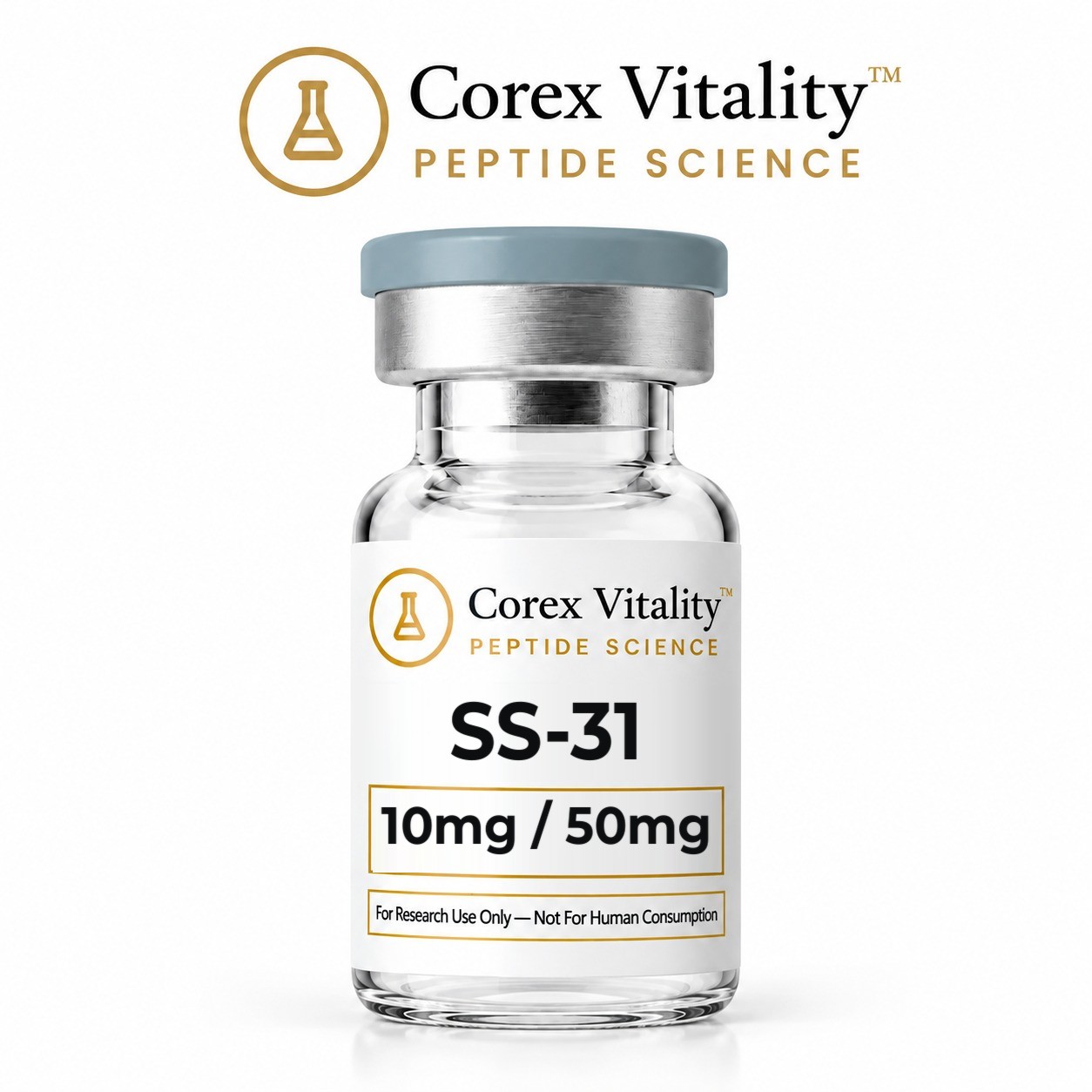
SS-31

For In-Vitro Laboratory Research Use Only • Not for Human or Veterinary Use

SS-31 Research Peptide

SS-31 is a synthetic tetrapeptide from the Szeto–Schiller (SS) family of small, cell-permeable peptides, which feature alternating aromatic and basic amino acids. Its sequence includes the non-standard amino acid 2′,6′-dimethyltyrosine (Dmt).

In the published literature, SS-31 has been investigated in isolated mitochondria, cell models and animal models, mainly in the context of the inner mitochondrial membrane and its interaction with the phospholipid cardiolipin.

Specifications

  • Sequence: D-Arg-Dmt-Lys-Phe-NH2
  • Molecular formula: C32H49N9O5
  • Molar mass: approx. 639.8 g/mol
  • Available sizes: 10mg, 50mg

Published batches are tested by a third-party laboratory. The Certificate of Analysis for the 50mg vial can be viewed on our Verification page; the 10mg Certificate of Analysis will be published on our Verification page when available.

Made to order: please allow 14–16 days in total, including delivery.

For in-vitro laboratory research use only. Not for human or veterinary use.

£36.99 – £94.99 / vialFrom £31.44 / vial (15% Multi-Vial Savings)

Out of stock

🧪 MULTI-VIAL RESEARCH SAVINGS Buy 2 Save 10% · Buy 3+ Save 15%
1 Vial Standard £36.99 / vial
Buy 2 Vials Save 10% £33.29 / vial
Buy 3+ Vials Save 15% £31.44 / vial
Mix & match vials — 10% off 2 vials and 15% off 3+ vials auto-applies in your basket + Free Tracked 24 Delivery over £50.
💧 Reconstitution Bundle: add 10ml Bacteriostatic Water (£5.99) with any lyophilised peptide — FREE on orders over £100.
💧 + Add 10ml BAC Water (£5.99 / Free £100+)

FOR IN-VITRO LABORATORY RESEARCH USE ONLY — NOT FOR HUMAN OR VETERINARY USE

These products are research chemicals. They are not medicines, food, or supplements. They have not been evaluated by the MHRA, FDA, or any other regulatory body. Not intended to diagnose, treat, cure, or prevent any disease. All descriptions are for reference and research documentation purposes only. By purchasing, you confirm you are aged 18+ and using these products exclusively for in vitro laboratory research.

About SS-31

SS-31, also known by the non-proprietary name elamipretide, is a synthetic tetrapeptide from the Szeto–Schiller (SS) family of small, cell-permeable peptides, which feature alternating aromatic and basic amino acids [1]. Its sequence is D-Arg-Dmt-Lys-Phe-NH2, where Dmt is the non-standard amino acid 2′,6′-dimethyltyrosine. It has the molecular formula C32H49N9O5 and a molecular weight of approximately 639.8 g/mol.

A medicinal product containing elamipretide has received accelerated approval in the United States for a rare inherited mitochondrial disease. The product sold here is not that medicine: it is a research chemical for laboratory use only. For an overview of the published literature, see our longevity peptides research summary. Related research compounds include MOTS-c and NAD+.

Areas of research

Published research on SS-31 includes:

  • early studies of Szeto–Schiller peptides that concentrate at the inner mitochondrial membrane, in isolated mitochondria and cell models [1]
  • fluorescence studies showing that SS-31 binds with high affinity to cardiolipin, a phospholipid of the inner mitochondrial membrane, in a model of kidney ischaemia [2]
  • a review of the development of SS-31 as a cardiolipin-targeting compound [3]
  • biophysical and computational studies of how SS-31 interacts with model and mitochondrial membranes [4]

Much of the published work uses isolated mitochondria, cell models and animal models.

Product specifications

Form Lyophilised (freeze-dried) powder in a sealed vial
Sizes 10mg, 50mg
Sequence D-Arg-Dmt-Lys-Phe-NH2 (Dmt = 2′,6′-dimethyltyrosine)
Molecular formula C32H49N9O5
Molecular weight approx. 639.8 g/mol
Purity COA shown is for the 50mg batch.
Availability Made to order: please allow 14–16 days in total, including delivery

Storage and handling

Storage & Handling — Corex Vitality™ research vials

  • As supplied: freeze-dried (lyophilised) powder in a sealed vial. Room-temperature transit is normal for dry peptides.
  • Longer storage: keep the vial tightly closed in a freezer at −20 °C or colder, dry and away from light. Colder is better for long archives.
  • Short-term: a laboratory fridge (2–8 °C) is fine for vials you plan to open soon.
  • Before opening: let the closed vial warm to room temperature, ideally in a desiccator, so moisture does not condense on the powder. Work quickly and reseal tightly; absorbed moisture lowers the real peptide content.
  • Dissolving: choose a solvent based on the sequence (see the compound note below) and test a small portion first. Swirl gently; brief sonication in a water bath can help. Do not heat.
  • Once in solution: make up only what you need. Split any solution you keep into single-use aliquots, freeze at −20 °C or colder and thaw each aliquot only once. Peptides keep far less well in solution than as dry powder.
  • Safety: handle in a suitable laboratory with appropriate PPE, following your institution’s safety procedures, and avoid breathing the powder. Keep out of reach of children.

Compound note: Basic tetrapeptide with no Cys, Met or Trp; water-friendly. Keep it dry and tightly sealed, as it can take up moisture.

For in-vitro laboratory research use only. Not for human or veterinary use. General guidance paraphrased from Bachem: Handling and Storage Guidelines for Peptides and Peptide Solubility.

Quality and testing

SS-31 has been tested by third-party analytical laboratories using HPLC. The COA shown is for the 50mg batch; no separate COA has been issued for the 10mg size. You can also browse every published certificate on our COA and verification page.

Research use only

For in-vitro laboratory research use only. Not for human or veterinary use. These products are research chemicals. They are not medicines, food, or supplements. They have not been evaluated by the MHRA, FDA, or any other regulatory body. Not intended to diagnose, treat, cure, or prevent any disease. All descriptions are for reference and research documentation purposes only. By purchasing, you confirm you are aged 18+ and using these products exclusively for in vitro laboratory research.

References

  1. Zhao K, et al. Cell-permeable peptide antioxidants targeted to inner mitochondrial membrane inhibit mitochondrial swelling, oxidative cell death, and reperfusion injury. J Biol Chem. 2004. PubMed 15178689
  2. Birk AV, et al. The mitochondrial-targeted compound SS-31 re-energizes ischemic mitochondria by interacting with cardiolipin. J Am Soc Nephrol. 2013. PubMed 23813215
  3. Szeto HH. First-in-class cardiolipin-protective compound as a therapeutic agent to restore mitochondrial bioenergetics. Br J Pharmacol. 2014. PubMed 24117165
  4. Mitchell W, et al. The mitochondria-targeted peptide SS-31 binds lipid bilayers and modulates surface electrostatics as a key component of its mechanism of action. J Biol Chem. 2020. PubMed 32273339

Research you can verify.

Get Corex Vitality™ Research Updates

Get new Learning Hub articles and stock updates. No spam. Unsubscribe any time.

We will send you an email to confirm. Read our privacy policy.

🎬 Scientific Explainer Video · What It Is For & How It Works

SS-31 (Elamipretide) — Laboratory Mechanism & Research Overview

⬇ Download Video (MP4) All Peptide Videos →
🔬 What Is This Peptide Researched For?
  • Studying selective binding to cardiolipin on the inner mitochondrial membrane (1,000–5,000x concentration)
  • Investigating mitochondrial cristae curvature stabilisation and respiratory supercomplex (I-III-IV) assembly
  • Examining inhibition of cytochrome c peroxidase activity and mitochondrial ROS generation in ageing tissues
⚙️ How Does It Work? (Mechanism of Action)
1. Potential-Independent Inner Membrane Entry: Alternating aromatic-cationic residues partition directly to the inner mitochondrial membrane.
2. Electrostatic & Hydrophobic Cardiolipin Binding: Binds cardiolipin headgroups and acyl chains, preventing cytochrome c unfolding into a peroxidase.
3. Enhanced Electron Transport & ATP Synthesis: Restores cristae architecture, accelerates electron transfer and reduces proton leak.
📚 Peer-Reviewed Literature · PubMed Indexed

Published Research — SS-31 (Elamipretide / D-Arg-Dmt-Lys-Phe-NH2)

NCBI PubMed Database ↗ Verify Batch COAs →
  1. [1] Birk AV et al. · J Am Soc Nephrol (2013)

    Fluorescence spectroscopy and Oxygraph respirometry study demonstrating that the aromatic-cationic tetrapeptide SS-31 binds selectively to inner-mitochondrial-membrane cardiolipin with 1:1 stoichiometry, preventing cytochrome c peroxidase conversion and preserving ATP synthesis.

    PMID: 23813215 ↗ DOI: 10.1681/ASN.2012121216 ↗
  2. [2] Mitchell W et al. · J Biol Chem (2020)

    Biophysical and 31P/2H solid-state NMR study showing that SS-31 partitions into cardiolipin-rich anionic lipid bilayers to down-regulate membrane surface electrostatic potential and prevent divalent calcium-induced lipid packing stress.

    PMID: 32273339 ↗ DOI: 10.1074/jbc.RA119.012094 ↗
  3. [3] Mitchell W et al. · Elife (2022)

    High-resolution structural and biophysical analysis of sixteen SS-31 tetrapeptide variants evaluating aromatic side-chain composition, bilayer insertion depth, membrane surface charge modulation, and cellular ATP production.

    PMID: 35913044 ↗ DOI: 10.7554/eLife.75531 ↗
  4. [4] Campbell MD et al. · Geroscience (2022)

    Quantitative mass-spectrometry phosphoproteomics and mitochondrial respiration study in murine skeletal muscle mapping post-translational phosphorylation changes across electron-transport-chain and metabolic signalling proteins.

    PMID: 36322234 ↗ DOI: 10.1007/s11357-022-00679-0 ↗

References are provided for scientific context only. All Corex Vitality™ compounds are supplied strictly for in-vitro laboratory research use (RUO).