About Epitalon
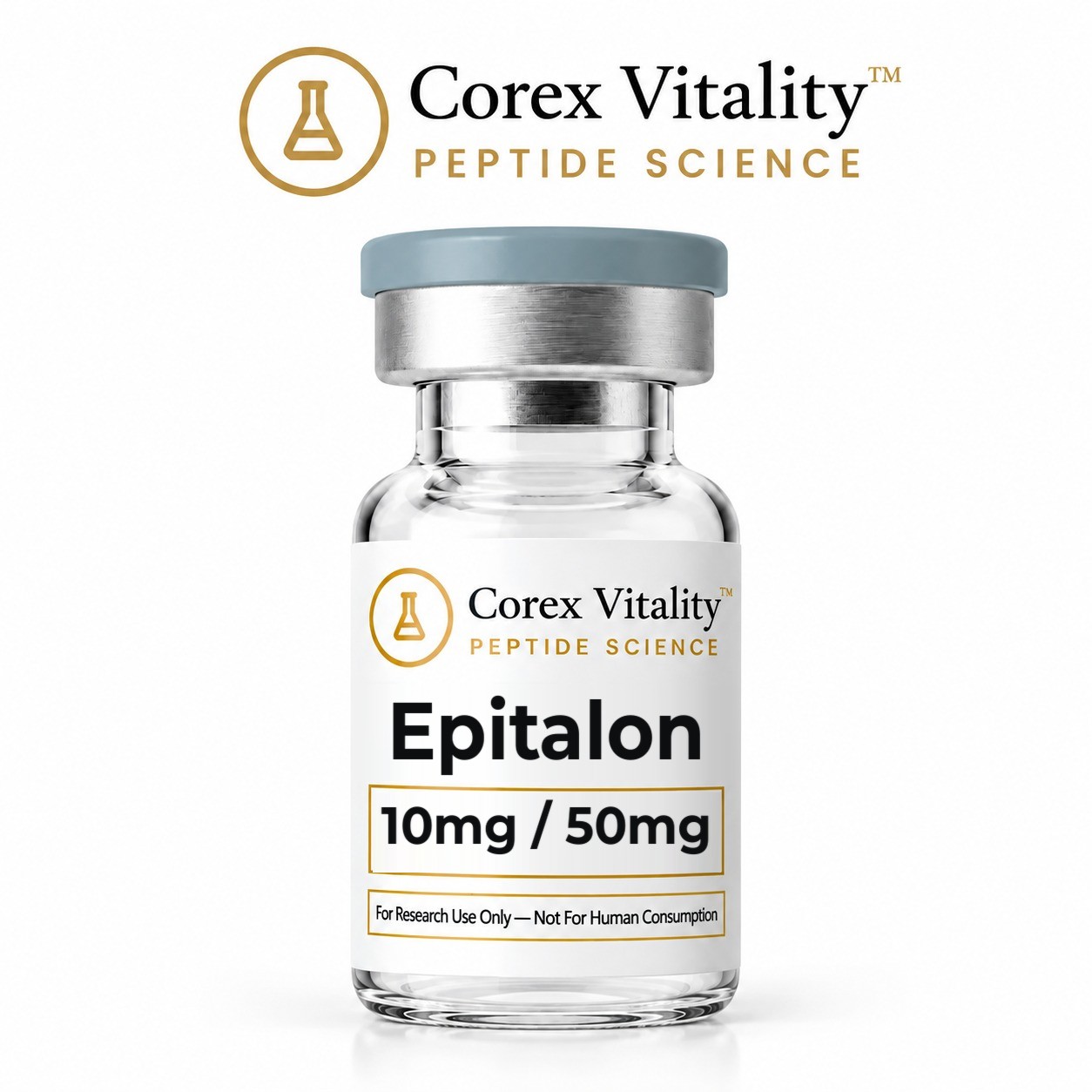
Epitalon (also written Epithalon or Epithalone, and known as AEDG peptide) is a synthetic tetrapeptide with the sequence Ala-Glu-Asp-Gly. It was developed by Khavinson and colleagues in St Petersburg, based on the amino acid composition of epithalamin, a polypeptide extract of the bovine pineal gland [4]. It has the molecular formula C14H22N4O9 and a molecular weight of approximately 390.3 g/mol.
Epitalon has not been approved as a medicine by the MHRA, the FDA or any other regulator. The product sold here is a research compound for laboratory use only. For an overview of the published literature, see our longevity peptides research summary. Related research compounds include MOTS-c, SS-31 and FOXO4-DRI.
Areas of research
Most published research on Epitalon comes from one research group and its collaborators. Published work includes:
- reports of telomerase activity and telomere length in cultured human fetal fibroblasts [1]
- a long-term study in female Swiss-derived SHR mice that recorded biomarkers of ageing, life span and spontaneous tumour incidence [2]
- gene expression and protein synthesis of neurogenic differentiation markers in human gingival mesenchymal stem cells, with molecular modelling of possible binding to histone proteins [3]
- a 2025 review summarising in vitro, in vivo and in silico studies over the past 25 years [4]
Independent replication of many of these findings is limited, and the evidence base remains at an early, largely preclinical stage.
Product specifications
| Form |
Lyophilised (freeze-dried) powder in a sealed vial |
| Sizes |
10mg, 50mg |
| Sequence |
Ala-Glu-Asp-Gly (AEDG) |
| Molecular formula |
C14H22N4O9 |
| Molecular weight |
approx. 390.3 g/mol |
| Purity |
See the COA for your size. |
| Availability |
Made to order: please allow 14–16 days in total, including delivery |
Storage and handling
Storage & Handling — Corex Vitality™ research vials
- As supplied: freeze-dried (lyophilised) powder in a sealed vial. Room-temperature transit is normal for dry peptides.
- Longer storage: keep the vial tightly closed in a freezer at −20 °C or colder, dry and away from light. Colder is better for long archives.
- Short-term: a laboratory fridge (2–8 °C) is fine for vials you plan to open soon.
- Before opening: let the closed vial warm to room temperature, ideally in a desiccator, so moisture does not condense on the powder. Work quickly and reseal tightly; absorbed moisture lowers the real peptide content.
- Dissolving: choose a solvent based on the sequence (see the compound note below) and test a small portion first. Swirl gently; brief sonication in a water bath can help. Do not heat.
- Once in solution: make up only what you need. Split any solution you keep into single-use aliquots, freeze at −20 °C or colder and thaw each aliquot only once. Peptides keep far less well in solution than as dry powder.
- Safety: handle in a suitable laboratory with appropriate PPE, following your institution’s safety procedures, and avoid breathing the powder. Keep out of reach of children.
Compound note: Small acidic tetrapeptide. Usually dissolves in water; a neutral buffer (e.g. PBS) or a trace of dilute aqueous ammonia helps if it is slow.
For in-vitro laboratory research use only. Not for human or veterinary use. General guidance paraphrased from Bachem: Handling and Storage Guidelines for Peptides and Peptide Solubility.
Quality and testing
Epitalon has been tested by third-party analytical laboratories using HPLC. COAs have been issued for both the 10mg and 50mg sizes sold here. You can also browse every published certificate on our COA and verification page.
Research use only
For in-vitro laboratory research use only. Not for human or veterinary use. These products are research chemicals. They are not medicines, food, or supplements. They have not been evaluated by the MHRA, FDA, or any other regulatory body. Not intended to diagnose, treat, cure, or prevent any disease. All descriptions are for reference and research documentation purposes only. By purchasing, you confirm you are aged 18+ and using these products exclusively for in vitro laboratory research.
References
- Khavinson VKh, et al. Epithalon peptide induces telomerase activity and telomere elongation in human somatic cells. Bull Exp Biol Med. 2003. PubMed 12937682
- Anisimov VN, et al. Effect of Epitalon on biomarkers of aging, life span and spontaneous tumor incidence in female Swiss-derived SHR mice. Biogerontology. 2003. PubMed 14501183
- Khavinson V, et al. AEDG peptide (Epitalon) stimulates gene expression and protein synthesis during neurogenesis: possible epigenetic mechanism. Molecules. 2020. PubMed 32019204
- Araj SK, et al. Overview of Epitalon – highly bioactive pineal tetrapeptide with promising properties. Int J Mol Sci. 2025. PubMed 40141333