
NAD+ in ageing research
A literature summary. Summarises published literature for educational purposes.
What is NAD+?
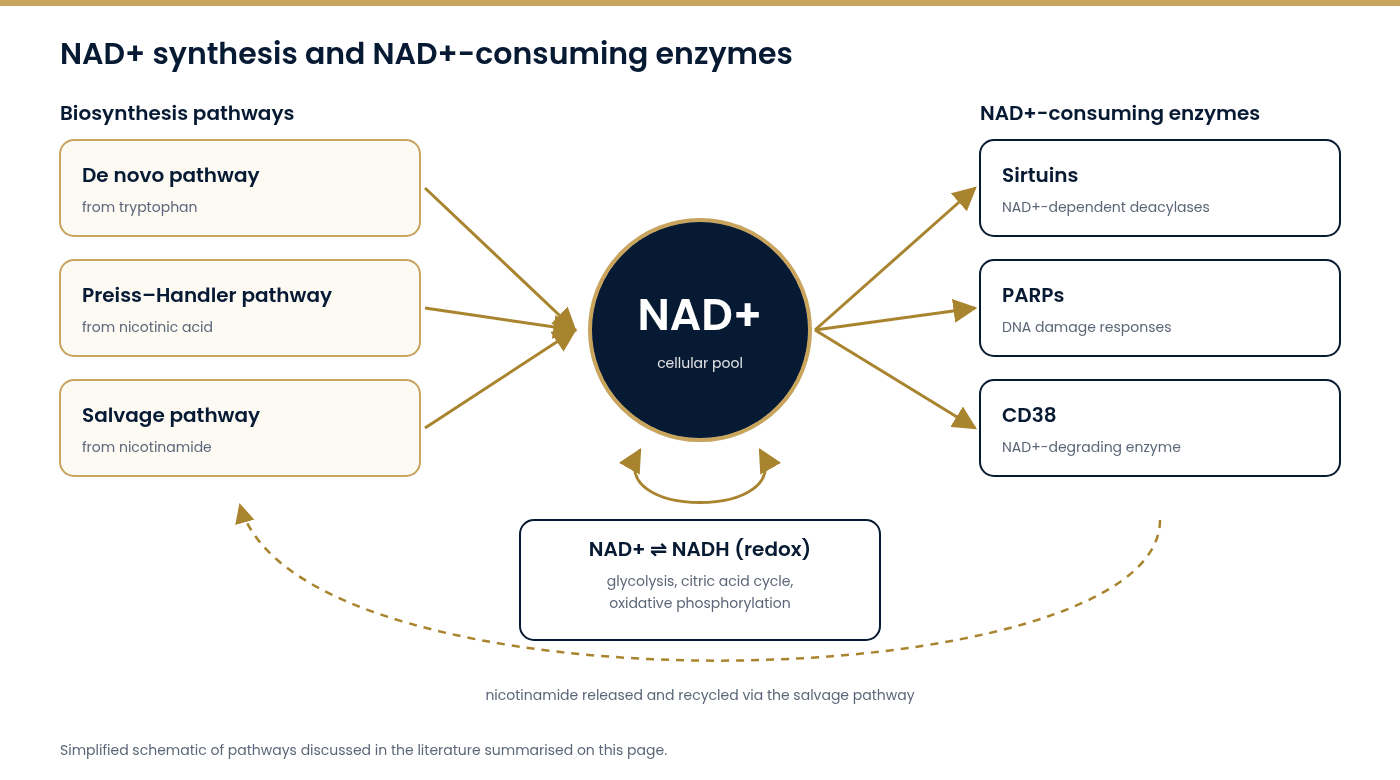
Nicotinamide adenine dinucleotide (NAD) is a coenzyme found in all living cells. It exists in an oxidised form (NAD+) and a reduced form (NADH). NAD+ has two broad roles that are central to its place in ageing research [1,2]:
- Redox reactions. NAD+/NADH carries electrons in metabolic pathways, including glycolysis, the citric acid cycle and mitochondrial oxidative phosphorylation.
- Enzyme substrate. NAD+ is consumed as a substrate by several enzyme families, including the sirtuins (NAD+-dependent deacylases), poly(ADP-ribose) polymerases (PARPs), which are involved in DNA damage responses, and the NAD+-degrading enzyme CD38.
| Property | Detail |
|---|---|
| Full name | Nicotinamide adenine dinucleotide (oxidised form) |
| Molecular formula | C21H27N7O14P2 |
| Molar mass | approx. 663.4 g/mol |
| Form supplied | Lyophilised powder (see product page and COA) |
Reported age-related changes in NAD+
Several studies have reported lower NAD+ levels in older tissue samples or older animals:
- Human tissue samples: in a study of pelvic skin samples from 49 donors aged from newborn to 77, NAD+ levels correlated negatively with age in both males and females. In males, PARP activity increased with age [3]. This was a cross-sectional study in a single tissue.
- Mice: expression and activity of the NAD+-degrading enzyme CD38 were reported to increase with age, and mice lacking CD38 did not show the same age-related NAD+ decline in the tissues studied [4].
- Mice: in ageing mouse muscle, lower NAD+ was linked to a disruption of communication between the nucleus and mitochondria involving SIRT1 and HIF-1α, which the authors described as a “pseudohypoxic” state [5].
Reviews of the field note that the size of the reported decline differs between tissues, species and measurement methods, and that measuring NAD+ accurately is technically demanding [2].
Research areas involving NAD+
| Research area | Why NAD+ is studied | Key reference |
|---|---|---|
| Sirtuin biology | Sirtuins require NAD+ as a co-substrate | Verdin 2015 [1] |
| DNA damage and PARPs | PARP activation consumes NAD+ | Massudi 2012 [3]; Covarrubias 2021 [2] |
| NAD+ degradation (CD38) | CD38 is a major NAD+-consuming enzyme in ageing tissues | Camacho-Pereira 2016 [4] |
| Mitochondrial function | NADH supplies electrons to the respiratory chain | Gomes 2013 [5] |
| NAD+ biosynthesis | Salvage, Preiss–Handler and de novo pathways | Covarrubias 2021 [2] |
Considerations for laboratory work
- NAD+ is sensitive to heat, pH and light in solution. Literature methods typically specify fresh preparation and controlled storage.
- Analytical methods reported for NAD+ quantification include enzymatic cycling assays and LC-MS. The choice of method affects the values reported [2].
- Results from cell and animal models should be interpreted within the limits of those models.
Research material: NAD+
NAD+
Price: 100mg £14.99 · 500mg £44.99 · 1000mg £74.99
Certificate of Analysis: NAD+ 1000mg, report LDA22161142 (Lingda Laboratory, tested 3 September 2026, HPLC purity >99.77%). View certificates on our Verification page
Research use only. This article summarises published scientific literature for educational purposes. It does not describe the effects of any Corex Vitality™ product. NAD+ supplied by Corex Vitality™ is for laboratory research use only and is not intended for human or veterinary use, or for the diagnosis, treatment, prevention or cure of any disease or medical condition.
References
- Verdin E. NAD+ in aging, metabolism, and neurodegeneration. Science. 2015;350(6265):1208-1213. PubMed: https://pubmed.ncbi.nlm.nih.gov/26785480/ · DOI: https://doi.org/10.1126/science.aac4854
- Covarrubias AJ, Perrone R, Grozio A, Verdin E. NAD+ metabolism and its roles in cellular processes during ageing. Nat Rev Mol Cell Biol. 2021;22(2):119-141. PubMed: https://pubmed.ncbi.nlm.nih.gov/33353981/ · DOI: https://doi.org/10.1038/s41580-020-00313-x
- Massudi H, Grant R, Braidy N, Guest J, Farnsworth B, Guillemin GJ. Age-associated changes in oxidative stress and NAD+ metabolism in human tissue. PLoS One. 2012;7(7):e42357. PubMed: https://pubmed.ncbi.nlm.nih.gov/22848760/ · DOI: https://doi.org/10.1371/journal.pone.0042357
- Camacho-Pereira J, Tarragó MG, Chini CCS, et al. CD38 dictates age-related NAD decline and mitochondrial dysfunction through an SIRT3-dependent mechanism. Cell Metab. 2016;23(6):1127-1139. PubMed: https://pubmed.ncbi.nlm.nih.gov/27304511/ · DOI: https://doi.org/10.1016/j.cmet.2016.05.006
- Gomes AP, Price NL, Ling AJY, et al. Declining NAD+ induces a pseudohypoxic state disrupting nuclear-mitochondrial communication during aging. Cell. 2013;155(7):1624-1638. PubMed: https://pubmed.ncbi.nlm.nih.gov/24360282/ · DOI: https://doi.org/10.1016/j.cell.2013.11.037