🚚 Free Tracked 24 on all pens · other orders free over £50, otherwise £5.99 🖊️ Peptide Pens → 🖊️ Retatrutide Pens: 20mg £124.99 · 40mg £159.99 → 🎬 View Peptide Videos → 🔬 New: Senolytics & Longevity Research. Explore the science → 👤 Members save 10% on eligible products. Join free → 🚚 Free Tracked 24 on all pens · other orders free over £50, otherwise £5.99 🖊️ Peptide Pens → 🖊️ Retatrutide Pens: 20mg £124.99 · 40mg £159.99 → 🎬 View Peptide Videos → 🔬 New: Senolytics & Longevity Research. Explore the science → 👤 Members save 10% on eligible products. Join free → 🚚 Free Tracked 24 on all pens · other orders free over £50, otherwise £5.99 🖊️ Peptide Pens → 🖊️ Retatrutide Pens: 20mg £124.99 · 40mg £159.99 → 🎬 View Peptide Videos → 🔬 New: Senolytics & Longevity Research. Explore the science → 👤 Members save 10% on eligible products. Join free →
Science & Quality

The Science Behind Every Batch

What a peptide actually is, how research peptides are made and tested, and how to read a batch certificate of analysis (COA), explained in plain English.

Peptide basics

Small chains, precise chemistry

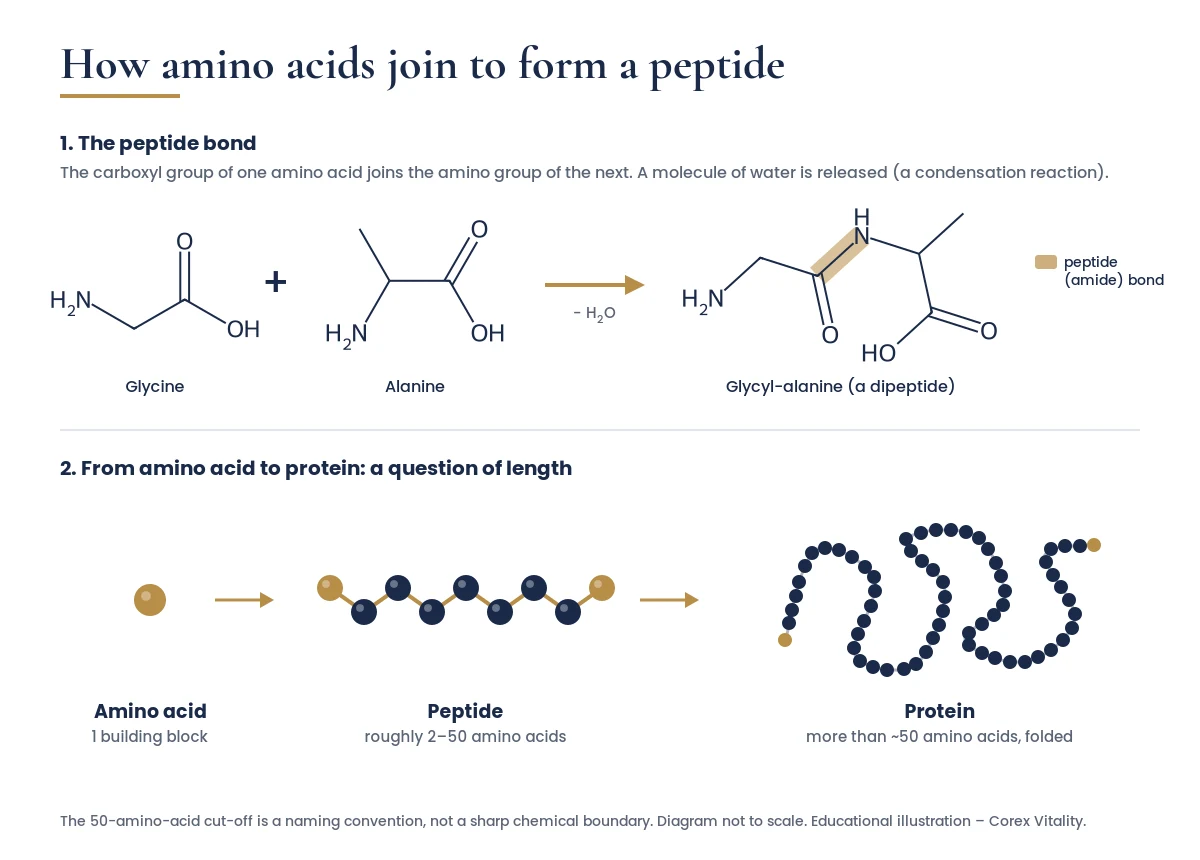
A peptide is a short chain of amino acids. The order of those amino acids (the sequence) defines exactly which molecule it is.

20standard amino acids are encoded by the genetic code. Each has the same backbone (an amino group and a carboxyl group) and a different side chain.
2–50amino acids is the usual size range called a “peptide”. Longer chains, above roughly 50, are generally called proteins. The cut-off is a convention, not a sharp boundary.
1 H2Ois released every time two amino acids join. The link that forms is called a peptide (amide) bond.
Diagram showing glycine and alanine joining through a peptide bond with loss of water, and a scale from single amino acid to peptide to folded protein
How amino acids join: the carboxyl group of one reacts with the amino group of the next. What remains of each amino acid in the chain is called a residue.

How big is a peptide?

MoleculeAmino acidsType
Glutathione3Tripeptide
Leu-enkephalin (Tyr-Gly-Gly-Phe-Leu)5Pentapeptide
BPC-15715Peptide, about 1,419.5 Da
Ribonuclease A124Protein (an enzyme)

BPC-157 sequence: Gly-Glu-Pro-Pro-Pro-Gly-Lys-Pro-Ala-Asp-Asp-Ala-Gly-Leu-Val (15 residues).

Why peptides are supplied as a dry powder

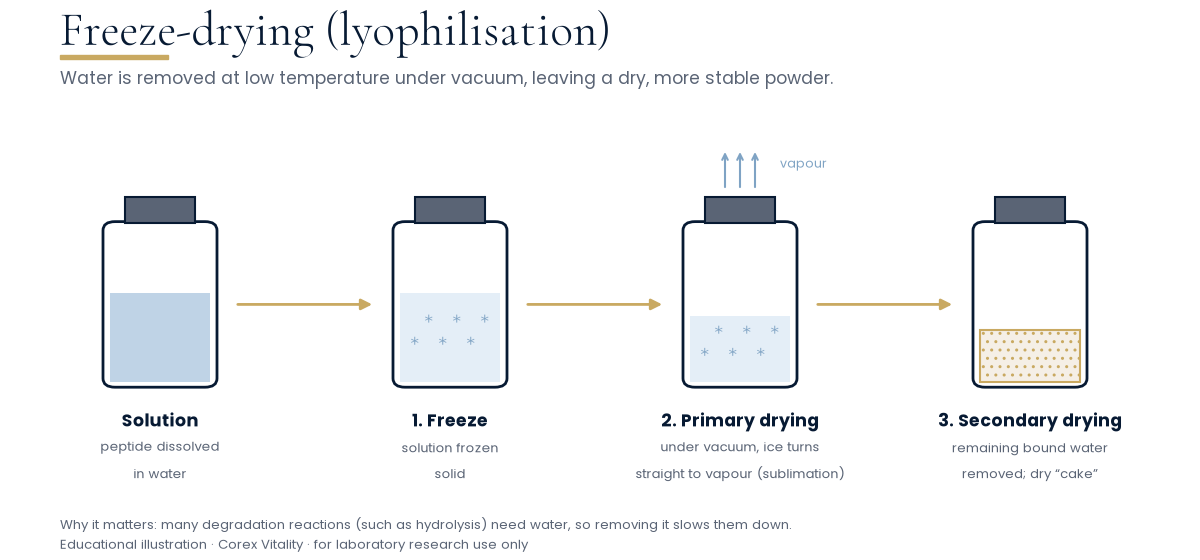
Research peptides are usually supplied lyophilised (freeze-dried). The peptide solution is frozen, then placed under vacuum so the ice turns straight into vapour (sublimation), and a second drying stage removes most of the remaining bound water.

Water takes part in many of the reactions that break peptides down, such as hydrolysis. Removing it slows those reactions considerably, which is why a freeze-dried powder generally keeps far better than a solution.

Read the full guide: What Are Peptides? →

Four-stage diagram of freeze-drying: solution, frozen, primary drying by sublimation under vacuum, secondary drying to a dry cake
Freeze-drying in three stages.
From synthesis to certificate

How research peptides are made and tested

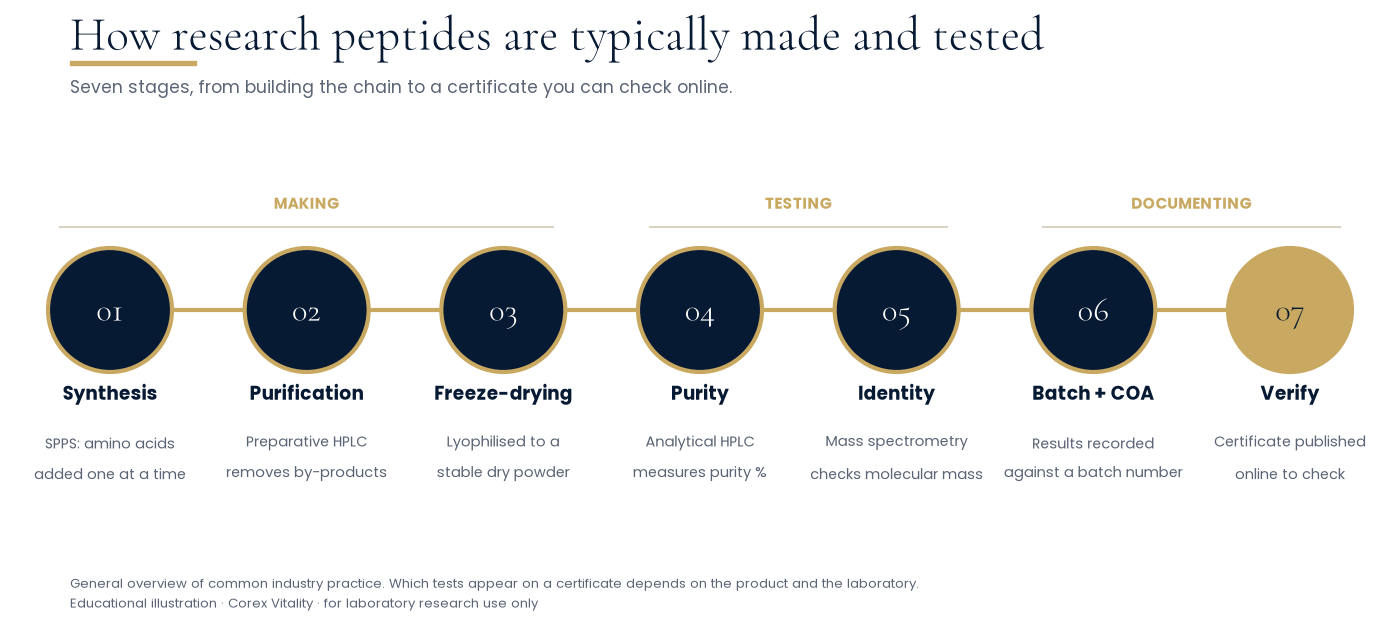
This is how research peptides are typically produced and checked across the industry. Every Corex Vitality™ batch is tested by a third-party laboratory, and its Certificate of Analysis is published for you to check.

Timeline of seven stages: synthesis, purification, freeze-drying, purity testing by HPLC, identity by mass spectrometry, batch number and COA, verify online
  1. 01

    Synthesis

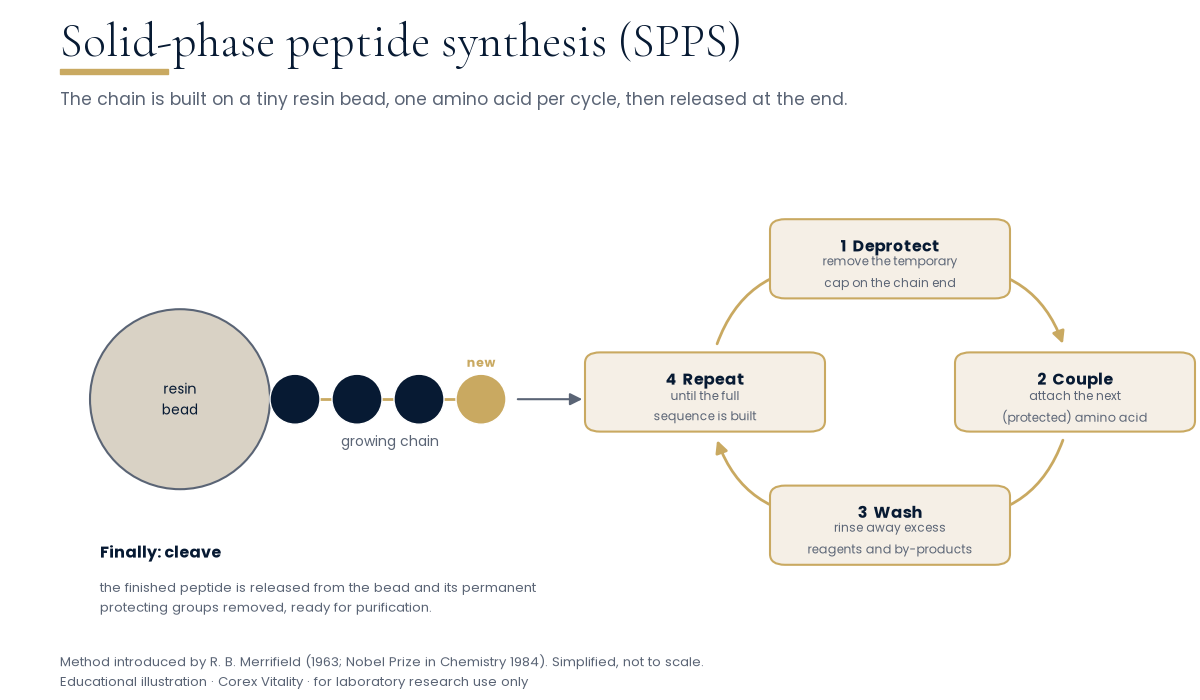
    Most research peptides are made by solid-phase peptide synthesis (SPPS). The first amino acid is anchored to a tiny resin bead, then each next amino acid is added one at a time: unblock the end of the chain, attach the next amino acid, wash away everything that did not attach, repeat. At the end the finished chain is cut free from the bead.

    FactThe method was introduced by R. Bruce Merrifield in 1963 and earned him the 1984 Nobel Prize in Chemistry.

  2. 02

    Purification

    No chemical step is perfect. If each coupling worked 99% of the time, only about 86% of 15-residue chains would come out full length; at 99.5% it is about 93%. The rest are close relatives, for example chains missing one amino acid. Preparative HPLC separates the target peptide from these by-products.

  3. 03

    Freeze-drying

    The purified peptide is lyophilised into a dry powder (the white “cake” you see in a vial), which is more stable for storage and transport.

  4. 04

    Purity: analytical HPLC

    A small sample is run through an analytical HPLC system. The result is a chromatogram, and the purity figure is the share of the main peak. See how to read one ↓

  5. 05

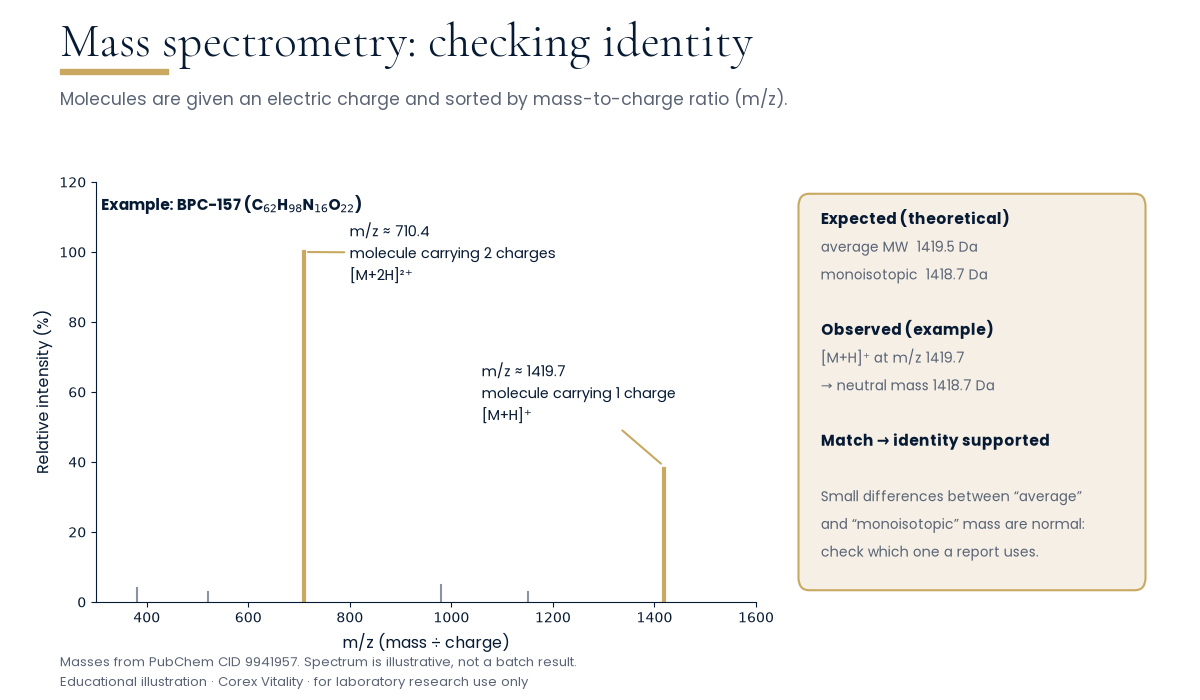
    Identity: mass spectrometry

    Mass spectrometry measures the mass of the molecule and compares it with the mass expected from its formula. This confirms it is the right peptide. It appears on a certificate only where the lab has run it: most of our published COAs report HPLC purity and quantity, and the MOTS-c 10mg COA also includes LC-MS identity. How it works ↓

  6. 06

    Batch number and certificate

    Results are recorded against a batch (lot) number on a Certificate of Analysis. Depending on the test, a certificate may also report results such as heavy metals, endotoxin or sterility.

  7. 07

    Verify online

    Match the batch number on your vial to its certificate on our verification page.

Diagram of solid-phase peptide synthesis: a chain growing on a resin bead through a repeating cycle of deprotect, couple, wash and repeat, then cleavage
The SPPS cycle repeats once for every amino acid in the sequence.
Analytical science

Reading an HPLC chromatogram

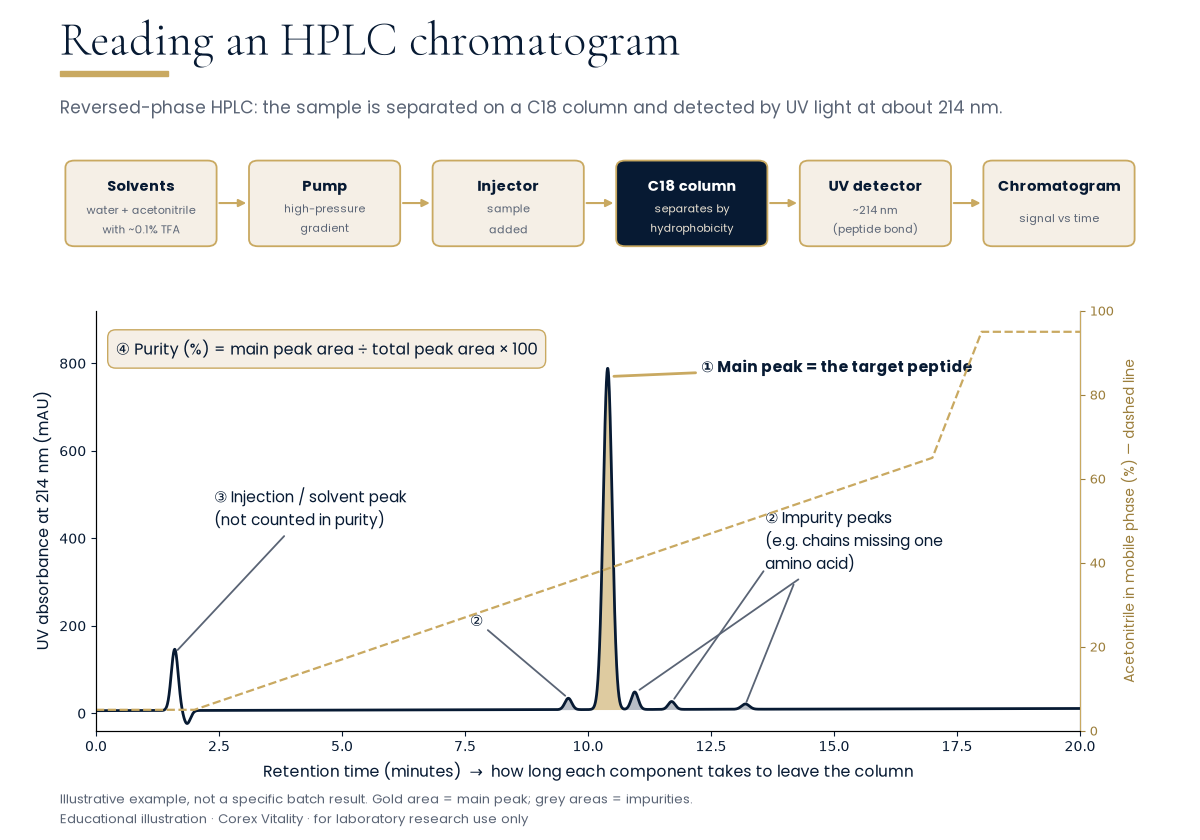
High-performance liquid chromatography (HPLC) separates a sample into its components so each one can be measured.

Annotated HPLC chromatogram showing a large main peak, small impurity peaks, an injection peak, retention time on the horizontal axis, UV absorbance at 214 nm on the vertical axis and the purity formula
Illustrative example, not a specific batch result.
1

The column

Peptides are usually analysed by reversed-phase HPLC on a C18 column, which has a water-repelling (hydrophobic) surface. The more hydrophobic a molecule, the longer it is held back.

2

The gradient

The liquid pumped through starts as mostly water and gradually becomes mostly acetonitrile. A little trifluoroacetic acid (TFA), typically about 0.1%, is added to give sharp, well-shaped peaks.

3

The detector

As each component leaves the column it passes a UV detector set to about 214–220 nm, a wavelength the peptide bond absorbs strongly, so every peptide-related component shows up.

Purity (%) = main peak area ÷ total peak area × 100. The x-axis is retention time (how long a component takes to leave the column) and the y-axis is UV absorbance. Peaks from the injection or solvent are not counted. Reversed-phase HPLC is sensitive enough to separate peptides that differ by a single amino acid.
Certificate of Analysis

How to read a COA

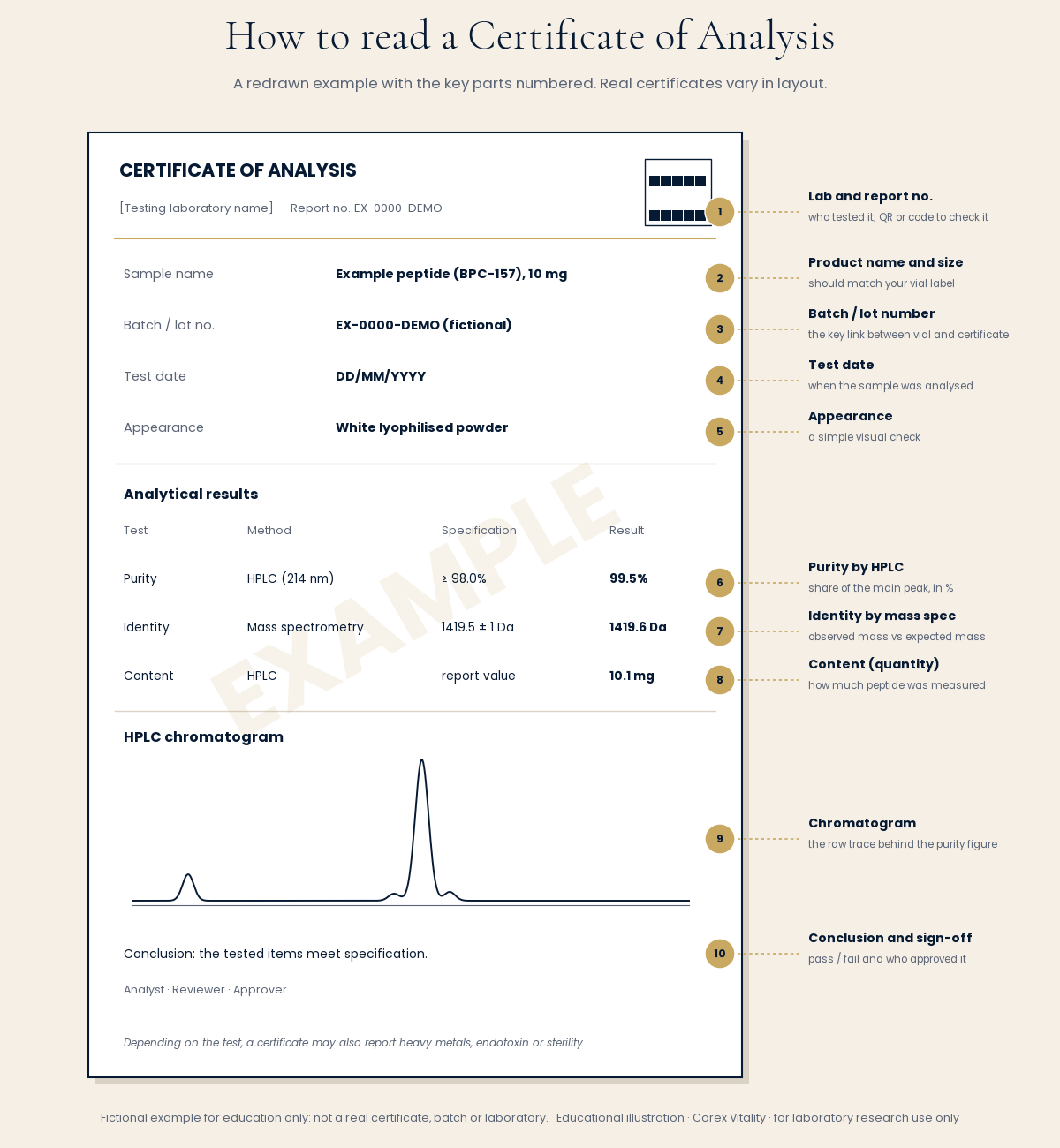
A Certificate of Analysis (COA) is the record of what was tested on a specific batch, how it was tested and what was found. The example below is redrawn and fictional, to show where each piece of information usually sits.

Fictional example Certificate of Analysis marked EXAMPLE, with numbered callouts for laboratory and report number, product, batch number, test date, appearance, HPLC purity, mass spectrometry identity, content, chromatogram and conclusion
Fictional example for education only. It is not a real certificate, batch or laboratory.
  1. Report number and laboratory: who tested it, often with a code to check the report.
  2. Product name and size: should match your vial label.
  3. Batch / lot number: the link between your vial and this certificate.
  4. Test date: when the sample was analysed.
  5. Appearance: a simple visual check, for example “white lyophilised powder”.
  6. Purity (HPLC %): the share of the main peak.
  7. Identity (MS): observed mass against expected mass, where reported.
  8. Content: how much peptide was measured, where reported.
  9. Chromatogram: the trace behind the purity figure.
  10. Conclusion and sign-off: whether results meet specification, and who approved them.
Depending on the test, a certificate may also report results such as heavy metals, endotoxin or sterility.

Find the COA for your batch →

Glossary

Key terms, explained

Full glossary →

Amino acid
The building block of peptides and proteins: an amino group, a carboxyl group and a side chain that gives each one its character.
Peptide bond
The amide link formed when the carboxyl group of one amino acid joins the amino group of the next, releasing a molecule of water.
Residue
What remains of an amino acid once it is part of a chain. A 15-residue peptide is made of 15 amino acids.
Lyophilised
Freeze-dried: frozen, then dried under vacuum so the ice turns straight to vapour, leaving a stable dry powder.
HPLC
High-performance liquid chromatography. A technique that separates the components of a sample so each can be measured; used to determine purity.
Retention time
How long a component takes to travel through the HPLC column and reach the detector. It is shown on the horizontal axis of a chromatogram.
Mass spectrometry (MS)
A technique that measures the mass-to-charge ratio of charged molecules; used to confirm a molecule’s identity from its mass.
Dalton (Da)
The unit of molecular mass: one twelfth of the mass of a carbon-12 atom. BPC-157 is about 1,419.5 Da.
Purity
The proportion of the material that is the target peptide, usually given as a percentage of the total HPLC peak area.
Batch / lot
A quantity produced and tested together, identified by one number that links each vial to its certificate.
COA
Certificate of Analysis: the document that records the tests carried out on a batch, the methods used and the results.
Bacteriostatic water
Sterile water containing a preservative, commonly 0.9% benzyl alcohol, which inhibits bacterial growth. Used in the laboratory as a diluent.

Research Use Notice

Corex Vitality™ products are supplied for laboratory research purposes only and are not intended for human or veterinary use, diagnosis, treatment, prevention or cure of any disease or medical condition. Information on this page is general scientific education and does not describe any product’s effects.

Reading a COA: How to verify a peptide COA
Cover of the free guide: How to read a COA

Free guide

How to read a COA

Get it by email, plus our research updates. No spam, unsubscribe any time.

We will email you to confirm first, then send the guide. We use your name and email only to send you these emails. Privacy policy. For laboratory research use only.

Listed on PepmarketVerified on PeptideReview