About BPC-157
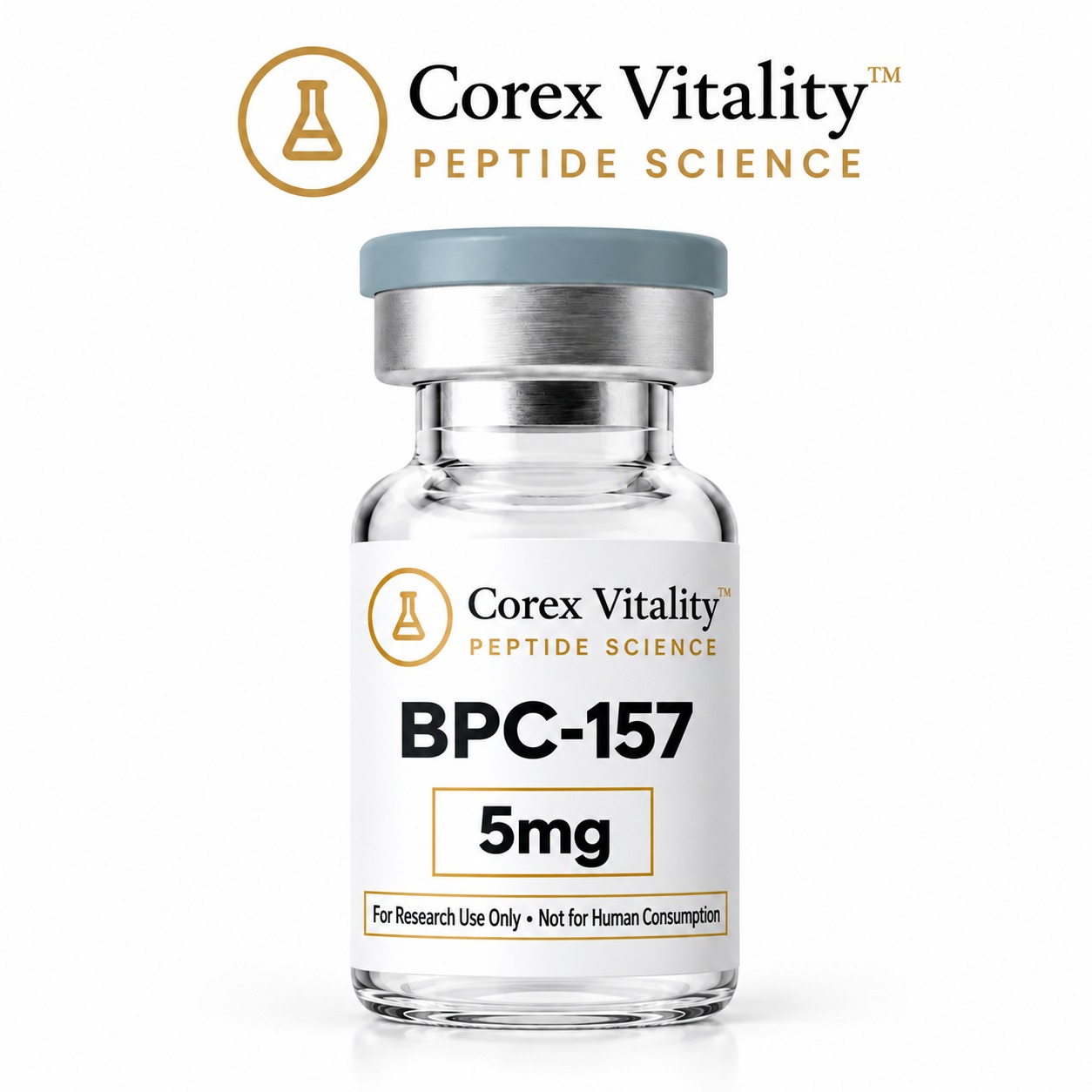
BPC-157 (Body Protection Compound-157) is a synthetic pentadecapeptide, a chain of 15 amino acids with the sequence Gly-Glu-Pro-Pro-Pro-Gly-Lys-Pro-Ala-Asp-Asp-Ala-Gly-Leu-Val (GEPPPGKPADDAGLV). Its sequence is derived from a protein found in human gastric juice. It has the molecular formula C62H98N16O22 and a molecular weight of approximately 1419.5 g/mol.
Related research compounds: TB-500, a synthetic peptide related to thymosin beta-4, and the TB-500 + BPC-157 Blend, which pairs one vial of each peptide.
Areas of research
Most published work on BPC-157 comes from preclinical studies in cell culture and animal models, much of it from a single research group at the University of Zagreb. Researchers have investigated:
- its activity in models of the gastrointestinal tract and the brain–gut axis [1]
- its interaction with angiogenic growth factor pathways [2]
- tendon cell outgrowth, survival and migration in laboratory and rat tendon models [3]
- muscle, tendon, ligament and bone injury models, as summarised in a 2025 systematic review [4]
That review identified 35 preclinical studies and only one clinical study, and found no clinical safety data in humans [4]. The evidence base therefore remains at an early, largely preclinical stage.
Product specifications
| Form |
Lyophilised (freeze-dried) powder in a sealed vial |
| Sizes |
2mg, 5mg, 10mg, 20mg |
| Sequence |
GEPPPGKPADDAGLV (15 amino acids) |
| Molecular formula |
C62H98N16O22 |
| Molecular weight |
approx. 1419.5 g/mol |
| Purity |
COAs are published for the 5mg and 10mg batches. The current 5mg COA reports HPLC purity of >99.6% and the 10mg COA >99.7%. |
Storage and handling
Storage & Handling — Corex Vitality™ research vials
- As supplied: freeze-dried (lyophilised) powder in a sealed vial. Room-temperature transit is normal for dry peptides.
- Longer storage: keep the vial tightly closed in a freezer at −20 °C or colder, dry and away from light. Colder is better for long archives.
- Short-term: a laboratory fridge (2–8 °C) is fine for vials you plan to open soon.
- Before opening: let the closed vial warm to room temperature, ideally in a desiccator, so moisture does not condense on the powder. Work quickly and reseal tightly; absorbed moisture lowers the real peptide content.
- Dissolving: choose a solvent based on the sequence (see the compound note below) and test a small portion first. Swirl gently; brief sonication in a water bath can help. Do not heat.
- Once in solution: make up only what you need. Split any solution you keep into single-use aliquots, freeze at −20 °C or colder and thaw each aliquot only once. Peptides keep far less well in solution than as dry powder.
- Safety: handle in a suitable laboratory with appropriate PPE, following your institution’s safety procedures, and avoid breathing the powder. Keep out of reach of children.
Compound note: Contains no Cys, Met or Trp. Overall slightly acidic: if it is slow to dissolve in water, a buffer around neutral pH (e.g. PBS, up to about 1 mg/mL) or a trace of dilute aqueous ammonia before dilution is the usual next step.
For in-vitro laboratory research use only. Not for human or veterinary use. General guidance paraphrased from Bachem: Handling and Storage Guidelines for Peptides and Peptide Solubility.
Quality and testing
BPC-157 has been tested by third-party analytical laboratories using HPLC. COAs are published for the 5mg batch (LDA22162336) and the 10mg batch (LDA22161152); no separate COA has been issued for the 2mg or 20mg sizes. You can also browse every published certificate on our COA and verification page.
Research use only
For in-vitro laboratory research use only. Not for human or veterinary use. These products are research chemicals. They are not medicines, food, or supplements. They have not been evaluated by the MHRA, FDA, or any other regulatory body. Not intended to diagnose, treat, cure, or prevent any disease. All descriptions are for reference and research documentation purposes only. By purchasing, you confirm you are aged 18+ and using these products exclusively for in vitro laboratory research.
References
- Sikiric P, et al. Brain-gut axis and pentadecapeptide BPC 157: theoretical and practical implications. Curr Neuropharmacol. 2016. PubMed 27138887
- Seiwerth S, et al. BPC 157 and standard angiogenic growth factors. Gastrointestinal tract repair, lessons from tendon, ligament, muscle and bone repair. Curr Pharm Des. 2018. PubMed 29998800
- Chang CH, et al. The promoting effect of pentadecapeptide BPC 157 on tendon repair involves tendon outgrowth, cell survival, and cell migration. J Appl Physiol. 2011. PubMed 21030672
- Vasireddi N, et al. Emerging use of BPC-157 in orthopaedic sports medicine: a systematic review. HSS J. 2025. PubMed 40756949