About Ipamorelin
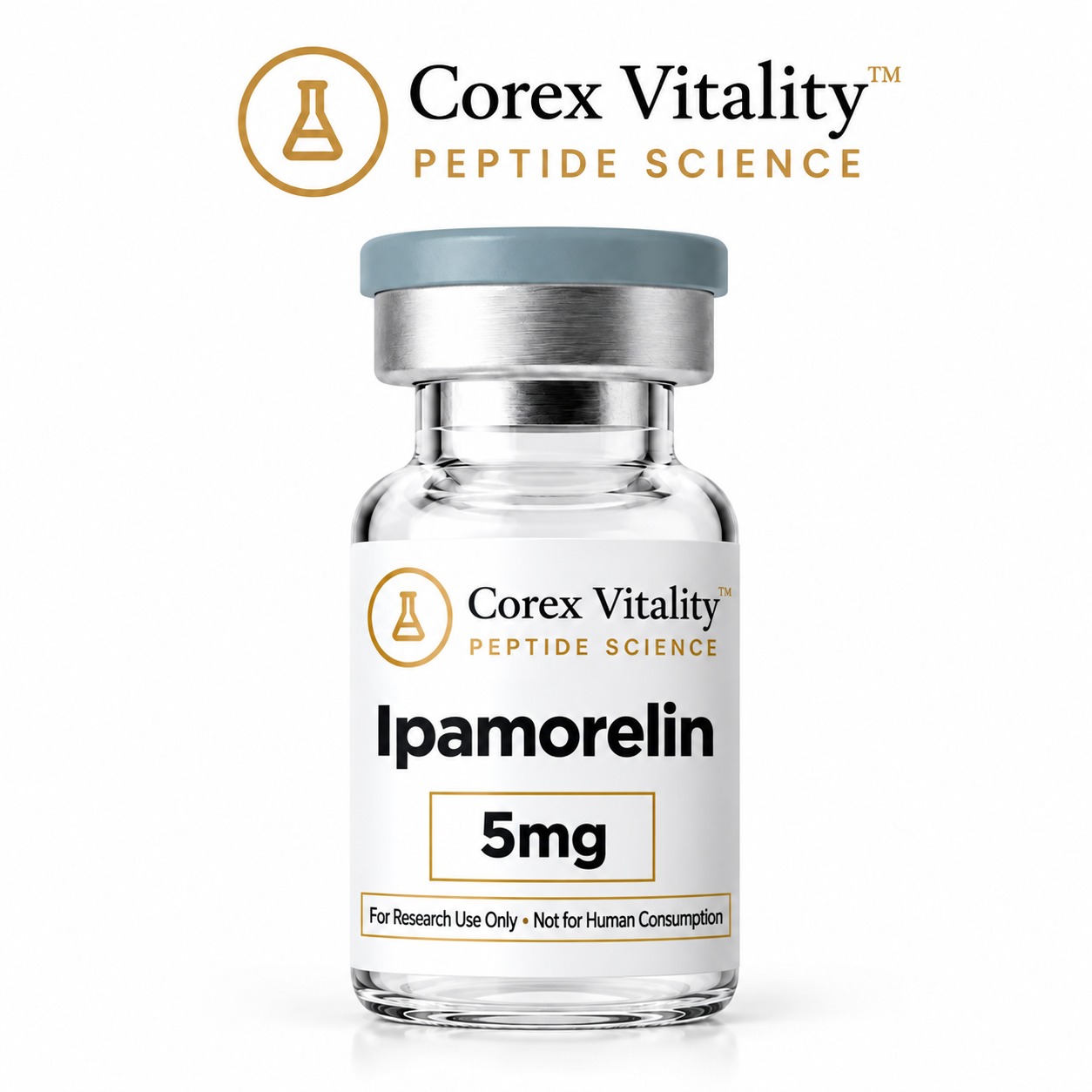
Ipamorelin is a synthetic pentapeptide, a chain of five amino acids with the sequence Aib-His-D-2-Nal-D-Phe-Lys-NH2. It includes non-standard amino acids: Aib (α-aminoisobutyric acid) and D-2-Nal (3-(2-naphthyl)-D-alanine). It belongs to a class of compounds known as growth hormone secretagogues, which act at the ghrelin (growth hormone secretagogue) receptor to stimulate growth hormone release from the pituitary gland [1]. It has the molecular formula C38H49N9O5 and a molecular weight of approximately 711.9 g/mol.
Ipamorelin has not been approved as a medicine by the MHRA, the FDA or any other regulator. The product sold here is a research compound for laboratory use only.
Related research compound: CJC-1295 (DAC-free), a synthetic analogue of growth hormone-releasing hormone (GHRH) that acts at a different receptor from Ipamorelin.
Areas of research
Ipamorelin was first described in 1998. Published research includes:
- its original pharmacological characterisation in rat pituitary cells, rats and pigs, where it was reported to be selective for growth hormone release, with no significant effect on ACTH or cortisol under the conditions tested [1]
- bone growth measurements in a 15-day study in adult female rats [2]
- a pharmacokinetic and pharmacodynamic modelling study in healthy male volunteers [3]
- a small phase 2 proof-of-concept trial in postoperative ileus, which found no significant difference from placebo on its efficacy endpoints [4]
Most published work on ipamorelin is preclinical, and the clinical data are limited to small early-phase studies. They are cited here for scientific background only.
Product specifications
| Form |
Lyophilised (freeze-dried) powder in a sealed vial |
| Sizes |
2mg, 5mg, 10mg |
| Sequence |
Aib-His-D-2-Nal-D-Phe-Lys-NH2 (5 amino acids) |
| Molecular formula |
C38H49N9O5 |
| Molecular weight |
approx. 711.9 g/mol |
| Purity |
COA shown is for the 10mg batch. The current 10mg COA reports HPLC purity of >99.7%. |
Storage and handling
Storage & Handling — Corex Vitality™ research vials
- As supplied: freeze-dried (lyophilised) powder in a sealed vial. Room-temperature transit is normal for dry peptides.
- Longer storage: keep the vial tightly closed in a freezer at −20 °C or colder, dry and away from light. Colder is better for long archives.
- Short-term: a laboratory fridge (2–8 °C) is fine for vials you plan to open soon.
- Before opening: let the closed vial warm to room temperature, ideally in a desiccator, so moisture does not condense on the powder. Work quickly and reseal tightly; absorbed moisture lowers the real peptide content.
- Dissolving: choose a solvent based on the sequence (see the compound note below) and test a small portion first. Swirl gently; brief sonication in a water bath can help. Do not heat.
- Once in solution: make up only what you need. Split any solution you keep into single-use aliquots, freeze at −20 °C or colder and thaw each aliquot only once. Peptides keep far less well in solution than as dry powder.
- Safety: handle in a suitable laboratory with appropriate PPE, following your institution’s safety procedures, and avoid breathing the powder. Keep out of reach of children.
Compound note: Basic pentapeptide with bulky aromatic residues. Usually water-friendly; a trace of dilute acetic acid helps if it is slow.
For in-vitro laboratory research use only. Not for human or veterinary use. General guidance paraphrased from Bachem: Handling and Storage Guidelines for Peptides and Peptide Solubility.
Quality and testing
Ipamorelin batches we sell have a published third-party HPLC Certificate of Analysis. On Lingda reports the Client is the manufacturer/supplier; we publish the file exactly as issued. The COA shown is for the 10mg batch; no separate COA has been issued for the 5mg size. For the 2mg size, the COA is published when this batch arrives. You can also browse every published certificate on our COA and verification page.
Ipamorelin identity and batch questions
What do “Aib” and “D-2-Nal” mean in the sequence?
They are non-standard amino acids. Aib is α-aminoisobutyric acid and D-2-Nal is 3-(2-naphthyl)-D-alanine. They are part of the five-residue sequence Aib-His-D-2-Nal-D-Phe-Lys-NH2 shown in the specifications table.
Is Ipamorelin the same compound as CJC-1295?
No. They are separate synthetic peptides with different sequences, and they act at different receptors. Each has its own listing and certificate. See CJC-1295 (DAC-free).
Does the 10mg certificate also cover the 5mg size?
No. The COA shown is for the 10mg batch, and no separate COA has been issued for the 5mg size. A certificate describes only the batch that was tested. Match your batch identifier on our verification page.
For laboratory research use only. Not for human consumption.
Research use only
For in-vitro laboratory research use only. Not for human or veterinary use. These products are research chemicals. They are not medicines, food, or supplements. They have not been evaluated by the MHRA, FDA, or any other regulatory body. Not intended to diagnose, treat, cure, or prevent any disease. All descriptions are for reference and research documentation purposes only. By purchasing, you confirm you are aged 18+ and using these products exclusively for in vitro laboratory research.
Related reading
References
- Raun K, et al. Ipamorelin, the first selective growth hormone secretagogue. Eur J Endocrinol. 1998. PubMed 9849822
- Johansen PB, et al. Ipamorelin, a new growth-hormone-releasing peptide, induces longitudinal bone growth in rats. Growth Horm IGF Res. 1999. PubMed 10373343
- Gobburu JV, et al. Pharmacokinetic-pharmacodynamic modeling of ipamorelin, a growth hormone releasing peptide, in human volunteers. Pharm Res. 1999. PubMed 10496658
- Beck DE, et al. Prospective, randomized, controlled, proof-of-concept study of the ghrelin mimetic ipamorelin for the management of postoperative ileus in experimental study cohorts. Int J Colorectal Dis. 2014. PubMed 25331030



Reviews
There are no reviews yet.