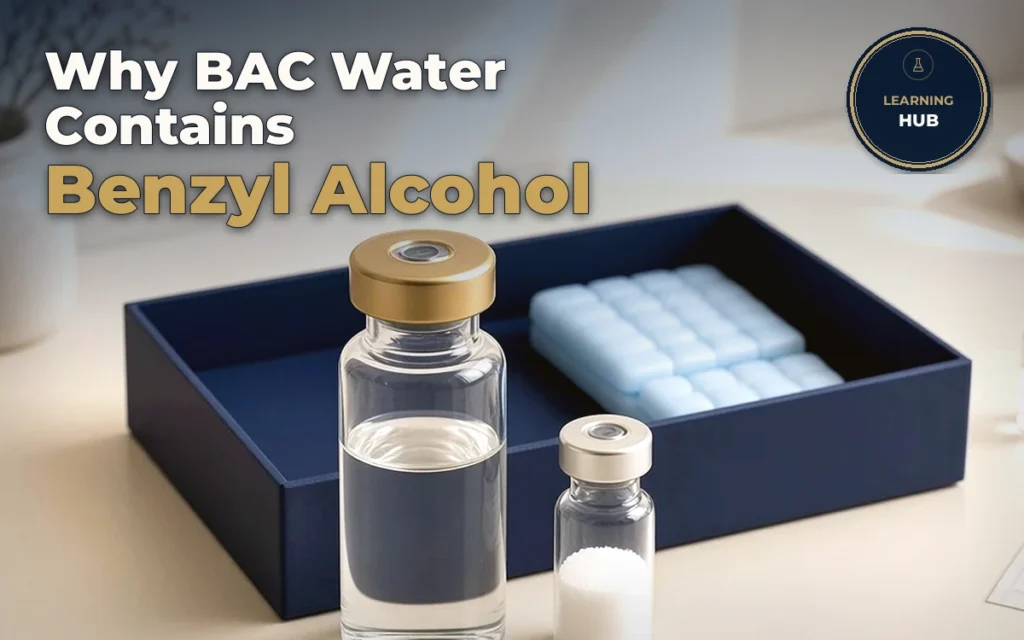
Benzyl Alcohol in Bacteriostatic Water: What It Is and Why It’s There
Benzyl Alcohol in Bacteriostatic Water: What It Is and Why It’s There
By the Corex Vitality™ Research Team · Last checked 9 November 2026 · Sources listed under Published Research
Quick summary
Benzyl alcohol is a simple aromatic alcohol, C6H5CH2OH (C7H8O, approx. 108.14 g/mol).
In bacteriostatic water (BAC water) it is the preservative, usually at 0.9% (9 mg in each mL).
It slows the growth of many bacteria. It does not sterilise a solution.
That preservative is the only difference between bacteriostatic water and sterile water.
Benzyl alcohol is the one ingredient that turns sterile water into bacteriostatic water. This guide explains what the molecule is, why it is there, how bacteriostatic water compares with sterile water, and what to check on a specification sheet. For product details, see our bacteriostatic water (BAC water) page.
1. What benzyl alcohol is
Structure: a benzene ring with one CH2OH (hydroxymethyl) group attached. That is why it is called an aromatic alcohol.
Formula and mass: C7H8O, approx. 108.14 g/mol.
Appearance: a colourless liquid with a faint, sweet smell. It boils at about 205 °C and has a density of about 1.04 g/mL.
In water: it is moderately soluble (roughly 4 g per 100 mL at room temperature), so a 0.9% solution is fully dissolved and clear.
Where it comes from: it occurs naturally in some plant oils and is also made industrially.
2. Why it slows bacterial growth
Part of the benzyl alcohol molecule likes water (the OH group) and part likes oil (the benzene ring). This lets it move into the fatty membranes of bacterial cells and disturb them. At 0.9% that is enough to hold back the growth of many common bacteria. This is what bacteriostatic means: it stops growth. It is not the same as bactericidal (killing all bacteria) or sterile (no living organisms at all). Some organisms and spores are less affected, so careful, clean handling still matters.
Benzyl alcohol also slowly reacts with oxygen in air to form benzaldehyde. This is one reason the liquid is kept in sealed containers, and why analytical labs check for benzaldehyde when testing stored material.
3. Bacteriostatic water vs sterile water
Property
Bacteriostatic water
Sterile water
Contents
Sterile water + 0.9% benzyl alcohol
Sterile water only
Preservative
Yes (benzyl alcohol)
None
After first opening
Can be kept for the in-use period on the label
Usually used once, then discarded
Compatibility
Not suitable for every compound or assay
Used where a preservative-free diluent is needed
Typical lab role
Preserved aqueous diluent for lyophilised research materials
Preservative-free diluent, e.g. for preservative-sensitive cell assays
Why compatibility matters: formulation studies show that antimicrobial preservatives, including benzyl alcohol, can encourage some proteins to partly unfold and clump together (aggregate) in solution [1, 2]. One study found that benzyl alcohol binds weakly to a model protein and shifts it towards partly unfolded, aggregation-prone forms [3]. A comparison of five common preservatives placed benzyl alcohol in the middle of the range (m-cresol > phenol > benzyl alcohol > phenoxyethanol > chlorobutanol) [2]. Short peptides behave differently from large proteins, but the lesson for the lab is the same: check that your diluent suits your material and method.
4. What to check on a BAC water spec sheet or COA
Composition: benzyl alcohol content (0.9% w/v) and the grade of water.
Lot (batch) number: it should match the vial label.
Dates: date of manufacture and expiry date.
Sterility: the sterility test result, plus endotoxin results where reported.
Container: sealed vial, fill volume (for example 3 ml or 10 ml).
Appearance: clear and colourless, with no visible particles.
Keep vials sealed, at room temperature and away from light, unless the label says otherwise.
Keep the vial closed between withdrawals and use aseptic technique.
After first opening, follow the in-use period on the label. Discard the vial if the liquid becomes cloudy or discoloured.
Watch contact with plastics: one study found some flexible tubing (silicone most of all) absorbed a large share of benzyl alcohol within hours, while fluoropolymer tubing absorbed none [4].
Is benzyl alcohol the same as the alcohol in hand gel?
No. Hand gels mostly use ethanol or isopropanol. “Alcohol” is a chemical family (molecules with an OH group). Benzyl alcohol has a benzene ring, and at 0.9% it works as a preservative, not as a disinfectant.
Why 0.9%?
Pharmacopoeia standards for bacteriostatic water set benzyl alcohol at 0.9% w/v, which is 9 mg in each mL. At this level it holds back bacterial growth and stays fully dissolved.
Does BAC water expire?
Yes. Each vial has an expiry date. Once opened, use it within the in-use period on the label, then discard it.
Key takeaways
Benzyl alcohol (C7H8O) is the preservative that makes water “bacteriostatic”, usually at 0.9%.
It slows bacterial growth by disturbing cell membranes. It does not sterilise.
Preservatives can affect some proteins, so match the diluent to your material and method.
Check concentration, lot, expiry and sterility on the spec sheet, and store vials sealed.
The peer-reviewed papers below were used for the science in this article. Each entry was checked against PubMed on 9 November 2026. Summaries describe chemistry, laboratory and cell-based findings only. Corex Vitality™ is not affiliated with the cited authors, journals or institutions.
Antimicrobial Preservatives for Protein and Peptide Formulations: An Overview. Stroppel L, Schultz-Fademrecht T, Cebulla M, et al. Pharmaceutics. 2023;15(2):563. PMID: 36839885 · DOI: 10.3390/pharmaceutics15020563 Review of antimicrobial preservatives used in protein and peptide products: which ones are used, their physical and chemical properties, compatibility with other ingredients and packaging, and how they interact with the active molecule.
Effect of antimicrobial preservatives on partial protein unfolding and aggregation. Hutchings RL, Singh SM, Cabello-Villegas J, et al. J Pharm Sci. 2013;102(2):365-76. PMID: 23169345 · DOI: 10.1002/jps.23362 Compared five preservatives on a model protein (cytochrome c). All increased partial unfolding and aggregation, in the order m-cresol > phenol > benzyl alcohol > phenoxyethanol > chlorobutanol.
Mechanism for benzyl alcohol-induced aggregation of recombinant human interleukin-1 receptor antagonist in aqueous solution. Zhang Y, Roy S, Jones LS, et al. J Pharm Sci. 2004;93(12):3076-89. PMID: 15514986 · DOI: 10.1002/jps.20219 Showed that benzyl alcohol interacts weakly with a model protein and shifts the population towards partly unfolded, aggregation-prone forms, which then clump together in solution.
Spalling and sorption of tubing for peristaltic pumps. Bahal SM, Romansky JM. Pharm Dev Technol. 2002;7(3):317-23. PMID: 12229263 · DOI: 10.1081/pdt-120005728 Compared flexible pump tubing for sorption of preservatives including benzyl alcohol. Silicone and PVC absorbed a large share; a fluoropolymer composite tubing absorbed none over 72 hours.
All Corex Vitality™ products are supplied strictly for in-vitro laboratory research use only. Not for human or veterinary use. No information here describes use in humans or animals.
Get it by email, plus our research updates. No spam, unsubscribe any time.
Help · Research use only
Chat questions stay on our website so we can answer them. We do not use them for marketing. We only keep unanswered questions (the question text, not your name or email) for a short weekly review. If you want a personal reply, email info@corexvitality.com.
Manage Consent
To provide the best experiences, we use technologies like cookies to store and/or access device information. Consenting to these technologies will allow us to process data such as browsing behaviour or unique IDs on this site. Not consenting or withdrawing consent may adversely affect certain features and functions.
Functional
Always active
The technical storage or access is strictly necessary for the legitimate purpose of enabling the use of a specific service explicitly requested by the subscriber or user, or for the sole purpose of carrying out the transmission of a communication over an electronic communications network.
Preferences
The technical storage or access is necessary for the legitimate purpose of storing preferences that are not requested by the subscriber or user.
Statistics
The technical storage or access that is used exclusively for statistical purposes.The technical storage or access that is used exclusively for anonymous statistical purposes. Without a subpoena, voluntary compliance on the part of your Internet Service Provider, or additional records from a third party, information stored or retrieved for this purpose alone cannot usually be used to identify you.
Marketing
The technical storage or access is required to create user profiles to send advertising, or to track the user on a website or across several websites for similar marketing purposes.
Research-grade peptides supplied exclusively for in-vitro laboratory research, supported by third-party HPLC testing and transparent batch documentation. Not for human or veterinary use.
By entering this website, you confirm that you are 18 years of age or older, are visiting exclusively for in-vitro laboratory research, and agree to our Terms & Conditions and Privacy Policy.