GHK-Cu is also searched as “GHKCu” or “GHK Cu”. These spelling variants refer to the compound named on this research listing; check the exact product and batch documentation. For in-vitro laboratory research only, not for human or veterinary use.
About GHK-Cu
GHK-Cu is a complex of copper(II) with the tripeptide glycyl-L-histidyl-L-lysine (Gly-His-Lys, or GHK), a naturally occurring human peptide. GHK binds copper(II) with high affinity, comparable to the copper transport site on serum albumin [1]. The GHK peptide has the molecular formula C14H24N6O4 and a molecular weight of approximately 340.4 g/mol, before copper is bound.
GHK-Cu has not been approved as a medicine by the MHRA, the FDA or any other regulator. The product sold here is a research compound for laboratory use only.
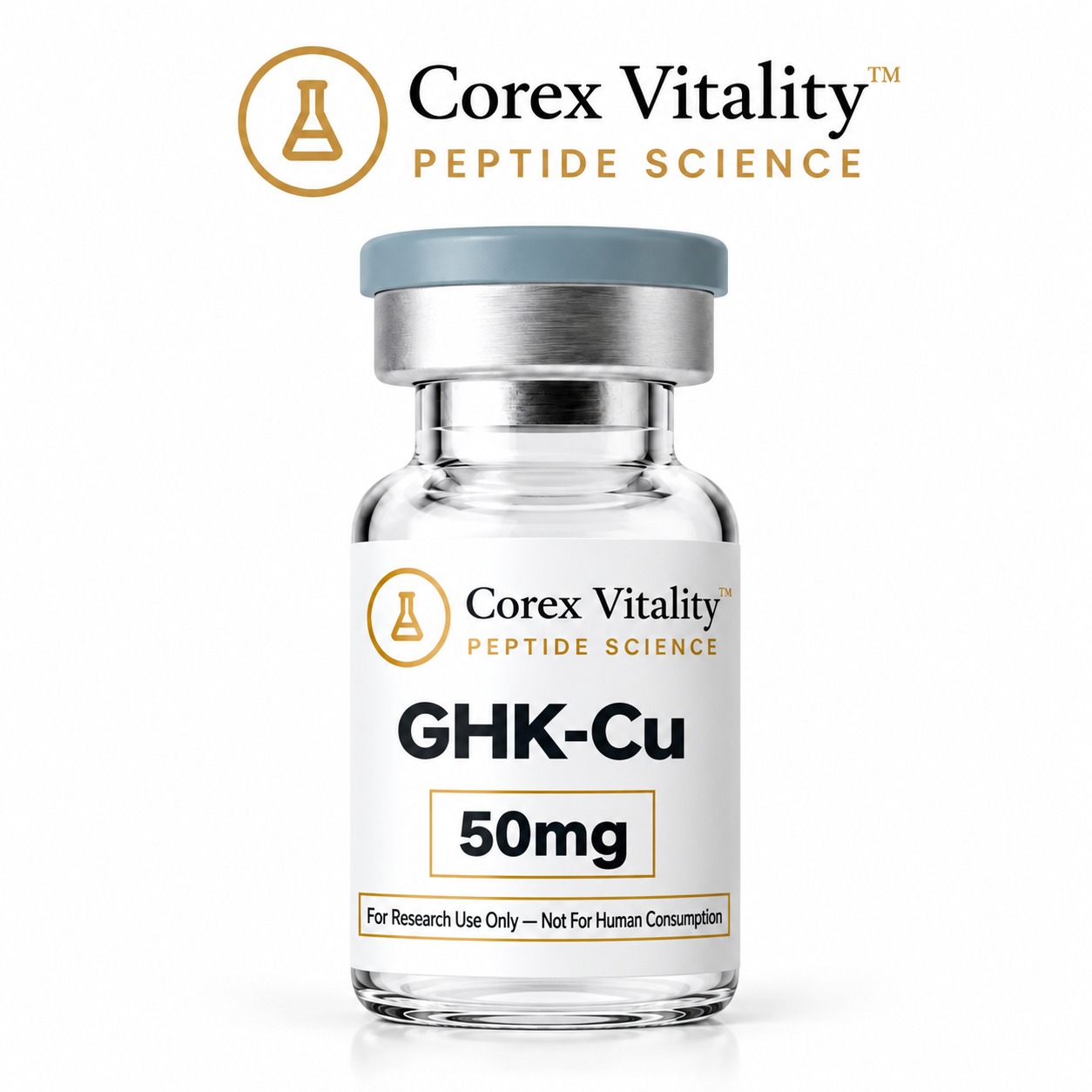
Related research compounds: Klow-80, a blend that contains 50mg of GHK-Cu per vial. For more background, see our GHK-Cu and Klow-80 research summary and our Senolytics & Longevity research hub.
Areas of research
Published research on GHK and GHK-Cu includes:
- reviews of its reported activities in cell and animal models of tissue remodelling [1]
- gene expression data suggesting that GHK may influence many biochemical pathways [2]
- spectroscopic (ESR) studies of how the copper(II)–GHK complex interacts with histidine and cells [3]
- its use as a high-affinity copper(II)-binding tag to aid protein crystallisation and structure determination [4]
Much of the biological literature on GHK-Cu comes from a small number of research groups and from laboratory models, and the evidence base remains at an early stage.
Product specifications
| Form |
Lyophilised (freeze-dried) powder in a sealed vial |
| Sizes |
50mg, 100mg |
| Sequence |
Gly-His-Lys (GHK) complexed with copper(II) |
| Molecular formula |
C14H24N6O4 (GHK peptide, before copper binding) |
| Molecular weight |
approx. 340.4 g/mol (GHK peptide) |
| Purity |
See the COA for your size. The current 50mg and 100mg COAs report HPLC purity above 99.6%. |
Storage and handling
Storage & Handling — Corex Vitality™ research vials
- As supplied: freeze-dried (lyophilised) powder in a sealed vial. Room-temperature transit is normal for dry peptides.
- Longer storage: keep the vial tightly closed in a freezer at −20 °C or colder, dry and away from light. Colder is better for long archives.
- Short-term: a laboratory fridge (2–8 °C) is fine for vials you plan to open soon.
- Before opening: let the closed vial warm to room temperature, ideally in a desiccator, so moisture does not condense on the powder. Work quickly and reseal tightly; absorbed moisture lowers the real peptide content.
- Dissolving: choose a solvent based on the sequence (see the compound note below) and test a small portion first. Swirl gently; brief sonication in a water bath can help. Do not heat.
- Once in solution: make up only what you need. Split any solution you keep into single-use aliquots, freeze at −20 °C or colder and thaw each aliquot only once. Peptides keep far less well in solution than as dry powder.
- Safety: handle in a suitable laboratory with appropriate PPE, following your institution’s safety procedures, and avoid breathing the powder. Keep out of reach of children.
Compound note: Copper(II) complex — the blue colour is normal. Water-friendly. Do not add reducing agents such as DTT, and avoid chelators (e.g. EDTA), which affect the copper. Protect from light.
For in-vitro laboratory research use only. Not for human or veterinary use. General guidance paraphrased from Bachem: Handling and Storage Guidelines for Peptides and Peptide Solubility.
Quality and testing
GHK-Cu batches we sell have a published third-party HPLC Certificate of Analysis. On Lingda reports the Client is the manufacturer/supplier; we publish the file exactly as issued. COAs have been issued for both the 50mg and 100mg sizes. You can also browse every published certificate on our COA and verification page.
GHK-Cu identity and batch questions
What does “Cu” mean in GHK-Cu?
Cu is the chemical symbol for copper. GHK-Cu is a complex of copper(II) with the tripeptide glycyl-L-histidyl-L-lysine (Gly-His-Lys, or GHK).
Why are the formula and weight given for GHK without copper?
The figures in the specifications table (C14H24N6O4, approx. 340.4 g/mol) describe the GHK peptide before copper is bound. They are reference values, not measured batch results. Measured results appear only on the batch certificate.
Which sizes have a certificate?
Check the COA for your size. The current 50mg and 100mg certificates report HPLC purity above 99.6%. Match the batch identifier on our verification page; a certificate for one batch is not a result for another.
For laboratory research use only. Not for human consumption.
Research use only
For in-vitro laboratory research use only. Not for human or veterinary use. These products are research chemicals. They are not medicines, food, or supplements. They have not been evaluated by the MHRA, FDA, or any other regulatory body. Not intended to diagnose, treat, cure, or prevent any disease. All descriptions are for reference and research documentation purposes only. By purchasing, you confirm you are aged 18+ and using these products exclusively for in vitro laboratory research.
Related reading
References
- Pickart L. The human tri-peptide GHK and tissue remodeling. J Biomater Sci Polym Ed. 2008. PubMed 18644225
- Pickart L, Margolina A. Regenerative and protective actions of the GHK-Cu peptide in the light of the new gene data. Int J Mol Sci. 2018. PubMed 29986520
- Antholine WE, et al. ESR studies of the interaction of copper(II)GHK, histidine, and Ehrlich cells. J Inorg Biochem. 1989. PubMed 2542448
- Mehr A, et al. The copper(II)-binding tripeptide GHK, a valuable crystallization and phasing tag for macromolecular crystallography. Acta Crystallogr D Struct Biol. 2020. PubMed 33263328



Reviews
There are no reviews yet.