
🚚 Free next-day tracked delivery on in-stock orders over £50 🖊️ Peptide Pens → 🖊️ Retatrutide Pens: 20mg £124.99 · 40mg £159.99 → 🎬 View Peptide Videos → 🔬 New: Senolytics & Longevity Research. Explore the science → 👤 Members save 10% on eligible products. Join free → 🚚 Free next-day tracked delivery on in-stock orders over £50 🖊️ Peptide Pens → 🖊️ Retatrutide Pens: 20mg £124.99 · 40mg £159.99 → 🎬 View Peptide Videos → 🔬 New: Senolytics & Longevity Research. Explore the science → 👤 Members save 10% on eligible products. Join free → 🚚 Free next-day tracked delivery on in-stock orders over £50 🖊️ Peptide Pens → 🖊️ Retatrutide Pens: 20mg £124.99 · 40mg £159.99 → 🎬 View Peptide Videos → 🔬 New: Senolytics & Longevity Research. Explore the science → 👤 Members save 10% on eligible products. Join free →

GHK-Cu & Klow-80 in ageing research

Illustration of the copper tripeptide GHK-Cu

A literature summary. Summarises published literature for educational purposes.

What is GHK-Cu?

GHK is a naturally occurring tripeptide made of three amino acids: glycine–histidine–lysine (Gly-His-Lys). It binds copper(II) ions with high affinity, forming the complex GHK-Cu (copper tripeptide-1). GHK was first isolated from human plasma by Pickart and Thaler in 1973, who reported that it altered the survival and growth of liver cells in culture [1].

Property Detail
Sequence Gly-His-Lys, complexed with Cu(II)
Molecular formula (GHK-Cu) C14H22CuN6O4
Molar mass approx. 401.9 g/mol
Form supplied Lyophilised powder (blue, owing to the copper complex)

Why GHK-Cu appears in ageing research

GHK-Cu is studied in ageing biology for three main reasons:

1. Extracellular matrix studies (in vitro).
In fibroblast cultures, GHK-Cu was reported to stimulate collagen synthesis [2]. Extracellular matrix turnover is a common topic in studies of tissue ageing, so this early finding is widely cited.

2. Gene-expression studies.
Campbell and colleagues (2012) compared gene-expression profiles from lung tissue with a public database of compound signatures (the Connectivity Map). GHK was identified as a compound whose expression signature ran opposite to the profile associated with emphysema-related tissue destruction. They then studied GHK in cultured lung fibroblasts [3]. Later reviews by Pickart and colleagues analysed Connectivity Map data and reported that GHK was associated with changes in the expression of a large number of human genes in those datasets [4,5].

3. Age-related differences in plasma GHK.
Reviews by Pickart and colleagues report lower plasma GHK concentrations in older individuals than in younger ones [4]. This observation comes from the group that first described GHK, and independent confirmation in the literature is limited.

Limitations of the evidence

  • Most mechanistic data come from cell culture and gene-expression database analyses. Changes in gene expression do not by themselves show a functional outcome.
  • Several of the main reviews come from one research group [4,5]. Readers should consult the primary studies.
  • Findings in cell models cannot be extrapolated to effects in humans.

Klow-80: composition

Klow-80 is a multi-peptide research blend supplied in a single vial. It contains four peptides in fixed proportions, with GHK-Cu as the largest component.

Peptide Description Amount % of vial
GHK-Cu Copper tripeptide complex (Gly-His-Lys-Cu) 50mg 62.5%
BPC-157 Synthetic pentadecapeptide (15 amino acids) 10mg 12.5%
TB-500 Synthetic research peptide 10mg 12.5%
KPV Tripeptide (Lys-Pro-Val) 10mg 12.5%
Total 80mg 100%

The GHK-Cu literature summarised above concerns GHK-Cu studied on its own. The blend as a whole has not been the subject of published peer-reviewed studies that we are aware of. Klow-80 is listed here because of its GHK-Cu content and is supplied for in-vitro research only.
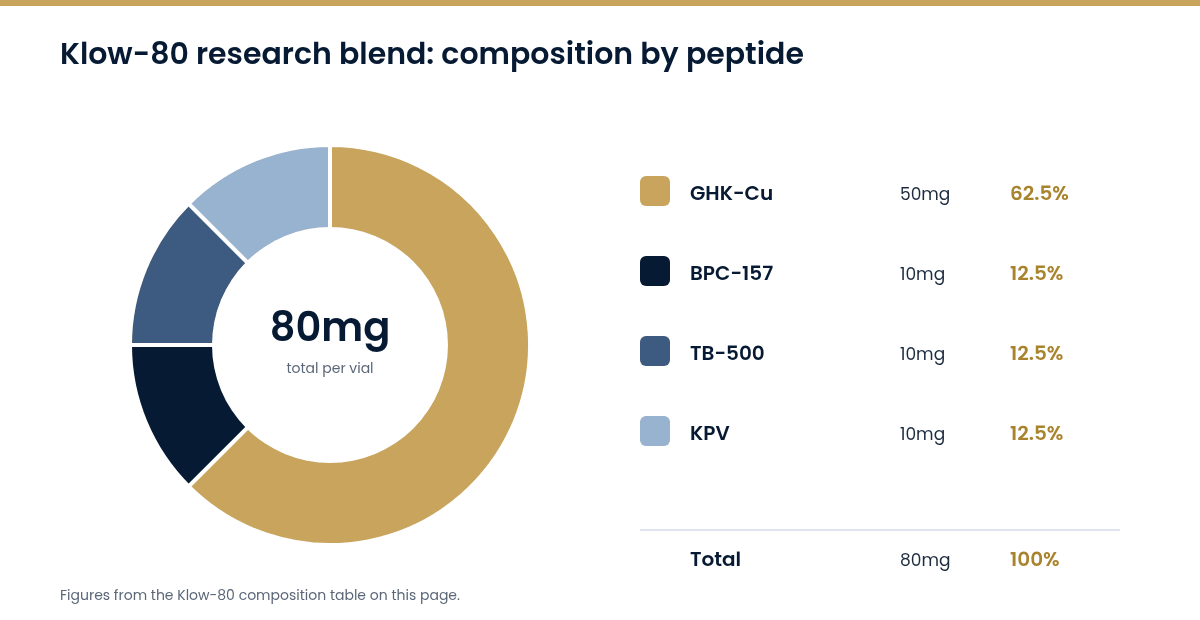
Composition of the Klow-80 research blend by peptide

Research materials

GHK-Cu

Price: 50mg £21.99 · 100mg £32.99

Certificates of Analysis: 50mg, report LDA22160942 (tested 1 September 2026, HPLC purity >99.68%); 100mg, report LDA22160952 (tested 2 September 2026, >99.75%). Lingda Laboratory. View certificates on our Verification page

View product

Klow-80

Price: 80mg £69.99

Certificate of Analysis: report LDA22161252 (Lingda Laboratory, tested 3 September 2026, HPLC purity >99.72%). View certificates on our Verification page

View product

Longevity Research Digest

Monthly summaries of new published research, new certificates and new stock. Sign-up opens soon.

Research use only. This article summarises published scientific literature for educational purposes. It does not describe the effects of any Corex Vitality™ product. GHK-Cu and Klow-80 are supplied for laboratory research use only and are not intended for human or veterinary use, or for the diagnosis, treatment, prevention or cure of any disease or medical condition.

References

  1. Pickart L, Thaler MM. Tripeptide in human serum which prolongs survival of normal liver cells and stimulates growth in neoplastic liver. Nat New Biol. 1973;243(124):85-87. PubMed: https://pubmed.ncbi.nlm.nih.gov/4349963/
  2. Maquart FX, Pickart L, Laurent M, Gillery P, Monboisse JC, Borel JP. Stimulation of collagen synthesis in fibroblast cultures by the tripeptide-copper complex glycyl-L-histidyl-L-lysine-Cu2+. FEBS Lett. 1988;238(2):343-346. PubMed: https://pubmed.ncbi.nlm.nih.gov/3169264/ · DOI: https://doi.org/10.1016/0014-5793(88)80509-X
  3. Campbell JD, McDonough JE, Zeskind JE, et al. A gene expression signature of emphysema-related lung destruction and its reversal by the tripeptide GHK. Genome Med. 2012;4(8):67. PubMed: https://pubmed.ncbi.nlm.nih.gov/22937864/ · DOI: https://doi.org/10.1186/gm367
  4. Pickart L, Vasquez-Soltero JM, Margolina A. GHK peptide as a natural modulator of multiple cellular pathways in skin regeneration. Biomed Res Int. 2015;2015:648108. PubMed: https://pubmed.ncbi.nlm.nih.gov/26236730/ · DOI: https://doi.org/10.1155/2015/648108
  5. Pickart L, Margolina A. Regenerative and protective actions of the GHK-Cu peptide in the light of the new gene data. Int J Mol Sci. 2018;19(7):1987. PubMed: https://pubmed.ncbi.nlm.nih.gov/29986520/ · DOI: https://doi.org/10.3390/ijms19071987

Research you can verify.

Get Corex Vitality™ Research Updates

Get new Learning Hub articles and stock updates. No spam. Unsubscribe any time.

We will send you an email to confirm. Read our privacy policy.

📚 Peer-Reviewed Literature · PubMed Indexed

Published Research — Peer-Reviewed Receptor & Pathway Studies

NCBI PubMed Database ↗ Verify Batch COAs →

GHK-Cu (Copper Tripeptide-1)

  1. [1] Pickart L et al. · Nature (1980)

    Foundational biochemical and structure-function study demonstrating that the histidyl-lysyl tripeptide chelates copper(II) in equimolar coordination and facilitates cellular copper transport in cultured hepatoma cells.

    PMID: 7453802 ↗ DOI: 10.1038/288715a0 ↗
  2. [2] Maquart FX et al. · FEBS Lett (1988)

    In-vitro fibroblast culture study showing picomolar-to-nanomolar (10^-12 to 10^-9 M) stimulation of collagen biosynthesis by the GHK–Cu(II) coordination complex independent of cell-number changes.

    PMID: 3169264 ↗ DOI: 10.1016/0014-5793(88)80509-x ↗
  3. [3] Wegrowski Y et al. · Life Sci (1992)

    Radiolabelled [3H]-glucosamine and [35S]-sulfate incorporation assay in cultured human fibroblasts demonstrating biphasic stimulation of extracellular dermatan sulfate and cell-layer heparan sulfate synthesis at 10^-9 to 10^-8 M GHK-Cu.

    PMID: 1522753 ↗ DOI: 10.1016/0024-3205(92)90504-i ↗
  4. [4] Mehr A et al. · Acta Crystallogr D Struct Biol (2020)

    X-ray crystallographic structural study resolving the high-affinity square-pyramidal copper(II) coordination sphere formed by the N-terminal GHK tripeptide motif in recombinant fusion proteins.

    PMID: 33263328 ↗ DOI: 10.1107/S2059798320013741 ↗

KLOW-80 Quad-Blend (GHK-Cu + BPC-157 + TB-500 + KPV)

  1. [1] Chavatte P et al. · J Pharm Pharmacol (2001)

    Two-dimensional 1H-NMR spectroscopy and molecular-mechanics conformational analysis of the α-MSH(11–13) C-terminal tripeptide Ac-Lys-Pro-Val-NH2 (KPV), defining its folded trans-proline secondary structure in solution.

    PMID: 11480545 ↗ DOI: 10.1211/0022357011776360 ↗
  2. [2] Dalmasso G et al. · Gastroenterology (2008)

    In-vitro Caco-2, HT29-Cl.19A, and Jurkat T-cell study demonstrating that the oligopeptide transporter PepT1 mediates intracellular uptake of the KPV tripeptide to inhibit NF-κB and MAPK pro-inflammatory signalling cascades.

    PMID: 18061177 ↗ DOI: 10.1053/j.gastro.2007.10.026 ↗
  3. [3] Land SC · Int J Physiol Pathophysiol Pharmacol (2012)

    In-vitro bronchial epithelial cell study demonstrating that the tripeptide KPV suppresses TNF-α- and respiratory syncytial virus-induced NF-κB nuclear translocation and IL-8/eotaxin chemokine secretion.

    PMID: 22837805 ↗
  4. [4] Songok AC et al. · PLoS One (2018)

    Synthetic peptide chemistry and NMR spectroscopic characterisation of modified Lys-Pro-Val (KPV) tripeptide derivatives engineered to resist proteolytic aminopeptidase degradation in biological matrices.

    PMID: 29953505 ↗ DOI: 10.1371/journal.pone.0199686 ↗

BPC-157 (Pentadecapeptide)

  1. [1] Chang CH et al. · J Appl Physiol (1985) (2011)

    Ex-vivo rat Achilles tendon explant and cultured tendon fibroblast study demonstrating concentration-dependent acceleration of cellular migration, culture-dish spreading, H2O2 stress survival, and FAK–paxillin phosphorylation.

    PMID: 21030672 ↗ DOI: 10.1152/japplphysiol.00945.2010 ↗
  2. [2] Hsieh MJ et al. · J Mol Med (Berl) (2017)

    In-vitro human vascular endothelial cell and chick chorioallantoic membrane (CAM) study showing upregulated VEGFR2 mRNA/protein expression, receptor internalisation, and VEGFR2–Akt–eNOS phosphorylation.

    PMID: 27847966 ↗ DOI: 10.1007/s00109-016-1488-y ↗
  3. [3] Chang CH et al. · Molecules (2014)

    cDNA microarray, RT-qPCR, and Western blot study in isolated rat Achilles tendon fibroblasts showing concentration- and time-dependent upregulation of growth hormone receptor expression and downstream JAK2 phosphorylation.

    PMID: 25415472 ↗ DOI: 10.3390/molecules191119066 ↗
  4. [4] Huang T et al. · Drug Des Devel Ther (2015)

    In-vitro human umbilical vein endothelial cell (HUVEC) transwell, scratch-migration, and Matrigel tube-formation assays demonstrating concentration-dependent cell-cycle progression and ERK1/2, FAK, and paxillin phosphorylation.

    PMID: 25995620 ↗ DOI: 10.2147/DDDT.S82030 ↗

TB-500

  1. [1] Safer D, Elzinga M, Nachmias VT · J Biol Chem (1991)

    Biochemical study showing that the actin-sequestering peptide Fx and thymosin beta 4 are the same molecule, and describing how it binds actin monomers.

    PMID: 1999398 ↗
  2. [2] Hannappel E · Ann N Y Acad Sci (2007)

    Review of the beta-thymosin peptide family: structure, distribution and known molecular interactions, including actin binding.

    PMID: 17468232 ↗ DOI: 10.1196/annals.1415.018 ↗
  3. [3] Philp D et al. · FASEB J (2003)

    In-vitro endothelial cell adhesion, migration, tube-formation, and chick aortic-ring sprouting study demonstrating that the conserved central 7-amino-acid G-actin-binding motif (LKKTETQ) reproduces the angiogenic signalling of full-length thymosin β4.

    PMID: 14500546 ↗ DOI: 10.1096/fj.03-0121fje ↗
  4. [4] Bock-Marquette I et al. · Nature (2004)

    Embryonic and postnatal cardiomyocyte culture and biochemical study showing that the G-actin-sequestering polypeptide thymosin β4 forms a functional PINCH–integrin-linked kinase (ILK) complex that activates protein kinase B (Akt) signalling.

    PMID: 15565145 ↗ DOI: 10.1038/nature03000 ↗

References are provided for scientific context only. All Corex Vitality™ compounds are supplied strictly for in-vitro laboratory research use (RUO).