Peptide ELISA Explained: What a New CJC-1295 Detection Study Shows
Peptide ELISA Explained: What a New CJC-1295 Detection Study Shows
By the Corex Vitality™ Research Team · Last checked 13 November 2026 · Sources listed under Published Research
Quick summary
In October 2026 a racing laboratory in Australia published an ELISA that detects the protein-bound form of CJC-1295 in horse plasma.
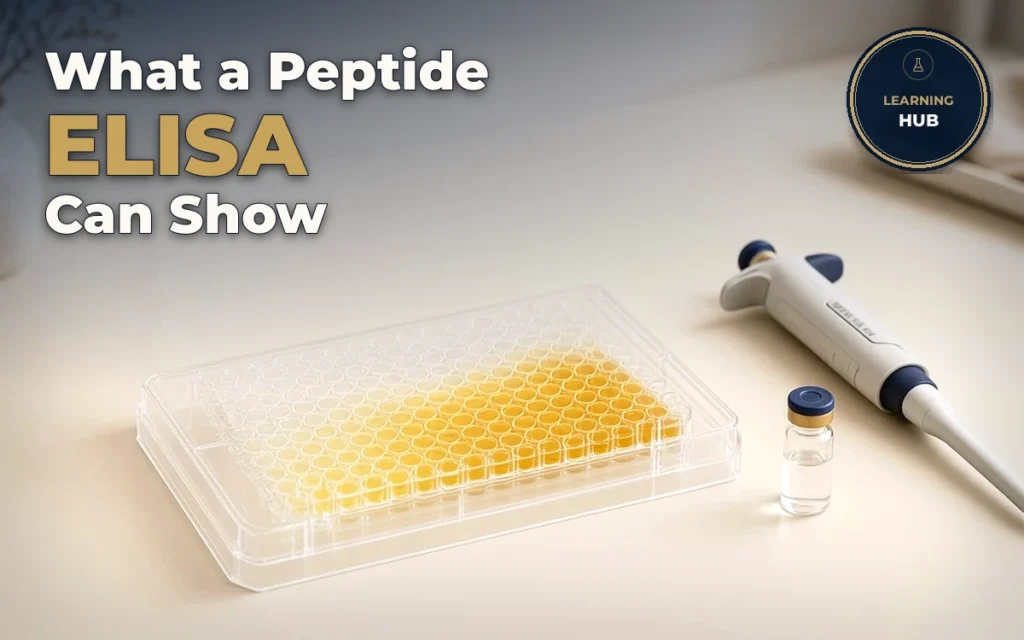
An ELISA is a plate test that uses antibodies to catch one molecule and an enzyme to turn that catch into a colour signal.
Antibodies were chosen because the “with DAC” version of CJC-1295 bonds to blood proteins, which makes it hard to find with peptide-mass screens.
Labs often screen with an antibody test first, then confirm with a separation method plus molecular-mass analysis.
An ELISA is a detection test. It is not a purity test, and it is not what a peptide COA usually reports.
A peptide ELISA is a long-established laboratory method for finding a small amount of a peptide in a complex sample. This guide uses a new 2026 paper on CJC-1295 to explain how the test works, why antibodies were the right tool for this molecule, and how an ELISA differs from the HPLC purity results printed on a Certificate of Analysis (COA). If you are new to peptides, start with What Are Peptides?
1. The news in brief
What: “Detection of CJC-1295 in Equine Plasma by ELISA”, by Timms, Cawley and Steel of Racing Analytical Services in Victoria, Australia.
Result: using monoclonal antibodies (identical antibodies made from one cell line) raised against the CJC-1295 peptide, the team detected CJC-1295–protein conjugates at concentrations as low as 12.5 pg/mL.
Purpose: the authors’ stated aim was controlling illicit use of CJC-1295 in racehorses. That part of the paper is outside the scope of this guide.
2. What an ELISA is
ELISA stands for enzyme-linked immunosorbent assay. Each part of the name describes a step:
Immuno: it relies on an antibody, a Y-shaped protein that binds tightly to one small region of a target molecule. That region is called the epitope.
Sorbent: the antibody is stuck (adsorbed) to the inside of a small plastic well, usually in a 96-well plate.
Enzyme-linked: a second antibody carries an enzyme, a protein that speeds up a chemical reaction. When a colourless liquid called a substrate is added, the enzyme turns it coloured.
Assay: a measurement. A plate reader measures how much colour each well makes. More target in the sample means more colour.
The common “sandwich” format traps the target between two antibodies, as shown below. A standard curve, made from wells with known amounts of the target, turns colour readings into concentrations.
How a sandwich ELISA finds a peptideGeneral principle, shown for a peptide bonded to a blood protein (the CJC-1295 “with DAC” problem)1. CaptureA capture antibodyis stuck to thebottom of a plate wellplate well surface2. BindproteinThe sample is added.The antibody grabs thepeptide (gold), even whenit is bonded to a proteinunbound material washed away3. DetectEA second antibodycarrying an enzyme (E)target sits in a “sandwich”4. ReadA substrate is added.The enzyme turns itcoloured. A plate readermeasures the colour.less target → more targetstandard curve gives pg/mLWhy antibodies for CJC-1295 with DAC?• The DAC (a maleimide group) bonds the peptide to blood proteins• The bonded form has no single, predictable mass• An antibody only needs to “see” its epitope on the peptide• 2026 ELISA: detected down to 12.5 pg/mL in plasmaDetection test vs COA purity test• ELISA: is the molecule there, and roughly how much?• HPLC: how much of the powder is the intended peptide?• Screening flags samples; separation plus molecular-mass analysis confirms themGeneric illustration of the sandwich format. Corex Vitality™ Science & Learning · For in-vitro laboratory research use only. Not for human or veterinary use.
3. Why antibodies suit this molecule
CJC-1295 is a lab-made analogue of the first 29 amino acids of growth hormone-releasing hormone (GHRH), a natural signalling peptide. Our guide CJC-1295 and Ipamorelin: Two Different Peptides covers its sequence.
The version studied in the 2026 paper carries a DAC (drug affinity complex). This is a reactive maleimide group added to the end of the chain. A 2005 chemistry paper showed that maleimide-bearing versions of GRF(1-29) bond to human serum albumin, the main protein in blood plasma, and that these bonded forms resisted the enzyme DPP-IV in the test tube. DPP-IV normally trims two amino acids from the front of this type of peptide.
That bond is the detection problem. Once the peptide is fixed to a large protein, it no longer has one neat, predictable mass. A 2019 paper from the same racing laboratory said this conjugation blocks “top-down” screens that look for intact peptides by their mass. An antibody does not care what the peptide is attached to. It only needs to see its epitope.
For more on how attached groups change a peptide’s behaviour, see Peptide Lipidation.
4. How sensitive is it?
A picogram (pg) is one trillionth of a gram. So 12.5 pg/mL means 12.5 trillionths of a gram in each millilitre of plasma. That is the lowest level the 2026 ELISA reported.
The same group’s earlier immuno-PCR screen went lower, to 0.8 pg/mL. It swaps the colour step for a DNA tag that is copied many times, which boosts the signal.
In that 2019 work, the assay also picked up the horse’s own natural GHRH. This is an example of cross-reactivity: an antibody binding something similar to its target. To allow for it, the screening threshold was set at 50 pg/mL.
The lesson for reading any assay paper: the lowest level a test can see is not the same as the level at which a result is called positive. Background signal and look-alike molecules matter.
5. Screening first, confirming second
Testing laboratories usually work in two stages.
Screening: fast, sensitive tests such as ELISA flag samples that might contain the target.
Confirmation: a separate method checks the flagged samples. For GHRH analogues this usually means liquid chromatography, which separates the sample, followed by molecular-mass analysis of the separated parts.
Two of the papers below show the confirmation side. A 2021 study from King’s College London made 19 in-vitro breakdown products of four GHRH analogues to use as reference materials. A 2022 study from Ghent built an antibody-free clean-up for the same family and found that sermorelin broke down quickly above 4 °C and below pH 7, a reminder that sample handling affects results. For why test-tube findings do not automatically carry over, see In Vitro vs In Vivo vs Ex Vivo.
6. What this means when you read a COA
Different question: an ELISA asks “is this molecule present, and roughly how much?” in a messy sample. A purity test asks “how much of this powder is the intended peptide?”
Our CJC-1295: the CJC-1295 (DAC-free) we list has no DAC, so it is a different molecule from the protein-bound form detected in the 2026 paper. Its published COA reports HPLC purity, not an ELISA result. You can check it with our COA verification guide.
Key takeaways
A peptide ELISA uses antibodies to catch a target and an enzyme to turn that catch into a measurable colour.
A new 2026 ELISA detects the protein-bound (DAC) form of CJC-1295 at levels down to 12.5 pg/mL.
Antibodies were used because the DAC form bonds to blood proteins and loses a single, predictable mass.
Screening tests flag samples; separation plus molecular-mass analysis confirms them. Cross-reactivity sets real-world thresholds.
The peer-reviewed papers below were used for the science in this article. Each entry was checked against PubMed (NCBI E-utilities) on 13 November 2026. Summaries describe study design and laboratory methods only. Corex Vitality™ is not affiliated with the cited authors, journals or institutions.
Detection of CJC-1295 in Equine Plasma by ELISA. Timms M, Cawley A, Steel R. Drug Test Anal. 2026 Oct 14. Online ahead of print. PMID: 42876013 · DOI: 10.1002/dta.70171 Assay-development study: monoclonal antibodies raised against the CJC-1295 peptide were used to build an ELISA that detects CJC-1295–protein conjugates in equine plasma at concentrations down to 12.5 pg/mL. The paper’s animal-sample section is not summarised here.
An immuno polymerase chain reaction screen for the detection of CJC-1295 and other growth-hormone-releasing hormone analogs in equine plasma. Timms M, Ganio K, Forbes G, et al. Drug Test Anal. 2019;11(6):804-812. PMID: 30489688 · DOI: 10.1002/dta.2554 Assay-development study describing an immuno-PCR screen: a pair of monoclonal antibodies captures the CJC-1295–protein conjugate and a DNA tag is copied for the read-out, giving detection down to 0.8 pg/mL. Cross-reaction with the horse’s own GHRH set the screening threshold at 50 pg/mL. The animal-sample section is not summarised here.
Human growth hormone-releasing factor (hGRF)1-29-albumin bioconjugates activate the GRF receptor on the anterior pituitary in rats: identification of CJC-1295 as a long-lasting GRF analog. Jetté L, Léger R, Thibaudeau K, et al. Endocrinology. 2005;146(7):3052-8. PMID: 15817669 · DOI: 10.1210/en.2004-1286 Chemistry and cell-assay study: three maleimido derivatives of hGRF(1-29) were bonded to human serum albumin outside the body, showed improved in-vitro stability against the enzyme DPP-IV, and were active in cultured rat anterior pituitary cells. The paper’s rat studies are not summarised here.
Advances in the detection of growth hormone releasing hormone synthetic analogs. Memdouh S, Gavrilović I, Ng K, et al. Drug Test Anal. 2021;13(11-12):1871-1887. PMID: 34665524 · DOI: 10.1002/dta.3183 In-vitro breakdown study of four GHRH analogues (sermorelin, tesamorelin, CJC-1295 and CJC-1295 with DAC): 19 major in-vitro breakdown products were identified, made and characterised as reference materials for a liquid chromatography method with tandem mass detection, tested in spiked (fortified) urine.
An antibody-free, ultrafiltration-based assay for the detection of growth hormone-releasing hormones in urine at low pg/mL concentrations using nanoLC-HRMS/MS. Coppieters G, Deventer K, Polet M, et al. J Pharm Biomed Anal. 2022;214:114726. PMID: 35298973 · DOI: 10.1016/j.jpba.2022.114726 Analytical method study: an antibody-free ultrafiltration clean-up combined with nano liquid chromatography and high-resolution tandem mass detection for GHRH analogues including CJC-1295, compared with antibody-based (immuno-affinity) purification. It also reports that sermorelin broke down quickly above 4 °C and below pH 7.
All Corex Vitality™ products are supplied strictly for in-vitro laboratory research use only. Not for human or veterinary use. No information here describes use in humans or animals.
Get it by email, plus our research updates. No spam, unsubscribe any time.
Help · Research use only
Chat questions stay on our website so we can answer them. We do not use them for marketing. We only keep unanswered questions (the question text, not your name or email) for a short weekly review. If you want a personal reply, email info@corexvitality.com.
Manage Consent
To provide the best experiences, we use technologies like cookies to store and/or access device information. Consenting to these technologies will allow us to process data such as browsing behaviour or unique IDs on this site. Not consenting or withdrawing consent may adversely affect certain features and functions.
Functional
Always active
The technical storage or access is strictly necessary for the legitimate purpose of enabling the use of a specific service explicitly requested by the subscriber or user, or for the sole purpose of carrying out the transmission of a communication over an electronic communications network.
Preferences
The technical storage or access is necessary for the legitimate purpose of storing preferences that are not requested by the subscriber or user.
Statistics
The technical storage or access that is used exclusively for statistical purposes.The technical storage or access that is used exclusively for anonymous statistical purposes. Without a subpoena, voluntary compliance on the part of your Internet Service Provider, or additional records from a third party, information stored or retrieved for this purpose alone cannot usually be used to identify you.
Marketing
The technical storage or access is required to create user profiles to send advertising, or to track the user on a website or across several websites for similar marketing purposes.
Research-grade peptides supplied exclusively for in-vitro laboratory research, supported by third-party HPLC testing and transparent batch documentation. Not for human or veterinary use.
By entering this website, you confirm that you are 18 years of age or older, are visiting exclusively for in-vitro laboratory research, and agree to our Terms & Conditions and Privacy Policy.