Peptide Lipidation: How a Fatty-Acid Chain Changes a Peptide
Peptide Lipidation: How a Fatty-Acid Chain Changes a Peptide
By the Corex Vitality™ Research Team · Last checked 7 November 2026 · Sources listed under Published Research
Quick summary
Peptide lipidation means attaching a fatty-acid chain to a peptide, usually on one amino acid side chain.
The fatty acid lets the peptide stick loosely to albumin, the most common protein in blood plasma.
Chain length, the linker and the attachment point all change how strongly it binds and how the peptide behaves in lab tests.
This guide covers the chemistry and the lab methods used to study it. It does not discuss personal use.
This is a plain-English guide to peptide lipidation for laboratory readers. It builds on our article on retatrutide structure and its fatty-acid chain, and looks at the general idea behind it: why chemists add a fatty acid to a peptide, and what changes when they do.
1. First, some basic words
A peptide is a short chain of amino acids. See What Are Peptides? if you are new to the subject.
Lipidation (also called acylation) is the attachment of a fatty-acid group. In research peptides it is often added to the side chain of a lysine.
A fatty acid is a long carbon chain with an acid group at one end. A fatty diacid has an acid group at both ends.
A linker (or spacer) is a short piece of chemistry between the peptide and the fatty acid, for example a γ-glutamic acid link or an AEEA spacer.
Albumin (human serum albumin, HSA) is a large carrier protein. It naturally carries fatty acids, which is why a fatty-acid “tag” can bind to it.
2. Why add a fatty acid at all?
Short unmodified peptides are small, so in animal studies they are cleared quickly and are easily cut by enzymes called proteases. Researchers have long looked for ways to make a peptide last longer in a test system without changing the part that binds its receptor.
Lipidation is one of the main answers. The fatty acid lets the peptide “piggy-back” on albumin. While it is bound, the peptide is bigger in effect and partly shielded. A 2017 paper in Nature Communications describes this “piggy-back” idea and builds a short acylated peptide tag that binds human albumin with a dissociation constant (Kd) of 39 nM.
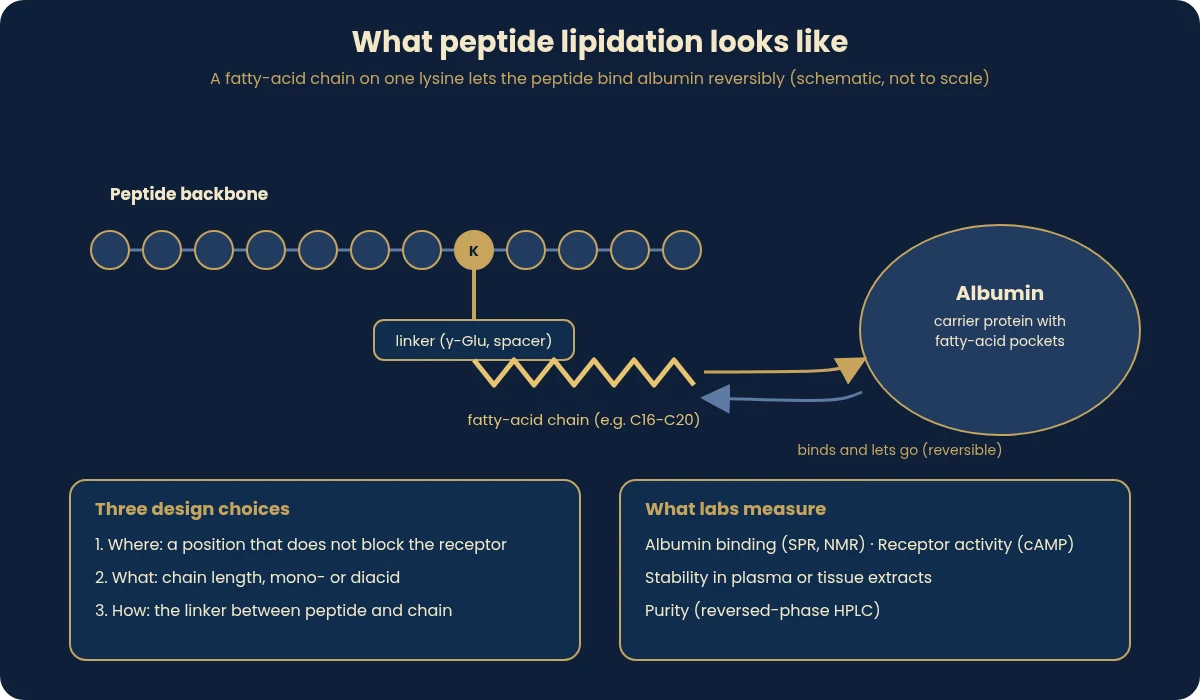
Schematic: peptide backbone, lysine side chain, linker and fatty-acid chain, and reversible binding to albumin. Not to scale.
3. The three design choices
Papers on lipidated peptides keep coming back to the same three choices:
Where the chain goes. It must sit on a position that does not block receptor binding. In the GLP-1 analogue work published in the Journal of Medicinal Chemistry in 2015, the chain is attached at lysine 26.
What the chain is. Longer chains and diacids generally bind albumin more strongly. The same 2015 paper reports that changing the fatty acid and linker raised albumin affinity, while receptor affinity fell about three-fold compared with an earlier analogue. That trade-off is normal and has to be measured.
How it is linked. Linkers change spacing, water-solubility and flexibility. The 2015 work names the fatty-acid group and the linking chemistry as the key features.
Retatrutide is a worked example: its lysine 17 carries a C20 fatty diacid through a γ-glutamic acid link and an AEEA spacer. Our retatrutide structure guide walks through it residue by residue.
4. Different ways to attach the chain
Chemical acylation after or during solid-phase synthesis is the usual route for research peptides.
Genetic encoding. A 2019 paper in Angewandte Chemie built a fatty-acid-bearing lysine (called HepoK) directly into a protein made in E. coli. The lipidated GLP-1 bound human serum albumin more strongly than the unmodified version in vitro, and still activated its receptor in cell tests.
Other peptides. The idea is not limited to incretin research. A 2017 study attached a myristic-acid-acylated lysine to thymopentin, a five-residue peptide. The modified peptide bound albumin more strongly and was much more stable in human plasma in vitro, and kept its activity in a macrophage cell assay.
5. Knock-on effects of the chemistry: self-association and breakdown
A fatty-acid chain is greasy (hydrophobic), so lipidated peptides can stick to each other as well as to albumin. This self-association is called oligomerisation.
A 2022 study in the Journal of Pharmaceutical and Biomedical Analysis used NMR and surface plasmon resonance (SPR) to compare oligomerisation and albumin binding across lipidated GLP-1 analogues. It also used an in-vitro assay to follow breakdown in tissue extracts. The authors found that oligomers were more protected from breakdown, and that albumin binding gave only limited protection where little albumin was present. They mapped the main cut site between Tyr19 and Leu20.
6. How labs measure lipidation effects
Albumin binding: SPR, NMR or equilibrium methods give a binding strength (Kd).
Receptor activity: cell-based cAMP or reporter assays check that the receptor still responds after the chain is added.
Stability: incubation in plasma or tissue extracts, followed by chromatography, shows how fast the peptide is cut and where.
Purity: reversed-phase HPLC separates the main peptide from related substances. Lipidated peptides elute later because they are more hydrophobic. See reading an HPLC chromatogram.
7. What this means when you read a COA
For a lipidated research peptide, the HPLC trace on the certificate should show one clear main peak. A version with a missing or different chain is a different molecule, so it would usually appear as a separate peak at another retention time. Our guides on HPLC purity vs net peptide content and peptide impurities explain what else to look for, and how to verify a peptide COA shows how to check the report number with the laboratory.
Key takeaways
Peptide lipidation adds a fatty-acid chain, usually to a lysine side chain, often through a linker.
The chain lets the peptide bind albumin reversibly, which extends its time in animal-model studies.
Attachment point, chain type and linker are tuned together, and receptor activity has to be re-measured each time.
Lipidated peptides can self-associate; NMR, SPR and chromatography are used to study binding and breakdown.
The peer-reviewed papers below were used for the science in this article. Each entry was checked against PubMed on 7 November 2026. Summaries describe chemistry, laboratory and cell-based findings only. Corex Vitality™ is not affiliated with the cited authors, journals or institutions.
Discovery of the Once-Weekly Glucagon-Like Peptide-1 (GLP-1) Analogue Semaglutide. Lau J, Bloch P, Schäffer L, et al. J Med Chem. 2015;58(18):7370-80. PMID: 26308095 · DOI: 10.1021/acs.jmedchem.5b00726 Medicinal-chemistry paper describing how the fatty-acid group and its linker were tuned on a GLP-1 analogue to raise albumin binding and stability against enzymes, reporting receptor affinity and albumin affinity measurements and half-life in mini-pigs.
Acylated heptapeptide binds albumin with high affinity and application as tag furnishes long-acting peptides. Zorzi A, Middendorp SJ, Wilbs J, et al. Nat Commun. 2017;8:16092. PMID: 28714475 · DOI: 10.1038/ncomms16092 Reports a short acylated heptapeptide ‘tag’ that binds human albumin with high affinity (Kd 39 nM) and lengthens the circulation time of attached cyclic peptides in animal models.
Genetically Encoding a Lipidated Amino Acid for Extension of Protein Half-Life in vivo. Fu C, Chen Q, Zheng F, et al. Angew Chem Int Ed Engl. 2019;58(5):1392-1396. PMID: 30474173 · DOI: 10.1002/anie.201811837 Shows a way to build a fatty-acid-bearing lysine (HepoK) directly into a protein chain in E. coli; the lipidated GLP-1 bound human serum albumin more strongly in vitro while still activating the GLP-1 receptor in cells.
Oligomerization, albumin binding and catabolism of therapeutic peptides in the subcutaneous compartment: An investigation on lipidated GLP-1 analogs. Gallo M, Vanni D, Esposito S, et al. J Pharm Biomed Anal. 2022;210:114566. PMID: 35042144 · DOI: 10.1016/j.jpba.2021.114566 Uses NMR and SPR to compare oligomerisation and albumin binding of lipidated GLP-1 analogues, and an in-vitro LC-HRMS assay of breakdown in subcutaneous tissue extracts, mapping the main cleavage site.
Myristic acid-modified thymopentin for enhanced plasma stability and immune-modulating activity. Tan Y, Wang W, Wu C, et al. Int Immunopharmacol. 2017;47:88-94. PMID: 28365509 · DOI: 10.1016/j.intimp.2017.03.025 Attaches a myristic-acid-acylated lysine to thymopentin; the modified peptide bound albumin more strongly and was far more stable in human plasma in vitro, with activity kept in a macrophage cell assay.
All Corex Vitality™ products are supplied strictly for in-vitro laboratory research use only. Not for human or veterinary use. No information here describes use in humans or animals.
Get it by email, plus our research updates. No spam, unsubscribe any time.
Help · Research use only
Chat questions stay on our website so we can answer them. We do not use them for marketing. We only keep unanswered questions (the question text, not your name or email) for a short weekly review. If you want a personal reply, email info@corexvitality.com.
Manage Consent
To provide the best experiences, we use technologies like cookies to store and/or access device information. Consenting to these technologies will allow us to process data such as browsing behaviour or unique IDs on this site. Not consenting or withdrawing consent may adversely affect certain features and functions.
Functional
Always active
The technical storage or access is strictly necessary for the legitimate purpose of enabling the use of a specific service explicitly requested by the subscriber or user, or for the sole purpose of carrying out the transmission of a communication over an electronic communications network.
Preferences
The technical storage or access is necessary for the legitimate purpose of storing preferences that are not requested by the subscriber or user.
Statistics
The technical storage or access that is used exclusively for statistical purposes.The technical storage or access that is used exclusively for anonymous statistical purposes. Without a subpoena, voluntary compliance on the part of your Internet Service Provider, or additional records from a third party, information stored or retrieved for this purpose alone cannot usually be used to identify you.
Marketing
The technical storage or access is required to create user profiles to send advertising, or to track the user on a website or across several websites for similar marketing purposes.
Research-grade peptides supplied exclusively for in-vitro laboratory research, supported by third-party HPLC testing and transparent batch documentation. Not for human or veterinary use.
By entering this website, you confirm that you are 18 years of age or older, are visiting exclusively for in-vitro laboratory research, and agree to our Terms & Conditions and Privacy Policy.