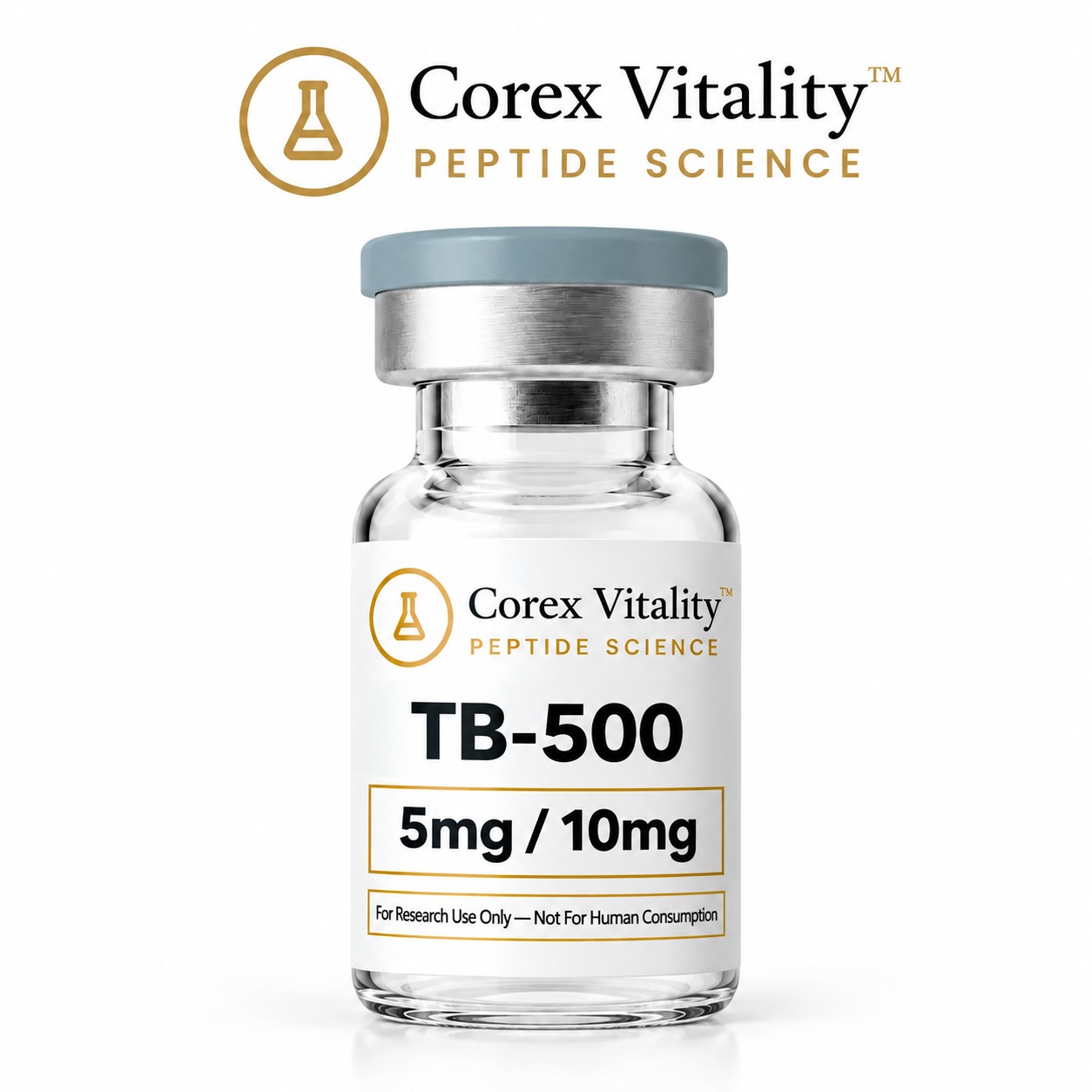
TB-500 is sometimes searched as “TB500”. TB-500 remains the product name used here. Review the exact compound and batch documentation for in-vitro laboratory research only; not for human or veterinary use.
About TB-500
TB-500 is a synthetic peptide related to thymosin beta-4, a naturally occurring 43-amino-acid protein that binds actin and is found in most mammalian tissues [3]. The compound name on each batch is shown on its Certificate of Analysis on our Verification page.
The name is not always used consistently, and some publications use “TB-500” for synthetic full-length thymosin beta-4. TB-500 has not been approved as a medicine by the MHRA, the FDA or any other regulator. The product sold here is a research compound for laboratory use only.
Related research compounds: BPC-157, a synthetic 15-amino-acid peptide, and the TB-500 + BPC-157 Blend, which pairs one vial of each peptide.
A short identity explainer is on our TB-500 research video page. Laboratory reconstitution and storage steps are in the peptide reconstitution and storage guide.
Areas of research
Published research relevant to TB-500 includes:
- biochemical studies of how this peptide family binds and holds actin monomers [1]
- its metabolism in human serum, laboratory enzyme systems and rats, and fibroblast assays comparing it with its metabolites [2]
- endothelial cell migration and vessel sprouting assays showing that the seven-amino-acid actin-binding motif of thymosin beta-4 accounts for its angiogenic activity in these models [3]
- a 2026 narrative review of approved and unapproved peptides, including TB-500, in sports medicine [4]
The authors of reference 2 note that the biological effects of TB-500 itself have been little documented, and the 2026 review found that rigorous human safety data for unapproved peptides such as TB-500 are scarce [2, 4]. The evidence base therefore remains at an early, largely preclinical stage.
Product specifications
| Form |
Lyophilised (freeze-dried) powder in a sealed vial |
| Sizes |
5mg, 10mg |
| Identity |
As named on the batch COA |
| Purity |
COAs are published for the 5mg and 10mg batches. The current 5mg COA reports HPLC purity of >99.5% and the 10mg COA >99.6%. |
Storage and handling
Storage & Handling — Corex Vitality™ research vials
- As supplied: freeze-dried (lyophilised) powder in a sealed vial. Room-temperature transit is normal for dry peptides.
- Longer storage: keep the vial tightly closed in a freezer at −20 °C or colder, dry and away from light. Colder is better for long archives.
- Short-term: a laboratory fridge (2–8 °C) is fine for vials you plan to open soon.
- Before opening: let the closed vial warm to room temperature, ideally in a desiccator, so moisture does not condense on the powder. Work quickly and reseal tightly; absorbed moisture lowers the real peptide content.
- Dissolving: choose a solvent based on the sequence (see the compound note below) and test a small portion first. Swirl gently; brief sonication in a water bath can help. Do not heat.
- Once in solution: make up only what you need. Split any solution you keep into single-use aliquots, freeze at −20 °C or colder and thaw each aliquot only once. Peptides keep far less well in solution than as dry powder.
- Safety: handle in a suitable laboratory with appropriate PPE, following your institution’s safety procedures, and avoid breathing the powder. Keep out of reach of children.
Compound note: Generally water-friendly. Avoid keeping it in solution; aliquot and freeze any solution you keep.
For in-vitro laboratory research use only. Not for human or veterinary use. General guidance paraphrased from Bachem: Handling and Storage Guidelines for Peptides and Peptide Solubility.
Quality and testing
HPLC tested TB-500 has been analysed by third-party laboratories using HPLC. COAs are published for the 5mg batch (LDA22162335) and the 10mg batch (LDA22161162); a 20mg batch COA is also published. You can also browse every published certificate on our COA and verification page.
TB-500 batch testing question
Does HPLC purity establish peptide identity?
Not by itself. Chromatographic purity and identity are different analytical questions. Check which methods and results the certificate actually reports, and match the exact compound, size and batch identifier on our verification page. Do not assume an identity test was performed unless the report says so.
For laboratory research use only. Not for human consumption.
Research use only
For in-vitro laboratory research use only. Not for human or veterinary use. These products are research chemicals. They are not medicines, food, or supplements. They have not been evaluated by the MHRA, FDA, or any other regulatory body. Not intended to diagnose, treat, cure, or prevent any disease. All descriptions are for reference and research documentation purposes only. By purchasing, you confirm you are aged 18+ and using these products exclusively for in vitro laboratory research.
Related reading
References
- Safer D, Elzinga M, Nachmias VT. Thymosin beta 4 and Fx, an actin-sequestering peptide, are indistinguishable. J Biol Chem. 1991. PubMed 1999398
- Hannappel E. beta-Thymosins. Ann N Y Acad Sci. 2007. PubMed 17468232
- Philp D, et al. The actin binding site on thymosin beta4 promotes angiogenesis. FASEB J. 2003. PubMed 14500546
- Mendias CL, et al. Safety and efficacy of approved and unapproved peptide therapies for musculoskeletal injuries and athletic performance. Sports Med. 2026. PubMed 41966639



Reviews
There are no reviews yet.