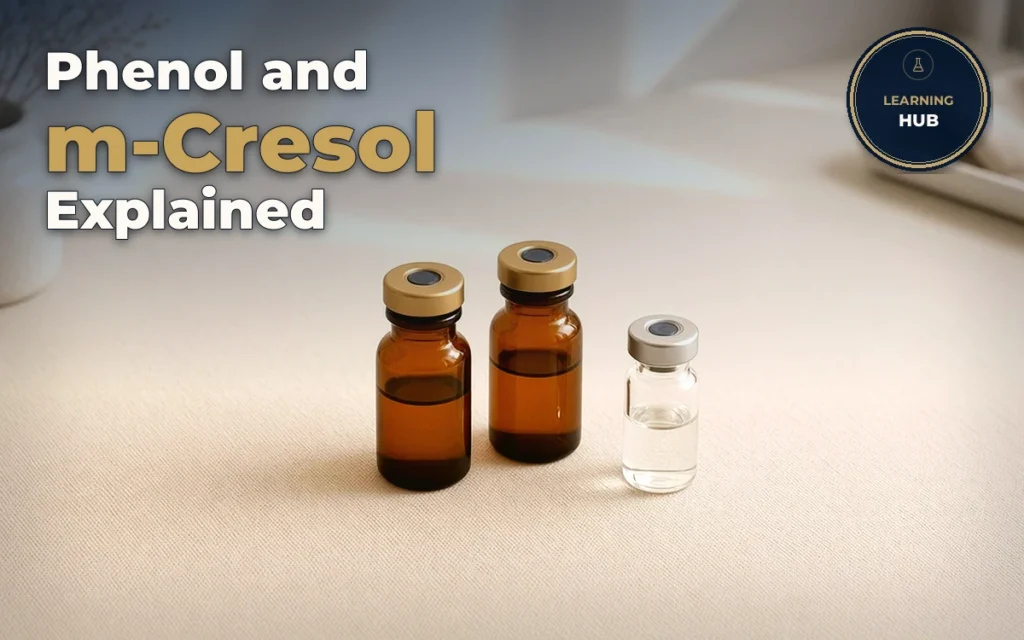
Phenol and m-Cresol: Preservatives in Pen Cartridges
Phenol and m-Cresol: Preservatives in Pen Cartridges
By the Corex Vitality™ Research Team · Last checked 7 November 2026 · Sources listed under Published Research
Quick summary
Phenol and m-cresol are antimicrobial preservatives. They stop bacteria and fungi growing in liquid products that are used more than once, such as pen cartridges.
They are added on purpose and are listed as excipients (inactive ingredients). They are not impurities.
Lab studies show they can also make some proteins and peptides partly unfold and clump together, so each formulation has to be tested.
This guide covers the chemistry and lab tests. It does not discuss personal use.
Pre-filled pen cartridges hold a peptide in solution and are used over a period of time. That creates a problem a dry, single-use vial does not have: bacteria or fungi could grow in the liquid. This plain-English guide explains why a phenol or m-cresol preservative is used, what the published research says about how these preservatives interact with peptides and proteins, and what that means when you read a label or COA. For the basics of pens, see pre-filled pens vs lyophilised vials.
1. First, some basic words
An excipient is any ingredient in a product other than the active molecule, for example a buffer, a salt or a preservative.
An antimicrobial preservative is an excipient that stops bacteria and fungi from growing.
Phenol is a benzene ring with one -OH group. m-Cresol (meta-cresol, 3-methylphenol) is phenol with an extra methyl group. Both are called phenolic preservatives.
Aggregation means peptide or protein molecules sticking together. Small clumps are called subvisible particles; large ones can be seen by eye.
Partial unfolding means one region of a folded molecule loosens while the rest stays folded.
2. Why preservatives are used in cartridges
A sealed, single-use container only has to be sterile once. A cartridge that is pierced or opened again and again needs protection for its whole in-use period. A 2023 review of protein and peptide products explains that such multi-use liquid products need an antimicrobial preservative, and lists the common choices:
phenol
m-cresol
benzyl alcohol (also the preservative in bacteriostatic water)
phenoxyethanol
chlorobutanol
The same review covers each preservative’s physical and chemical properties, how it behaves with other excipients and packaging, and includes a list of licensed protein and peptide products and the preservatives they use.
3. The trade-off: an m-cresol preservative can cause clumping
The review also notes that some preservatives have been reported to increase particle formation. Two laboratory studies from the same group looked at why.
With a model protein (cytochrome c), all five preservatives increased partial unfolding of one region of the protein, and that same region acted as a “hot-spot” for aggregation. The ranking was m-cresol > phenol > benzyl alcohol > phenoxyethanol > chlorobutanol. Making the hot-spot region more stable reduced aggregation for all five.
With interferon alpha-2a, aggregation rose as the preservative concentration rose, and followed the same order. The authors suggest the mechanism may be broadly similar across different proteins.
4. What antibody studies add
Larger proteins such as antibodies have also been tested, which shows how the result depends on the molecule and the test conditions:
A reference IgG1 antibody was tested with 1.1% benzyl alcohol, 0.62% phenol and 0.42% m-cresol. All three lowered its conformational stability. Phenol had the largest effect, then m-cresol, then benzyl alcohol. Over 4 weeks at 40 °C, phenol and m-cresol raised subvisible particle counts, but size-exclusion chromatography showed no change in the amount of single (monomer) antibody.
In a study with the antibody trastuzumab under agitation stress, 0.3% m-cresol produced visible particles within 72 hours. Phenoxyethanol was the most compatible of the four preservatives tested.
The common lesson is that a preservative has to be matched to the molecule. A choice that works well for one peptide may not suit another.
5. How labs test preservative compatibility
Size-exclusion chromatography (SEC): measures how much of the molecule stays as single molecules and how much forms soluble clumps.
Subvisible particle counting: light obscuration or flow imaging counts particles too small to see.
Differential scanning calorimetry (DSC): measures the temperature at which the molecule unfolds. A lower value means lower stability.
Hydrogen-exchange and NMR methods: show which regions of a molecule become more flexible.
If a cartridge lists phenol, m-cresol or another preservative, it is a deliberate part of the formulation. On a COA, check what the purity figure refers to: usually the peptide relative to its related substances, not the whole solution. Our guides on HPLC purity vs net peptide content and peptide impurities explain the difference. Storage conditions on the label matter too, because heat and shaking were the stress conditions used in the studies above. See our peptide pens storage and handling guide.
Key takeaways
Phenol and m-cresol are phenolic antimicrobial preservatives used in multi-use liquid products such as pen cartridges.
They are excipients added on purpose, not impurities.
In lab studies they can cause partial unfolding and aggregation; m-cresol and phenol caused the most clumping of the common preservatives in two protein models.
Effects depend on the molecule, the concentration and the stress conditions, so each formulation is tested with SEC, particle counts and DSC.
The peer-reviewed papers below were used for the science in this article. Each entry was checked against PubMed on 7 November 2026. Summaries describe chemistry, laboratory and cell-based findings only. Corex Vitality™ is not affiliated with the cited authors, journals or institutions.
Antimicrobial Preservatives for Protein and Peptide Formulations: An Overview. Stroppel L, Schultz-Fademrecht T, Cebulla M, et al. Pharmaceutics. 2023;15(2):563. PMID: 36839885 · DOI: 10.3390/pharmaceutics15020563 Review of antimicrobial preservatives used in protein and peptide products: which ones are used, their physical and chemical properties, compatibility with other ingredients and packaging, how they interact with the active molecule, and a list of licensed products.
Effect of antimicrobial preservatives on partial protein unfolding and aggregation. Hutchings RL, Singh SM, Cabello-Villegas J, et al. J Pharm Sci. 2013;102(2):365-76. PMID: 23169345 · DOI: 10.1002/jps.23362 Compared five preservatives on a model protein (cytochrome c). All increased partial unfolding of one region and aggregation, in the order m-cresol > phenol > benzyl alcohol > phenoxyethanol > chlorobutanol. Stabilising that region reduced aggregation for all five.
Antimicrobial preservatives induce aggregation of interferon alpha-2a: the order in which preservatives induce protein aggregation is independent of the protein. Bis RL, Mallela KM. Int J Pharm. 2014;472(1-2):356-61. PMID: 24974985 · DOI: 10.1016/j.ijpharm.2014.06.044 Repeated the preservative comparison on interferon alpha-2a. Aggregation rose with preservative concentration and followed the same order as the model protein (m-cresol > phenol > benzyl alcohol > phenoxyethanol).
Interaction between preservatives and a monoclonal antibody in support of multi-aliquot formulation development. Karunaratne SP, Jolliffe MC, Trayton I, et al. Int J Pharm. 2023;648:123600. PMID: 37967687 · DOI: 10.1016/j.ijpharm.2023.123600 Tested 1.1% benzyl alcohol, 0.62% phenol and 0.42% m-cresol with a reference IgG1 antibody (NIST mAb). Hydrogen-exchange measurements and differential scanning calorimetry showed lower conformational stability with all three; phenol and m-cresol raised subvisible particle counts over 4 weeks at 40 °C, while size-exclusion chromatography showed no change in monomer content.
Effects of antimicrobial preservatives on protein folding stability and subvisible particle formation in monoclonal antibody trastuzumab. Maharjan R, Hada S, Shin IJ, et al. Eur J Pharm Biopharm. 2025;215:114835. PMID: 40754203 · DOI: 10.1016/j.ejpb.2025.114835 Compared benzyl alcohol, m-cresol, phenoxyethanol and benzalkonium chloride with the antibody trastuzumab under agitation stress. m-Cresol (0.3%) produced visible particles within 72 hours; phenoxyethanol kept monomer content and particle counts close to baseline.
All Corex Vitality™ products are supplied strictly for in-vitro laboratory research use only. Not for human or veterinary use. No information here describes use in humans or animals.
Get it by email, plus our research updates. No spam, unsubscribe any time.
Help · Research use only
Chat questions stay on our website so we can answer them. We do not use them for marketing. We only keep unanswered questions (the question text, not your name or email) for a short weekly review. If you want a personal reply, email info@corexvitality.com.
Manage Consent
To provide the best experiences, we use technologies like cookies to store and/or access device information. Consenting to these technologies will allow us to process data such as browsing behaviour or unique IDs on this site. Not consenting or withdrawing consent may adversely affect certain features and functions.
Functional
Always active
The technical storage or access is strictly necessary for the legitimate purpose of enabling the use of a specific service explicitly requested by the subscriber or user, or for the sole purpose of carrying out the transmission of a communication over an electronic communications network.
Preferences
The technical storage or access is necessary for the legitimate purpose of storing preferences that are not requested by the subscriber or user.
Statistics
The technical storage or access that is used exclusively for statistical purposes.The technical storage or access that is used exclusively for anonymous statistical purposes. Without a subpoena, voluntary compliance on the part of your Internet Service Provider, or additional records from a third party, information stored or retrieved for this purpose alone cannot usually be used to identify you.
Marketing
The technical storage or access is required to create user profiles to send advertising, or to track the user on a website or across several websites for similar marketing purposes.
Research-grade peptides supplied exclusively for in-vitro laboratory research, supported by third-party HPLC testing and transparent batch documentation. Not for human or veterinary use.
By entering this website, you confirm that you are 18 years of age or older, are visiting exclusively for in-vitro laboratory research, and agree to our Terms & Conditions and Privacy Policy.