By the Corex Vitality™ Research Team · Last checked 10 November 2026 · Sources listed under Published Research
Quick summary
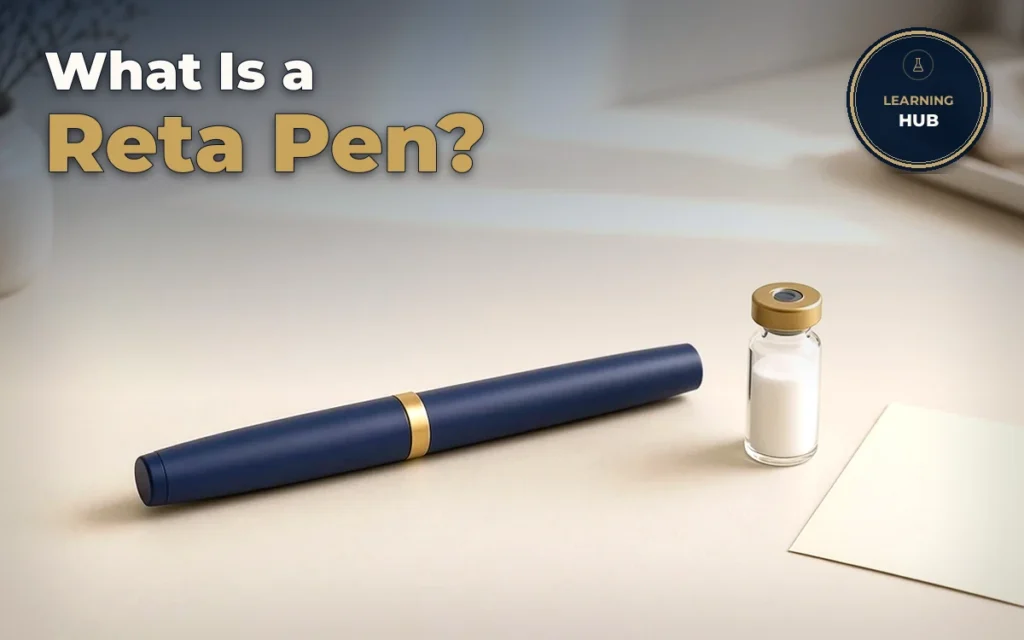
A Reta Pen is a short name for a Retatrutide pen: retatrutide supplied in solution in a pen-format research container. It is not a licensed medicine.
A lyophilised vial holds the same compound as a dry, freeze-dried powder. A Reta Pen holds it already in solution in a sealed cartridge.
Storage is different. A dry powder generally lasts longer if it is kept dry and at the temperature on the label. A solution is typically kept refrigerated at 2–8 °C and should not be frozen.
Choose the format that matches the laboratory protocol. Both formats are for in-vitro laboratory research use only.
People searching for a reta pen are usually asking a simple question: what is it, and how is it different from a vial of retatrutide? This guide answers that in plain English, with a focus on laboratory storage. It does not describe any use in humans or animals. For the mechanical detail of cartridges versus vials, see our longer pens vs lyophilised vials guide.
1. What is a Reta Pen?
“Reta Pen” is a short name for a Retatrutide pen. It is retatrutide presented as a ready-made solution in a sealed, pen-format research container, rather than as a freeze-dried powder in a vial. The compound is the same as the matching lyophilised Retatrutide research vials. You can read the chemistry of that molecule in our article on retatrutide structure.
At Corex Vitality™, each Retatrutide pen is filled fresh to order from in-stock lyophilised compound, then labelled for laboratory sale. The certificate that accompanies the pen is the source-batch Certificate of Analysis (COA) for the lyophilised batch the cartridge is prepared from. The filled solution itself is not separately tested. You can open those batch documents on our verification page.
A Reta Pen is a research-only format. It is not a licensed medicine.
2. What is in each container
The two common laboratory formats look different because the water has been handled differently:
Lyophilised vial. The peptide is freeze-dried. Water is removed under cold vacuum, leaving a dry powder or cake under a stopper, often with a vacuum or an inert headspace. The laboratory starts from that solid when the work begins.
Reta Pen (solution in a cartridge). The same compound is already in solution inside a sealed glass cartridge. The laboratory receives a liquid, not a powder.
If you already have a Retatrutide Pen (Reta Pen) kit, a Refill Pen is the pen only, with no hard case or box. Storage for the refill is the same as for the kit pen, because both hold a solution. The product pages list what is included with each option.
Lab storage at a glance: a lyophilised vial is a dry powder; a Reta Pen is a solution in a sealed cartridge, kept at 2–8 °C and not frozen.
3. Why the two formats need different storage
Once a peptide is in water, chemical and physical changes can proceed more readily than they do in a dry solid. Published reviews of peptide and protein storage describe hydrolysis, deamidation, oxidation and aggregation as routes that are favoured in aqueous solution. Liquid preparations often need cold storage, or drying, to reach a useful shelf life.
Freeze-drying is used to remove most of that water, which slows those routes and is why a dry powder generally keeps for longer. The dried solid is not inert, though. A 1999 review of solid-state peptide and protein chemistry notes that deamidation, cleavage, oxidation and aggregation can still occur in the dry state, and that temperature and residual moisture affect the rate.
That science maps onto everyday laboratory handling:
Reta Pen (solution): keep the pen refrigerated at 2–8 °C, sealed and away from light. Do not freeze it. Ice can stress the glass cartridge and the seal, and can also affect the dissolved peptide. A solution has a shorter labelled storage period than a dry powder. Use within 30 to 45 days after first use of the pen. Some cartridges also contain a small amount of a preservative; that is covered in our article on phenol and m-cresol in pen cartridges.
Lyophilised vial (dry powder): keep the vial dry, sealed and protected from light, at the temperature on the label. For longer storage, lyophilised peptides are often kept frozen. Do not let moisture into the powder before you are ready to dissolve it for the experiment. Our peptide storage guide covers handling of the dry format in more detail.
4. Side-by-side: lab storage
Point
Lyophilised vial
Reta Pen (solution)
What you receive
Dry, freeze-dried powder in a vial
Retatrutide already in solution in a sealed cartridge
Typical storage
Dry, dark, and at the labelled temperature; often frozen for longer storage
Refrigerated at 2–8 °C, sealed, away from light
Freezing
Often used for longer storage of the dry solid, if the label allows it
Do not freeze the solution
When a solution is made
In the laboratory, when the work starts
Already in solution when the pen arrives
Storage period
Usually longer, if the powder stays dry
Shorter labelled period. Use within 30 to 45 days after first use of the pen
Certificate of Analysis
Batch COA for that lyophilised lot
Source-batch COA for the lyophilised lot the cartridge was prepared from; the filled solution is not separately tested
5. Choosing a format for a laboratory protocol
Choose a Retatrutide pen (Reta Pen) when a ready-made solution in a sealed cartridge suits the protocol, and when refrigerated storage at 2–8 °C is available. Choose a lyophilised Retatrutide vial when the work starts from dry powder, or when you need to choose the solvent and the working concentration in the laboratory.
The two formats are alternatives for in-vitro laboratory work, not interchangeable storage conditions. A solution and a dry powder have to be kept differently, even when the compound name is the same.
Key takeaways
A Reta Pen is a Retatrutide pen: retatrutide in solution in a pen-format research container, not a licensed medicine.
A lyophilised vial holds the same compound as a dry powder; a pen holds it already in solution.
Published storage science explains the difference: water speeds up many breakdown routes, so a dry powder generally keeps longer, and a solution is kept cold and is not frozen.
The peer-reviewed papers below were used for the science in this article. Each entry was checked against PubMed on 10 November 2026. Summaries describe chemistry, laboratory and cell-based findings only. Corex Vitality™ is not affiliated with the cited authors, journals or institutions.
Solid-state chemical stability of proteins and peptides. Lai MC, Topp EM. J Pharm Sci. 1999;88(5):489-500. PMID: 10229638 · DOI: 10.1021/js980374e Review of chemical reactions that can still occur in a dried peptide or protein solid, including deamidation, chain cleavage, oxidation and aggregation. Temperature, moisture and the physical state of the solid all affect how fast those changes happen, which is why a dry powder is usually more stable than a solution but is not inert.
Instability, stabilization, and formulation of liquid protein pharmaceuticals. Wang W. Int J Pharm. 1999;185(2):129-88. PMID: 10460913 · DOI: 10.1016/s0378-5173(99)00152-0 Review of chemical and physical instability in aqueous protein preparations. The author notes that liquid products often need cold storage, or drying, to reach a useful shelf life, and surveys the main breakdown routes in water and the means used to slow them.
Rational design of stable lyophilized protein formulations: some practical advice. Carpenter JF, Pikal MJ, Chang BS, Randolph TW. Pharm Res. 1997;14(8):969-75. PMID: 9279875 · DOI: 10.1023/a:1012180707283 A short practical review on designing stable freeze-dried (lyophilised) protein preparations, including why water is removed to extend storage life and why residual moisture and storage temperature of the dried solid still matter.
Stability of protein pharmaceuticals: an update. Manning MC, Chou DK, Murphy BM, Payne RW, Katayama DS. Pharm Res. 2010;27(4):544-75. PMID: 20143256 · DOI: 10.1007/s11095-009-0045-6 An update of a widely cited 1989 review, covering chemical and physical instability and the ways proteins and peptides can be stabilised both in aqueous solution and in the dried state.
All Corex Vitality™ products are supplied strictly for in-vitro laboratory research use only. Not for human or veterinary use. No information here describes use in humans or animals.
Get it by email, plus our research updates. No spam, unsubscribe any time.
Help · Research use only
Chat questions stay on our website so we can answer them. We do not use them for marketing. We only keep unanswered questions (the question text, not your name or email) for a short weekly review. If you want a personal reply, email info@corexvitality.com.
Manage Consent
To provide the best experiences, we use technologies like cookies to store and/or access device information. Consenting to these technologies will allow us to process data such as browsing behaviour or unique IDs on this site. Not consenting or withdrawing consent may adversely affect certain features and functions.
Functional
Always active
The technical storage or access is strictly necessary for the legitimate purpose of enabling the use of a specific service explicitly requested by the subscriber or user, or for the sole purpose of carrying out the transmission of a communication over an electronic communications network.
Preferences
The technical storage or access is necessary for the legitimate purpose of storing preferences that are not requested by the subscriber or user.
Statistics
The technical storage or access that is used exclusively for statistical purposes.The technical storage or access that is used exclusively for anonymous statistical purposes. Without a subpoena, voluntary compliance on the part of your Internet Service Provider, or additional records from a third party, information stored or retrieved for this purpose alone cannot usually be used to identify you.
Marketing
The technical storage or access is required to create user profiles to send advertising, or to track the user on a website or across several websites for similar marketing purposes.
Research-grade peptides supplied exclusively for in-vitro laboratory research, supported by third-party HPLC testing and transparent batch documentation. Not for human or veterinary use.
By entering this website, you confirm that you are 18 years of age or older, are visiting exclusively for in-vitro laboratory research, and agree to our Terms & Conditions and Privacy Policy.