
What are senolytics?

A research overview. Summarises published literature for educational purposes.
In brief
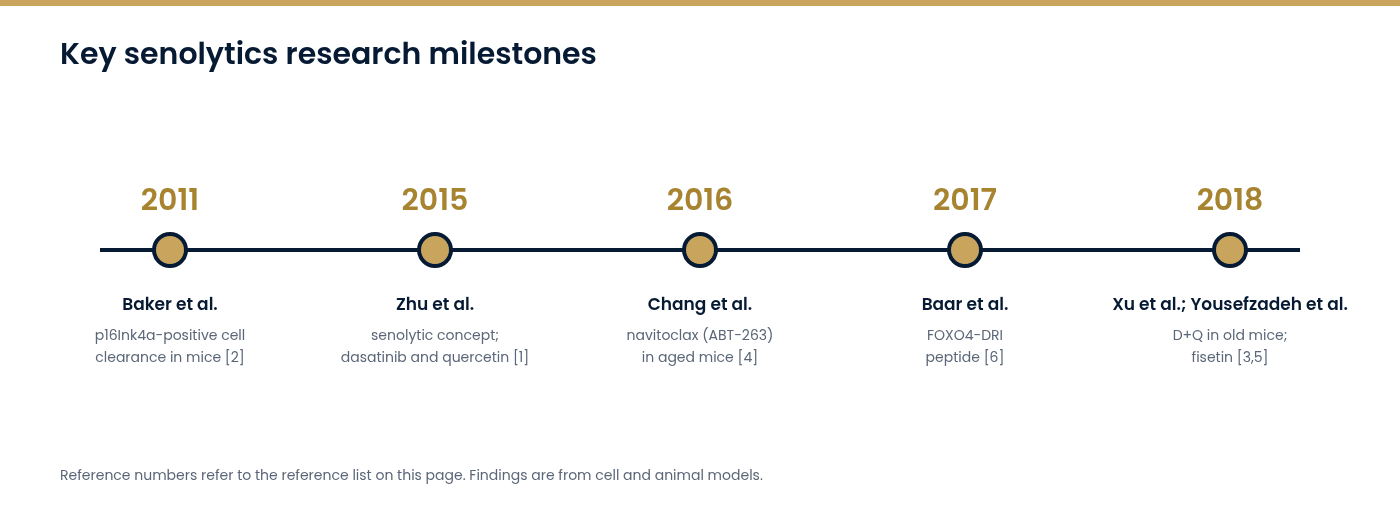
“Senolytic” is the term researchers use for agents that selectively induce death in senescent cells while leaving non-senescent cells largely unaffected in the experimental system being studied. The word combines senescence and -lytic (causing breakdown). The concept was first set out in the literature in 2015 [1]. Since then, senolytics have become one of the most widely discussed topics in ageing biology.
Background: why target senescent cells?
Senescent cells are cells that have permanently stopped dividing but remain metabolically active. Many of them release a mixture of signalling molecules known as the senescence-associated secretory phenotype (SASP). For a fuller explanation, see Cellular senescence explained.
A key early study used a genetically engineered mouse model (INK-ATTAC) in which cells expressing the senescence marker p16Ink4a could be selectively eliminated by giving the animals a drug. In that progeroid (fast-ageing) mouse model, removing p16Ink4a-positive cells delayed the onset of several age-associated changes in the tissues studied [2]. This genetic “proof of concept” prompted the search for small molecules and peptides that could achieve a similar effect.
How the first senolytics were identified
Zhu and colleagues (2015) reasoned that senescent cells survive by relying on pro-survival (“anti-apoptotic”) pathways. They used transcriptome analysis to identify these pathways and then screened compounds that interfere with them. They reported that dasatinib and quercetin each preferentially reduced the viability of different senescent cell types in culture, and they studied the combination in mice [1]. The authors called these networks “senescent cell anti-apoptotic pathways” (SCAPs).
Compound classes studied in the literature
The compounds below appear in the senolytics literature. They are listed as background only. Corex Vitality™ does not sell dasatinib, quercetin, fisetin or navitoclax.
| Compound / class | What it is | Models reported in | Key reference |
|---|---|---|---|
| Dasatinib + quercetin (D+Q) | A tyrosine kinase inhibitor combined with a plant flavonoid | Cell culture; mice | Zhu 2015 [1]; Xu 2018 [3] |
| Navitoclax (ABT-263) | Inhibitor of the BCL-2 family of pro-survival proteins | Cell culture; aged mice (haematopoietic stem cells) | Chang 2016 [4] |
| Fisetin | A plant flavonoid identified in a screen of flavonoids | Cell culture; mice | Yousefzadeh 2018 [5] |
| FOXO4-DRI | A modified (D-retro-inverso) peptide designed to disrupt the FOXO4–p53 interaction | Cell culture; mice | Baar 2017 [6] |
FOXO4-DRI is the one peptide in this list. A separate research summary is on our Longevity peptides page.
What animal studies have reported
- In mice, transplanting small numbers of senescent cells into young animals was reported to cause measurable physical dysfunction. In separate experiments, intermittent D+Q treatment in old mice was associated with reduced senescent-cell markers and changes in survival measures [3].
- In aged mice, navitoclax treatment was reported to deplete senescent cells in the bone marrow and alter the function of haematopoietic stem cells [4].
- Fisetin reduced senescence markers in several tissues of progeroid and naturally aged mice in the conditions tested [5].
- FOXO4-DRI selectively induced apoptosis in senescent cells in culture and was studied in fast-ageing and naturally aged mouse models [6].
These are findings from specific experimental models. Results in cells and rodents do not establish effects in humans.
Senolytics and senomorphics
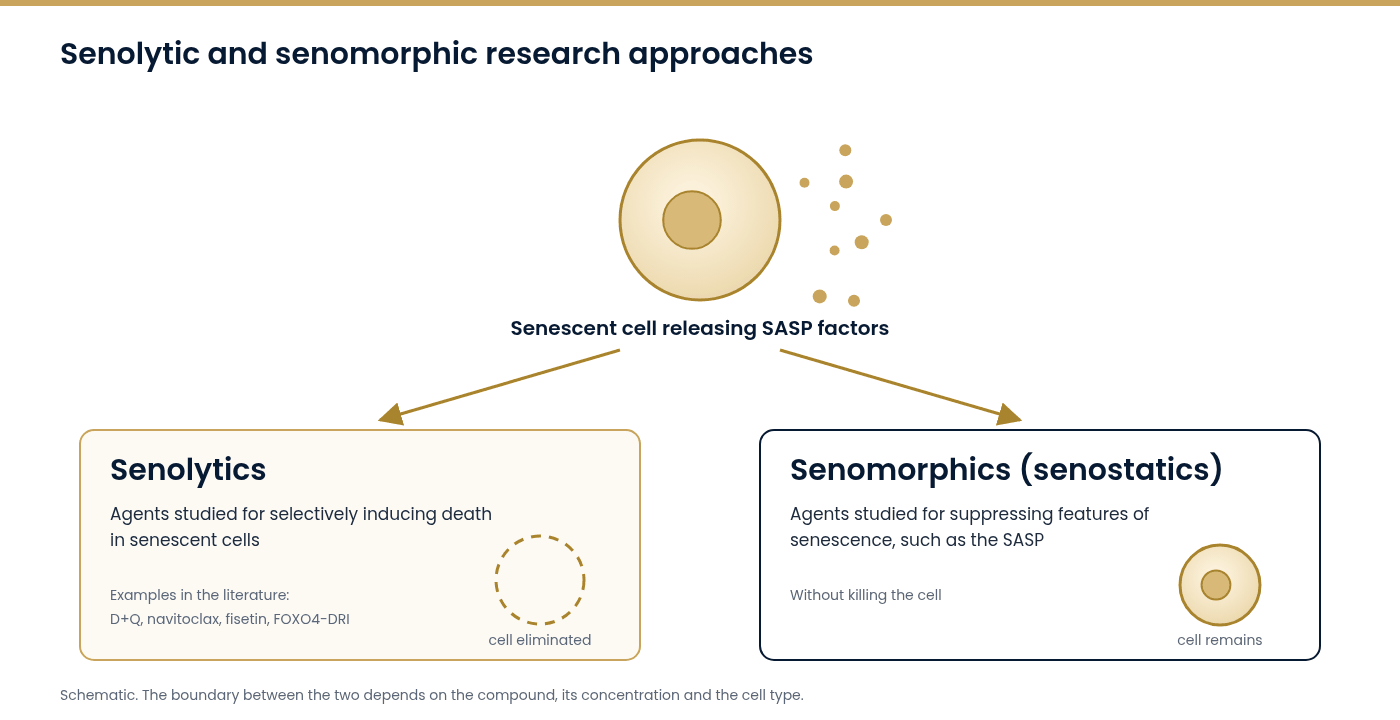
Researchers distinguish senolytics, which eliminate senescent cells, from senomorphics (also called senostatics), which suppress features of senescence such as the SASP without killing the cell [7]. Both approaches are under investigation, and the boundary between them depends on the compound, its concentration and the cell type.
Open questions in the field
Reviews of the field highlight several unresolved issues [7]:
- Selectivity: senescent cells vary between tissues and triggers, so no single agent acts on all of them.
- Markers: there is no single universal marker of senescence, so studies typically combine several (see Cellular senescence explained).
- Physiological roles of senescence: senescence also plays roles in processes such as embryonic development and wound repair, and the consequences of removing senescent cells are still being characterised.
- Translation: early-stage clinical studies have begun, but they are outside the scope of this page. Findings from animal models cannot be extrapolated to humans.
Related research compounds
Longevity peptides research summary · View all longevity research compounds
Research use only. This article summarises published scientific literature for educational purposes. It does not describe the effects of any Corex Vitality™ product. Corex Vitality™ products are supplied for laboratory research purposes only and are not intended for human or veterinary use, or for the diagnosis, treatment, prevention or cure of any disease or medical condition.
References
- Zhu Y, Tchkonia T, Pirtskhalava T, et al. The Achilles’ heel of senescent cells: from transcriptome to senolytic drugs. Aging Cell. 2015;14(4):644-658. PubMed: https://pubmed.ncbi.nlm.nih.gov/25754370/ · DOI: https://doi.org/10.1111/acel.12344
- Baker DJ, Wijshake T, Tchkonia T, et al. Clearance of p16Ink4a-positive senescent cells delays ageing-associated disorders. Nature. 2011;479(7372):232-236. PubMed: https://pubmed.ncbi.nlm.nih.gov/22048312/ · DOI: https://doi.org/10.1038/nature10600
- Xu M, Pirtskhalava T, Farr JN, et al. Senolytics improve physical function and increase lifespan in old age. Nat Med. 2018;24(8):1246-1256. PubMed: https://pubmed.ncbi.nlm.nih.gov/29988130/ · DOI: https://doi.org/10.1038/s41591-018-0092-9
- Chang J, Wang Y, Shao L, et al. Clearance of senescent cells by ABT263 rejuvenates aged hematopoietic stem cells in mice. Nat Med. 2016;22(1):78-83. PubMed: https://pubmed.ncbi.nlm.nih.gov/26657143/ · DOI: https://doi.org/10.1038/nm.4010
- Yousefzadeh MJ, Zhu Y, McGowan SJ, et al. Fisetin is a senotherapeutic that extends health and lifespan. EBioMedicine. 2018;36:18-28. PubMed: https://pubmed.ncbi.nlm.nih.gov/30279143/ · DOI: https://doi.org/10.1016/j.ebiom.2018.09.015
- Baar MP, Brandt RMC, Putavet DA, et al. Targeted apoptosis of senescent cells restores tissue homeostasis in response to chemotoxicity and aging. Cell. 2017;169(1):132-147.e16. PubMed: https://pubmed.ncbi.nlm.nih.gov/28340339/ · DOI: https://doi.org/10.1016/j.cell.2017.02.031
- Kirkland JL, Tchkonia T. Senolytic drugs: from discovery to translation. J Intern Med. 2020;288(5):518-536. PubMed: https://pubmed.ncbi.nlm.nih.gov/32686219/ · DOI: https://doi.org/10.1111/joim.13141