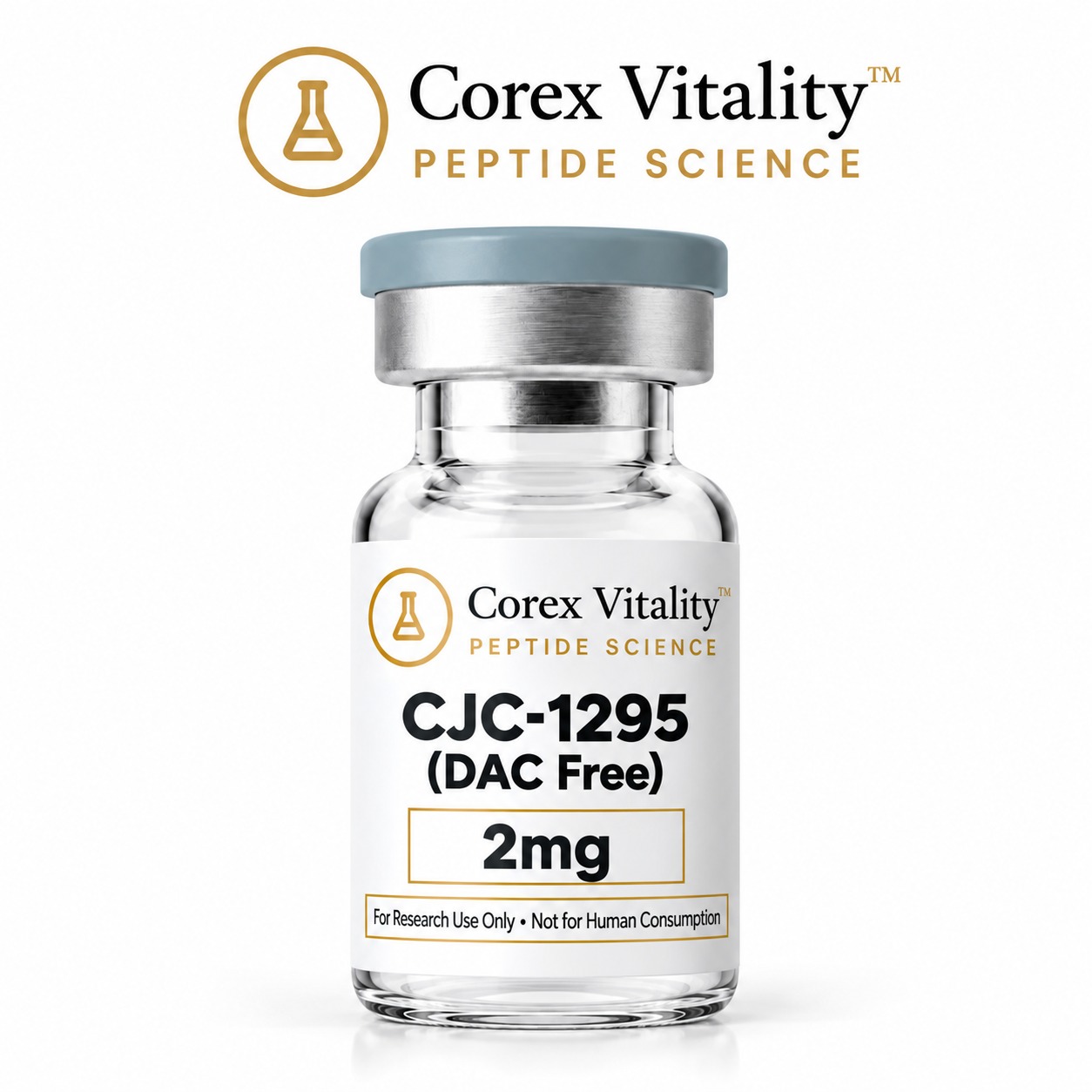
About CJC-1295 (DAC-free)
CJC-1295 (DAC-free), also known as modified GRF (1-29), is a synthetic analogue of the first 29 amino acids of growth hormone-releasing hormone (GHRH), the region that carries the full biological activity of the hormone [2]. Four amino acids are substituted (D-Ala at position 2, Gln at 8, Ala at 15 and Leu at 27) to make it more resistant to breakdown, and the C-terminus is amidated [1, 2]. It has the sequence Tyr-D-Ala-Asp-Ala-Ile-Phe-Thr-Gln-Ser-Tyr-Arg-Lys-Val-Leu-Ala-Gln-Leu-Ser-Ala-Arg-Lys-Leu-Leu-Gln-Asp-Ile-Leu-Ser-Arg-NH2.
The original CJC-1295 described in the scientific literature also carries a “drug affinity complex” (DAC): an extra lysine with a maleimidopropionyl group that binds covalently to serum albumin and greatly extends its half-life [1]. The product sold here does not contain the DAC. CJC-1295 has not been approved as a medicine by the MHRA, the FDA or any other regulator, and the product sold here is a research compound for laboratory use only.
Related research compound: Ipamorelin, a synthetic pentapeptide that acts at the ghrelin (growth hormone secretagogue) receptor and not at the GHRH receptor.
Areas of research
Most published research concerns CJC-1295 with DAC, and dedicated studies of the DAC-free form are limited. Published work includes:
- the design of albumin-binding derivatives of GRF(1-29), and their stability and activity in rat pituitary cell assays and in rats [1]
- pharmacokinetic and pharmacodynamic studies of CJC-1295 with DAC in healthy adult volunteers [2, 3]
- studies of growth parameters in mice lacking the GHRH gene [4]
Findings on the DAC version cannot be assumed to apply to the DAC-free form, which lacks the albumin-binding group. The evidence base remains at an early stage.
Product specifications
| Form |
Lyophilised (freeze-dried) powder in a sealed vial |
| Sizes |
2mg, 5mg, 10mg |
| Sequence |
29 amino acids, C-terminal amide (modified GRF 1-29), without DAC |
| Molecular formula |
C152H252N44O42 (calculated from sequence) |
| Molecular weight |
approx. 3368 g/mol (calculated from sequence) |
| Purity |
COA shown is for the 5mg batch. The current 5mg COA reports HPLC purity of >99.6%. |
Storage and handling
Storage & Handling — Corex Vitality™ research vials
- As supplied: freeze-dried (lyophilised) powder in a sealed vial. Room-temperature transit is normal for dry peptides.
- Longer storage: keep the vial tightly closed in a freezer at −20 °C or colder, dry and away from light. Colder is better for long archives.
- Short-term: a laboratory fridge (2–8 °C) is fine for vials you plan to open soon.
- Before opening: let the closed vial warm to room temperature, ideally in a desiccator, so moisture does not condense on the powder. Work quickly and reseal tightly; absorbed moisture lowers the real peptide content.
- Dissolving: choose a solvent based on the sequence (see the compound note below) and test a small portion first. Swirl gently; brief sonication in a water bath can help. Do not heat.
- Once in solution: make up only what you need. Split any solution you keep into single-use aliquots, freeze at −20 °C or colder and thaw each aliquot only once. Peptides keep far less well in solution than as dry powder.
- Safety: handle in a suitable laboratory with appropriate PPE, following your institution’s safety procedures, and avoid breathing the powder. Keep out of reach of children.
Compound note: No Cys, Met or Trp, but three glutamines, so it keeps less well in solution — aliquot and freeze promptly. Basic: a trace of dilute acetic acid before dilution if slow.
For in-vitro laboratory research use only. Not for human or veterinary use. General guidance paraphrased from Bachem: Handling and Storage Guidelines for Peptides and Peptide Solubility.
Quality and testing
CJC-1295 (DAC-free) has been tested by third-party analytical laboratories using HPLC. The COA shown is for the 5mg batch; no separate COA has been issued for the 2mg or 10mg sizes. You can also browse every published certificate on our COA and verification page.
Research use only
For in-vitro laboratory research use only. Not for human or veterinary use. These products are research chemicals. They are not medicines, food, or supplements. They have not been evaluated by the MHRA, FDA, or any other regulatory body. Not intended to diagnose, treat, cure, or prevent any disease. All descriptions are for reference and research documentation purposes only. By purchasing, you confirm you are aged 18+ and using these products exclusively for in vitro laboratory research.
References
- Jetté L, et al. Human growth hormone-releasing factor (hGRF)1-29-albumin bioconjugates activate the GRF receptor on the anterior pituitary in rats: identification of CJC-1295 as a long-lasting GRF analog. Endocrinology. 2005. PubMed 15817669
- Teichman SL, et al. Prolonged stimulation of growth hormone (GH) and insulin-like growth factor I secretion by CJC-1295, a long-acting analog of GH-releasing hormone, in healthy adults. J Clin Endocrinol Metab. 2006. PubMed 16352683
- Ionescu M, Frohman LA. Pulsatile secretion of growth hormone (GH) persists during continuous stimulation by CJC-1295, a long-acting GH-releasing hormone analog. J Clin Endocrinol Metab. 2006. PubMed 17018654
- Alba M, et al. Once-daily administration of CJC-1295, a long-acting growth hormone-releasing hormone (GHRH) analog, normalizes growth in the GHRH knockout mouse. Am J Physiol Endocrinol Metab. 2006. PubMed 16822960