Department of Kinesiology, McMaster University (Canada), with Brock University
Model
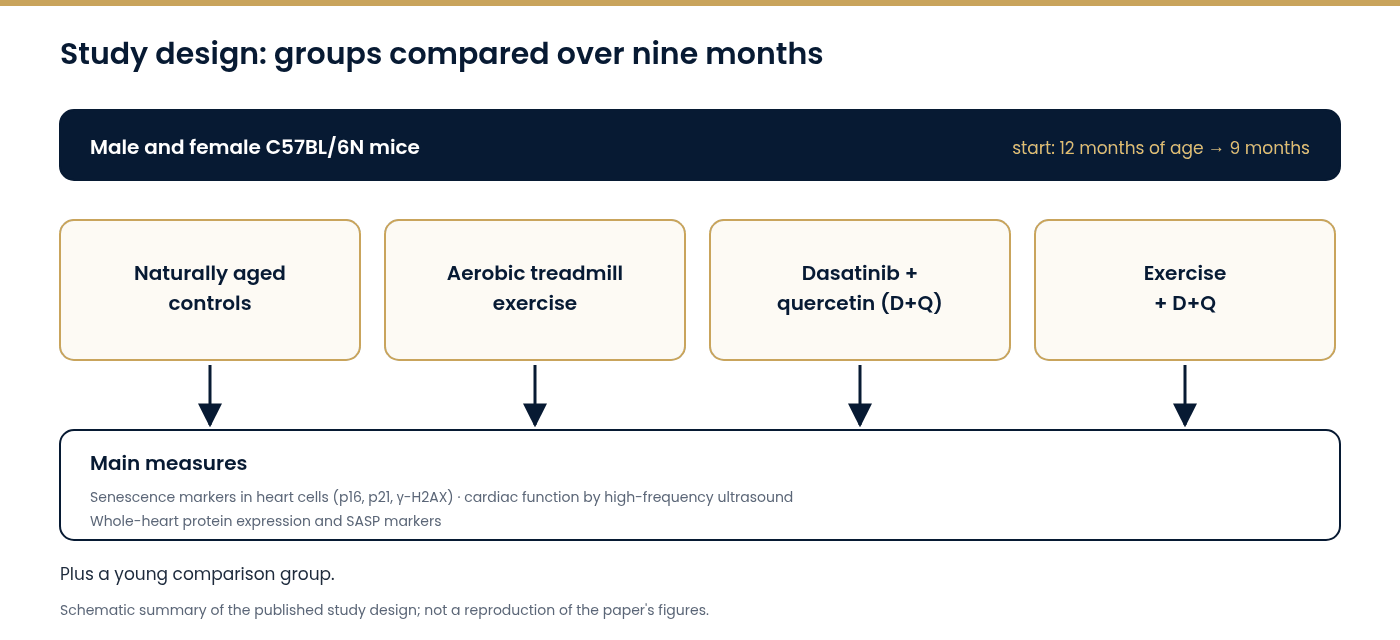
Male and female C57BL/6N mice, starting at 12 months of age
Duration
9 months
Groups compared
Naturally aged controls; aerobic treadmill exercise; the senolytic combination dasatinib + quercetin (D+Q); exercise and D+Q combined; plus a young comparison group
Main measures
Senescence markers in heart cells (p16, p21, γ-H2AX), cardiac function by high-frequency ultrasound, whole-heart protein expression and SASP markers
Why the study was done
Senescent cells have been reported to accumulate in the heart with age, both in cardiomyocytes (heart muscle cells) and in interstitial cells. Earlier studies had examined senolytic compounds and exercise separately, but mostly over short periods. The authors asked two questions: whether either approach, applied long-term from middle age, would change senescence markers in the mouse heart, and whether combining them would have an additive effect [1].
What the authors reported
In all three intervention groups (D+Q, exercise, and both combined), the proportion of heart cells positive for p16, p21 and γ-H2AX was lower than in the naturally aged control mice.
The intervention groups also showed differences in several ultrasound measures of heart function, including measures of diastolic (filling) function, compared with the aged controls.
No additive effect was seen: the combined group did not differ meaningfully from either intervention alone. The authors suggest that each approach may already have reduced the pool of senescent cells, leaving little room for an extra effect.
At the whole-heart level, p16 and p21 protein increased with age, but neither these nor the SASP markers measured were altered by any intervention.
Males and females were both included. The authors report that a sex-based analysis found no significant differences, although the data were not shown.
Limitations noted
No universal senescence marker. As the authors note, senescence was inferred from a combination of markers rather than identified definitively [1].
Whole-heart lysates may mask changes in specific cell types, which could explain why the SASP findings differed from the cell-level findings.
Sample sizes were modest (roughly 11–16 animals per group at the end of the study).
This is a mouse study. The authors note that further investigation is needed, and findings in mice cannot be extrapolated to other species.
Why it matters for researchers
The study adds long-duration data on two very different ways of influencing senescence in a single tissue. It also illustrates a methodological point that recurs throughout senescence research: results can differ depending on whether markers are measured cell by cell or in whole-tissue samples [2]. For background on these markers, see Cellular senescence explained. For more on D+Q and other senolytics in the literature, see What are senolytics?
Note: dasatinib and quercetin are discussed here as part of the published literature only. Corex Vitality™ does not sell them.
Longevity Research Digest
Monthly summaries of new published research, new certificates and new stock. Sign-up opens soon.
Research use only. This post summarises a published scientific study for educational purposes. It does not describe the effects of any Corex Vitality™ product. Corex Vitality™ products are supplied for laboratory research purposes only and are not intended for human or veterinary use, or for the diagnosis, treatment, prevention or cure of any disease or medical condition.
References
Bevington RT, Johnson AL, Hockey BL, Fajardo VA, Parise G. Chronic senolytic treatment and/or aerobic exercise reduce senescence and improve myocardial function during aging in the heart. Aging Cell. 2026;25(10):e70759. PubMed: https://pubmed.ncbi.nlm.nih.gov/42841582/ · DOI: https://doi.org/10.1111/acel.70759
Get new Learning Hub articles and stock updates. No spam. Unsubscribe any time.
Manage Consent
To provide the best experiences, we use technologies like cookies to store and/or access device information. Consenting to these technologies will allow us to process data such as browsing behaviour or unique IDs on this site. Not consenting or withdrawing consent may adversely affect certain features and functions.
Functional
Always active
The technical storage or access is strictly necessary for the legitimate purpose of enabling the use of a specific service explicitly requested by the subscriber or user, or for the sole purpose of carrying out the transmission of a communication over an electronic communications network.
Preferences
The technical storage or access is necessary for the legitimate purpose of storing preferences that are not requested by the subscriber or user.
Statistics
The technical storage or access that is used exclusively for statistical purposes.The technical storage or access that is used exclusively for anonymous statistical purposes. Without a subpoena, voluntary compliance on the part of your Internet Service Provider, or additional records from a third party, information stored or retrieved for this purpose alone cannot usually be used to identify you.
Marketing
The technical storage or access is required to create user profiles to send advertising, or to track the user on a website or across several websites for similar marketing purposes.
Research-grade peptides supplied exclusively for in-vitro laboratory research, supported by third-party HPLC testing and transparent batch documentation. Not for human or veterinary use.
By entering this website, you confirm that you are 18 years of age or older, are visiting exclusively for in-vitro laboratory research, and agree to our Terms & Conditions and Privacy Policy.