By the Corex Vitality™ Research Team · Last checked 5 November 2026 · Sources listed under Published Research
Quick summary
Telomeres are short DNA repeats that protect the ends of chromosomes.
Telomerase is the enzyme that can add those repeats. Its catalytic subunit is called TERT.
Protein coats called shelterin and CST help keep the ends stable and help set length.
Labs measure telomere length and TERT activity with several standard assays. This guide explains the biology and those assays only.
This article is a plain-English guide to telomerase telomere biology for laboratory readers. It sits alongside our autophagy explained guide and the wider senolytics and longevity research section. It does not discuss products for personal use.
1. First, some basic words
A chromosome is a long DNA package inside a cell nucleus.
The very tip of a chromosome is the telomere. In humans it is mostly the short DNA pattern TTAGGG, repeated many times.
Telomerase is a ribonucleoprotein enzyme. That means it has both an RNA piece and a protein piece. The protein that copies the RNA template into DNA is TERT (telomerase reverse transcriptase).
Cellular senescence, in cell-culture work, means a lasting stop in cell division after stress or after many divisions. It is a lab readout, not a lifestyle claim.
2. Why chromosome ends need a special cap
Ordinary DNA-copying machinery has trouble finishing the very end of a linear chromosome. Without a special system, ends would shorten every time a cell divides, and free DNA ends could be mistaken for broken DNA.
Reviews of telomere biology describe three cooperating systems:
the TTAGGG DNA repeats themselves;
the shelterin protein complex, which coats the repeats;
the CST complex, which helps with end replication and capping.
Together they keep the genome stable in dividing cells. A 2021 review in Life summarises how these modulators interact.
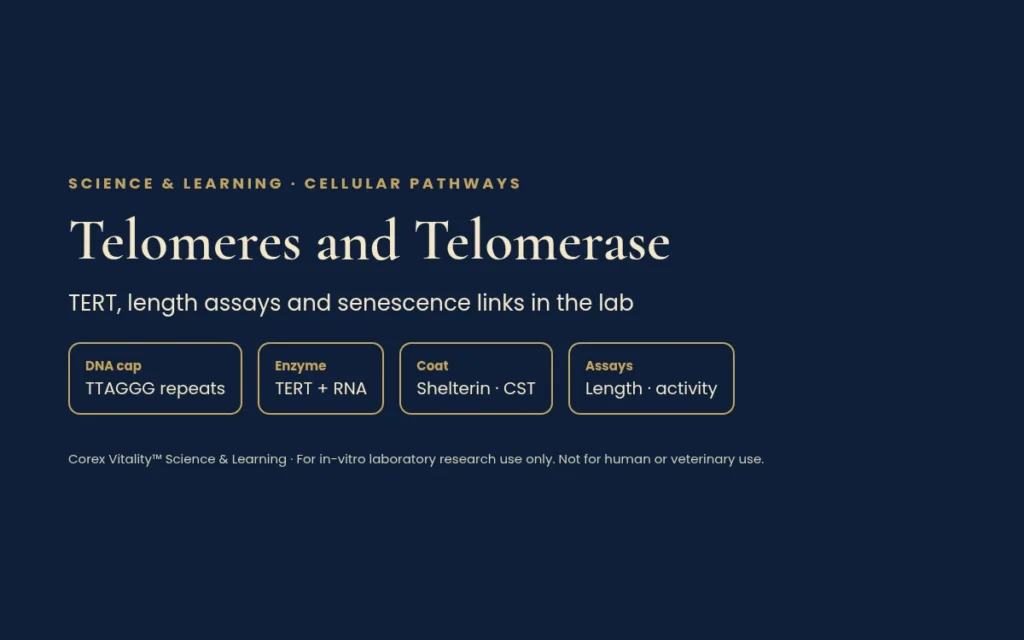
Overview of a chromosome end: TTAGGG repeats, shelterin/CST coats, TERT-based telomerase, and common lab assays. Diagram: Corex Vitality™ Science & Learning.
3. TERT and the telomerase enzyme
Telomerase adds TTAGGG repeats by using its RNA template and the TERT reverse transcriptase. A methods chapter on telomere neurobiology walks through TR (the RNA), TERT, and basic experimental approaches used in cell studies.
In many somatic cells grown in culture, telomerase activity is low or hard to detect. Some cell types keep higher activity. Published work also studies how TERT levels change when its gene is amplified, when its promoter sequence changes, or when different RNA splice forms appear. Those are molecular observations in cells and tissues, not instructions for use.
4. Shelterin, POT1–TPP1 and length control
Shelterin is a set of proteins that bind telomeric DNA. One important pair is POT1–TPP1. A 2020 review explains how this pair helps regulate telomere length and end capping, and why that matters for genome stability in cell models.
When capping fails in experimental systems, cells can show DNA-damage signals at chromosome ends. Researchers use that as a readout when they study mutants or knockdowns of shelterin parts.
5. How labs measure telomeres and TERT
Common laboratory approaches include:
Telomere length by Southern blot (terminal restriction fragments), quantitative PCR, or FISH-based methods that label the repeats under a microscope.
TERT expression by measuring TERT mRNA or protein.
Telomerase activity assays that detect the enzyme’s ability to extend a short DNA primer in a tube.
Senescence-linked markers in culture (for example cell-cycle exit markers), used only as experimental endpoints.
Each method has limits. Length assays average many cells. Activity assays can be sensitive to how the extract is made. Good papers report the method, the cell type and the controls.
6. What published cancer-cell studies add (and what they do not)
A large share of the telomere literature looks at cancer cell lines and tumours. Reviews describe TERT promoter mutations as a frequent non-coding change in those models, and they discuss how telomere maintenance can support continued division of those cells. That is useful background for reading papers. It is not a claim about any Corex Vitality™ product, and it is not advice for people.
The peer-reviewed papers below were used for the science in this article. Each entry was checked against PubMed on 5 November 2026. Summaries describe laboratory, cell-based and structural findings only. Corex Vitality™ is not affiliated with the cited authors, journals or institutions.
Telomeres and Cancer Fan HC, Chang FW, Tsai JD, Lin KM, Chen CM et al. Life (Basel). 2021;11(12). PMID: 34947936 · DOI: 10.3390/life11121405 Review of how telomeres protect chromosome ends, and how the shelterin and CST complexes, plus telomerase, keep telomere length under control in cells.
Telomere neurobiology Mattson MP, Zhang P, Cheng A. Methods Mol Biol. 2008;438:185-96. PMID: 18369758 · DOI: 10.1007/978-1-59745-133-8_15 Methods chapter covering telomere DNA repeats, the RNA template (TR), the reverse transcriptase TERT, and common ways labs study telomeres in cells.
POT1-TPP1 telomere length regulation and disease Aramburu T, Plucinsky S, Skordalakes E. Comput Struct Biotechnol J. 2020;18:1939-1946. PMID: 32774788 · DOI: 10.1016/j.csbj.2020.06.040 Review of POT1–TPP1, part of shelterin, and how this pair helps control telomere length and end capping in a way that keeps the genome stable.
TERT-Regulation and Roles in Cancer Formation Dratwa M, Wysoczańska B, Łacina P, Kubik T, Bogunia-Kubik K. Front Immunol. 2020;11:589929. PMID: 33329574 · DOI: 10.3389/fimmu.2020.589929 Review of TERT regulation, including gene copy number, promoter changes and splicing, and how those changes appear in published cell and tissue studies.
TERT promoter mutations and telomeres during tumorigenesis Lorbeer FK, Hockemeyer D. Curr Opin Genet Dev. 2020;60:56-62. PMID: 32163830 · DOI: 10.1016/j.gde.2020.02.001 Review of TERT promoter mutations as a frequent non-coding change in published cancer-cell studies, and how they relate to telomere maintenance in those models.
All Corex Vitality™ products are supplied strictly for in-vitro laboratory research use only. Not for human or veterinary use. No information here describes use in humans or animals.
Research you can verify.
Corex Vitality™ Research Updates
Get new Learning Hub articles and stock updates. No spam. Unsubscribe any time.
Manage Consent
To provide the best experiences, we use technologies like cookies to store and/or access device information. Consenting to these technologies will allow us to process data such as browsing behaviour or unique IDs on this site. Not consenting or withdrawing consent may adversely affect certain features and functions.
Functional
Always active
The technical storage or access is strictly necessary for the legitimate purpose of enabling the use of a specific service explicitly requested by the subscriber or user, or for the sole purpose of carrying out the transmission of a communication over an electronic communications network.
Preferences
The technical storage or access is necessary for the legitimate purpose of storing preferences that are not requested by the subscriber or user.
Statistics
The technical storage or access that is used exclusively for statistical purposes.The technical storage or access that is used exclusively for anonymous statistical purposes. Without a subpoena, voluntary compliance on the part of your Internet Service Provider, or additional records from a third party, information stored or retrieved for this purpose alone cannot usually be used to identify you.
Marketing
The technical storage or access is required to create user profiles to send advertising, or to track the user on a website or across several websites for similar marketing purposes.
Research-grade peptides supplied exclusively for in-vitro laboratory research, supported by third-party HPLC testing and transparent batch documentation. Not for human or veterinary use.
By entering this website, you confirm that you are 18 years of age or older, are visiting exclusively for in-vitro laboratory research, and agree to our Terms & Conditions and Privacy Policy.