🚚 Free next-day tracked delivery on in-stock orders over £50 🖊️ Peptide Pens → 🖊️ Retatrutide Pens: 20mg £124.99 · 40mg £159.99 → 🎬 View Peptide Videos → 🔬 New: Senolytics & Longevity Research. Explore the science → 👤 Members save 10% on eligible products. Join free → 🚚 Free next-day tracked delivery on in-stock orders over £50 🖊️ Peptide Pens → 🖊️ Retatrutide Pens: 20mg £124.99 · 40mg £159.99 → 🎬 View Peptide Videos → 🔬 New: Senolytics & Longevity Research. Explore the science → 👤 Members save 10% on eligible products. Join free → 🚚 Free next-day tracked delivery on in-stock orders over £50 🖊️ Peptide Pens → 🖊️ Retatrutide Pens: 20mg £124.99 · 40mg £159.99 → 🎬 View Peptide Videos → 🔬 New: Senolytics & Longevity Research. Explore the science → 👤 Members save 10% on eligible products. Join free →

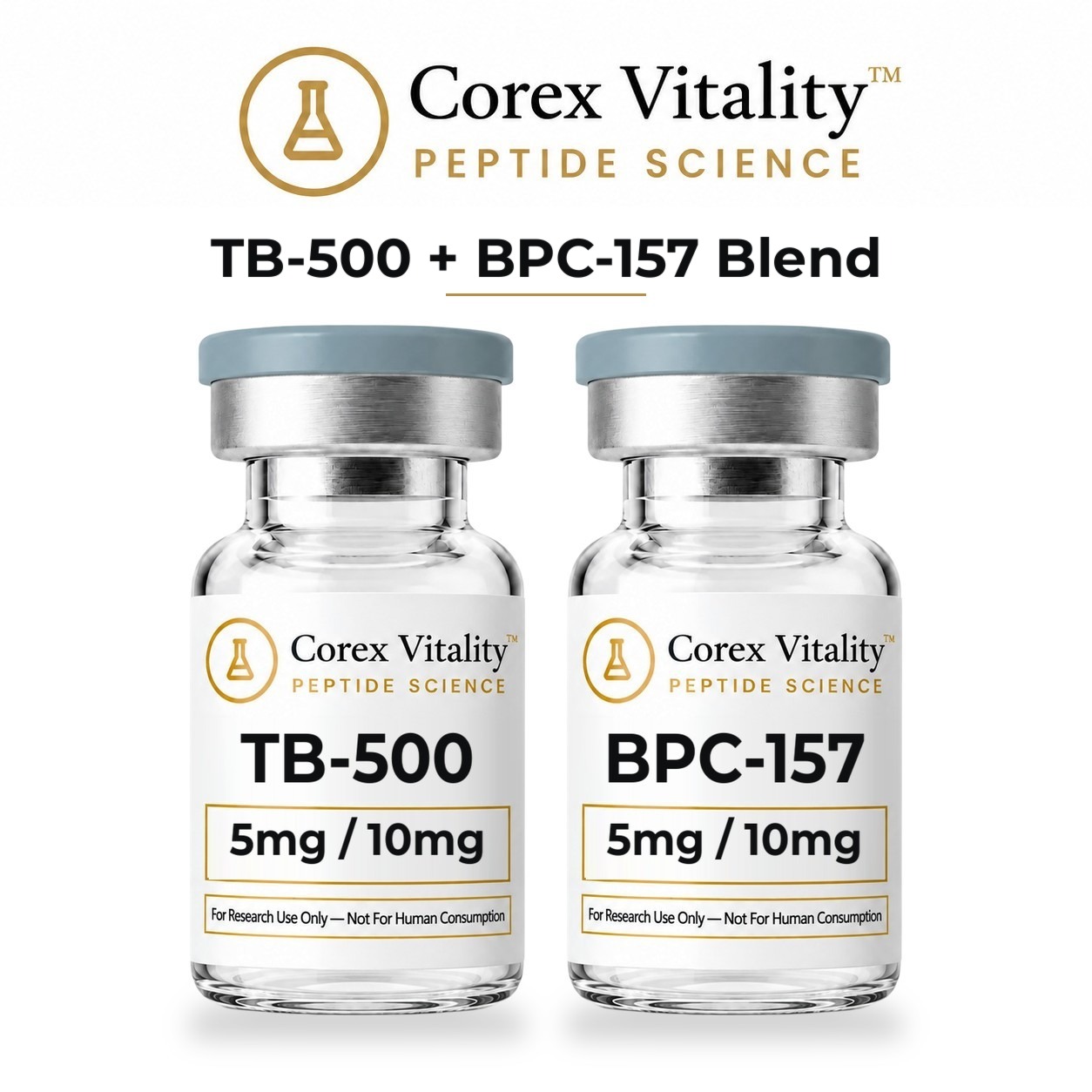
TB-500 + BPC-157 Blend

For In-Vitro Laboratory Research Use Only • Not for Human or Veterinary Use

TB-500 + BPC-157 Peptide Blend

The TB-500 + BPC-157 Blend combines two distinct research peptides in one product, with 5mg/10mg of each compound. TB-500 is a synthetic research peptide, while BPC-157 is a synthetic 15-amino-acid pentadecapeptide studied in preclinical in-vitro and experimental models examining actin-binding dynamics and cellular migration pathways. Explore the TB-500 + BPC-157 Blend at Corex Vitality™, with clear product specifications and batch verification details.

£28.99 – £47.99 / vialFrom £24.64 / vial (15% Multi-Vial Savings)

🧪 MULTI-VIAL RESEARCH SAVINGS Buy 2 Save 10% · Buy 3+ Save 15%
1 Vial Standard £28.99 / vial
Buy 2 Vials Save 10% £26.09 / vial
Buy 3+ Vials Save 15% £24.64 / vial
Mix & match vials — 10% off 2 vials and 15% off 3+ vials auto-applies in your basket + Free Tracked 24 Delivery over £50.
💧 Reconstitution Bundle: add 10ml Bacteriostatic Water (£5.99) with any lyophilised peptide — FREE on orders over £100.
💧 + Add 10ml BAC Water (£5.99 / Free £100+)

FOR IN-VITRO LABORATORY RESEARCH USE ONLY — NOT FOR HUMAN OR VETERINARY USE

These products are research chemicals. They are not medicines, food, or supplements. They have not been evaluated by the MHRA, FDA, or any other regulatory body. Not intended to diagnose, treat, cure, or prevent any disease. All descriptions are for reference and research documentation purposes only. By purchasing, you confirm you are aged 18+ and using these products exclusively for in vitro laboratory research.

About the TB-500 + BPC-157 Blend

This product pairs two synthetic research peptides, TB-500 and BPC-157, supplied as two separate vials: one vial of each, in the size you choose. Each is also available on its own: see our TB-500 and BPC-157 product pages for full details of each compound.

  • TB-500 is a synthetic peptide related to thymosin beta-4. The compound name on each batch is shown on its Certificate of Analysis.
  • BPC-157 is a synthetic 15-amino-acid peptide (GEPPPGKPADDAGLV) whose sequence is derived from a protein found in human gastric juice.

Neither compound has been approved as a medicine by the MHRA, the FDA or any other regulator. The product sold here is a research compound for laboratory use only.

Related research compounds: Klow-80, a four-compound blend that also contains TB-500 and BPC-157, together with GHK-Cu and KPV.

Areas of research

Published research relevant to this combination includes:

  • biochemical studies of how this peptide family binds actin monomers [1]
  • a 2025 systematic review of BPC-157 in preclinical musculoskeletal models, which found no clinical safety data in humans [2]
  • a 2026 rat Achilles tendon study comparing BPC-157, TB-500 and their combination with untreated controls [3]
  • a 2026 narrative review of approved and unapproved peptides, including BPC-157 and TB-500, which found that rigorous human safety data are scarce [4]

Research on the two compounds together is very limited, and the evidence base remains at an early, largely preclinical stage.

Product specifications

Form Lyophilised (freeze-dried) powder in two sealed vials
Sizes 5mg of each, 10mg of each
Contents One vial of TB-500 and one vial of BPC-157
TB-500 identity As named on the batch COA
BPC-157 GEPPPGKPADDAGLV; C62H98N16O22; approx. 1419.5 g/mol
Purity COA shown is for the 10mg + 10mg batch.

Storage and handling

Storage & Handling — Corex Vitality™ research vials

  • As supplied: freeze-dried (lyophilised) powder in a sealed vial. Room-temperature transit is normal for dry peptides.
  • Longer storage: keep the vial tightly closed in a freezer at −20 °C or colder, dry and away from light. Colder is better for long archives.
  • Short-term: a laboratory fridge (2–8 °C) is fine for vials you plan to open soon.
  • Before opening: let the closed vial warm to room temperature, ideally in a desiccator, so moisture does not condense on the powder. Work quickly and reseal tightly; absorbed moisture lowers the real peptide content.
  • Dissolving: choose a solvent based on the sequence (see the compound note below) and test a small portion first. Swirl gently; brief sonication in a water bath can help. Do not heat.
  • Once in solution: make up only what you need. Split any solution you keep into single-use aliquots, freeze at −20 °C or colder and thaw each aliquot only once. Peptides keep far less well in solution than as dry powder.
  • Safety: handle in a suitable laboratory with appropriate PPE, following your institution’s safety procedures, and avoid breathing the powder. Keep out of reach of children.

Compound note: Two separate vials. Store both as described above and reconstitute each one on its own, using the TB-500 and BPC-157 notes on their product pages.

For in-vitro laboratory research use only. Not for human or veterinary use. General guidance paraphrased from Bachem: Handling and Storage Guidelines for Peptides and Peptide Solubility.

Quality and testing

The TB-500 + BPC-157 Blend has been tested by third-party analytical laboratories using HPLC. The COA shown is for the 10mg + 10mg blend batch; no separate COA has been issued for the 5mg + 5mg size. You can also browse every published certificate on our COA and verification page.

Research use only

For in-vitro laboratory research use only. Not for human or veterinary use. These products are research chemicals. They are not medicines, food, or supplements. They have not been evaluated by the MHRA, FDA, or any other regulatory body. Not intended to diagnose, treat, cure, or prevent any disease. All descriptions are for reference and research documentation purposes only. By purchasing, you confirm you are aged 18+ and using these products exclusively for in vitro laboratory research.

References

  1. Safer D, Elzinga M, Nachmias VT. Thymosin beta 4 and Fx, an actin-sequestering peptide, are indistinguishable. J Biol Chem. 1991. PubMed 1999398
  2. Vasireddi N, et al. Emerging use of BPC-157 in orthopaedic sports medicine: a systematic review. HSS J. 2025. PubMed 40756949
  3. Biçer O, et al. Effects of BPC-157 and TB-500 on Achilles tendon repair in rats: a histopathological and biomechanical study. Jt Dis Relat Surg. 2026. PubMed 42542926
  4. Mendias CL, et al. Safety and efficacy of approved and unapproved peptide therapies for musculoskeletal injuries and athletic performance. Sports Med. 2026. PubMed 41966639

Research you can verify.

Get Corex Vitality™ Research Updates

Get new Learning Hub articles and stock updates. No spam. Unsubscribe any time.

We will send you an email to confirm. Read our privacy policy.

🎬 Scientific Explainer Video · What It Is For & How It Works

TB-500 + BPC-157 (Dual-Pathway Blend) — Laboratory Mechanism & Research Overview

⬇ Download Video (MP4) All Peptide Videos →
🔬 What Is This Peptide Researched For?
  • Evaluating dual-pathway synergy between intracellular actin mobilisation (TB-500) and FAK/VEGFR2 signalling (BPC-157)
  • Studying coordinated angiogenesis, fibroblast chemotaxis and collagen I/III matrix alignment
  • Comparing combined vs single-peptide kinetics in connective-tissue & endothelial cell assays
⚙️ How Does It Work? (Mechanism of Action)
1. Dual Extracellular + Cytoskeletal Action: BPC-157 primes VEGFR2/FAK-paxillin while TB-500 mobilises monomeric G-actin pools.
2. Convergent eNOS & ILK-Akt Cascades: Simultaneously activates nitric oxide microvascular pathways and integrin survival signalling.
3. Accelerated Matrix Organisation: Supports synchronized fibroblast migration and capillary network formation in vitro.
📚 Peer-Reviewed Literature · PubMed Indexed

Published Research — Peer-Reviewed Receptor & Pathway Studies

NCBI PubMed Database ↗ Verify Batch COAs →

BPC-157 (Pentadecapeptide)

  1. [1] Chang CH et al. · J Appl Physiol (1985) (2011)

    Ex-vivo rat Achilles tendon explant and cultured tendon fibroblast study demonstrating concentration-dependent acceleration of cellular migration, culture-dish spreading, H2O2 stress survival, and FAK–paxillin phosphorylation.

    PMID: 21030672 ↗ DOI: 10.1152/japplphysiol.00945.2010 ↗
  2. [2] Hsieh MJ et al. · J Mol Med (Berl) (2017)

    In-vitro human vascular endothelial cell and chick chorioallantoic membrane (CAM) study showing upregulated VEGFR2 mRNA/protein expression, receptor internalisation, and VEGFR2–Akt–eNOS phosphorylation.

    PMID: 27847966 ↗ DOI: 10.1007/s00109-016-1488-y ↗
  3. [3] Chang CH et al. · Molecules (2014)

    cDNA microarray, RT-qPCR, and Western blot study in isolated rat Achilles tendon fibroblasts showing concentration- and time-dependent upregulation of growth hormone receptor expression and downstream JAK2 phosphorylation.

    PMID: 25415472 ↗ DOI: 10.3390/molecules191119066 ↗
  4. [4] Huang T et al. · Drug Des Devel Ther (2015)

    In-vitro human umbilical vein endothelial cell (HUVEC) transwell, scratch-migration, and Matrigel tube-formation assays demonstrating concentration-dependent cell-cycle progression and ERK1/2, FAK, and paxillin phosphorylation.

    PMID: 25995620 ↗ DOI: 10.2147/DDDT.S82030 ↗

TB-500

  1. [1] Safer D, Elzinga M, Nachmias VT · J Biol Chem (1991)

    Biochemical study showing that the actin-sequestering peptide Fx and thymosin beta 4 are the same molecule, and describing how it binds actin monomers.

    PMID: 1999398 ↗
  2. [2] Hannappel E · Ann N Y Acad Sci (2007)

    Review of the beta-thymosin peptide family: structure, distribution and known molecular interactions, including actin binding.

    PMID: 17468232 ↗ DOI: 10.1196/annals.1415.018 ↗
  3. [3] Philp D et al. · FASEB J (2003)

    In-vitro endothelial cell adhesion, migration, tube-formation, and chick aortic-ring sprouting study demonstrating that the conserved central 7-amino-acid G-actin-binding motif reproduces the angiogenic signalling of full-length thymosin β4.

    PMID: 14500546 ↗ DOI: 10.1096/fj.03-0121fje ↗
  4. [4] Bock-Marquette I et al. · Nature (2004)

    Embryonic and postnatal cardiomyocyte culture and biochemical study showing that the G-actin-sequestering polypeptide thymosin β4 forms a functional PINCH–integrin-linked kinase (ILK) complex that activates protein kinase B (Akt) signalling.

    PMID: 15565145 ↗ DOI: 10.1038/nature03000 ↗

References are provided for scientific context only. All Corex Vitality™ compounds are supplied strictly for in-vitro laboratory research use (RUO).