
Longevity peptides: a research summary

Summarises published literature for educational purposes. Each compound is available as a made-to-order research material. Allow 14–16 days for delivery.
Four peptides appear frequently in the published literature on ageing biology. Each has been studied for a different biological process: telomere biology (Epitalon), mitochondrial signalling (MOTS-c), the inner mitochondrial membrane (SS-31) and cellular senescence (FOXO4-DRI). The summaries below describe what each compound is, the models it has been investigated in, and the key references.
Jump to: Epitalon · MOTS-c · SS-31 · FOXO4-DRI · Comparison table · View all longevity research compounds
Epitalon
| Property | Detail |
|---|---|
| Other names | Epithalon, Epithalone, AEDG peptide |
| Sequence | Ala-Glu-Asp-Gly (tetrapeptide) |
| Molecular formula | C14H22N4O9 |
| Molar mass | approx. 390.3 g/mol |
| Research area | Telomere biology and telomerase |
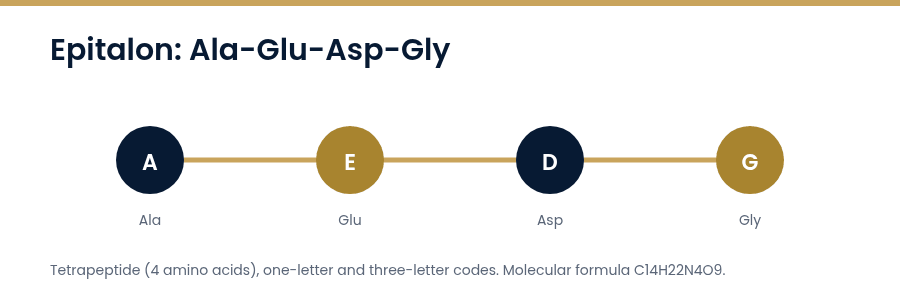
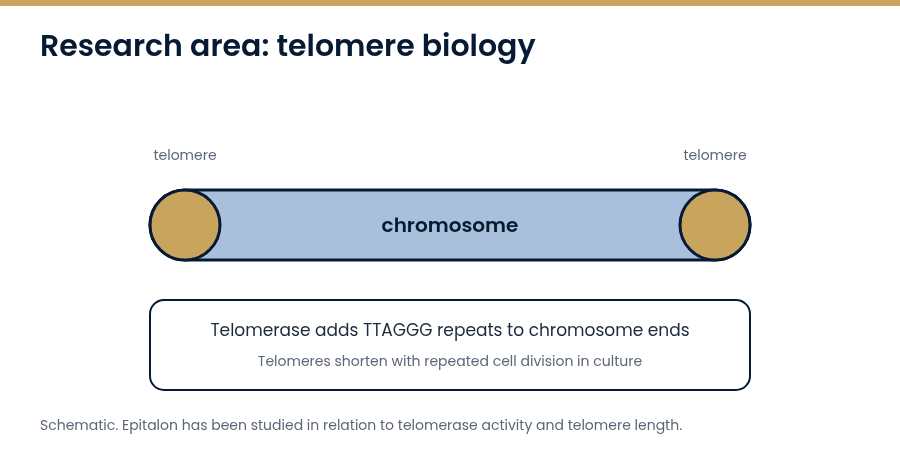
Background. Epitalon is a synthetic tetrapeptide developed by Khavinson and colleagues in St Petersburg. It was designed on the basis of epithalamin, an extract of the pineal gland.
Studied in:
- Human cells in culture: Khavinson and colleagues (2003) reported that Epitalon induced telomerase activity and telomere elongation in cultured human somatic cells [1].
- Mice: in a lifelong study in female SHR mice, Epitalon did not change mean lifespan, body weight or food consumption. The authors reported differences in some secondary measures, including chromosome aberrations in bone marrow cells and the lifespan of the longest-lived animals [2].
- Human cell lines (2025): researchers at Brunel University London studied Epitalon in normal epithelial cells, fibroblasts and breast cancer cell lines. They reported telomere length increases associated with hTERT expression and telomerase activity in the normal cells, and with ALT (alternative lengthening of telomeres) activity in the cancer cell lines [3].
Limitations. Much of the early literature comes from one research group. The 2025 study [3] offers independent data in cell lines, but there are few independent replications in animal models.
Epitalon
Price: 10mg £18.99 · 50mg £44.99
Made to order: please allow 14–16 days for delivery.
Certificates of Analysis: 10mg (report LDA22161072) and 50mg (report LDA22161082). View certificates on our Verification page
MOTS-c
| Property | Detail |
|---|---|
| Full name | Mitochondrial open reading frame of the 12S rRNA type-c |
| Length | 16 amino acids (MRWQEMGYIFYPRKLR) |
| Molar mass | approx. 2174.6 g/mol (consistent with the expected mass on the Bio-Analysis Centre COA) |
| Research area | Mitochondrial-derived peptides; metabolic signalling |
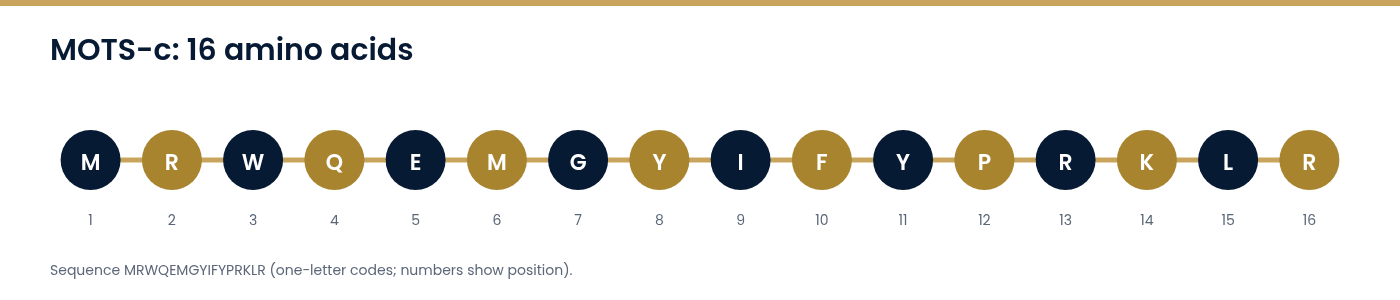
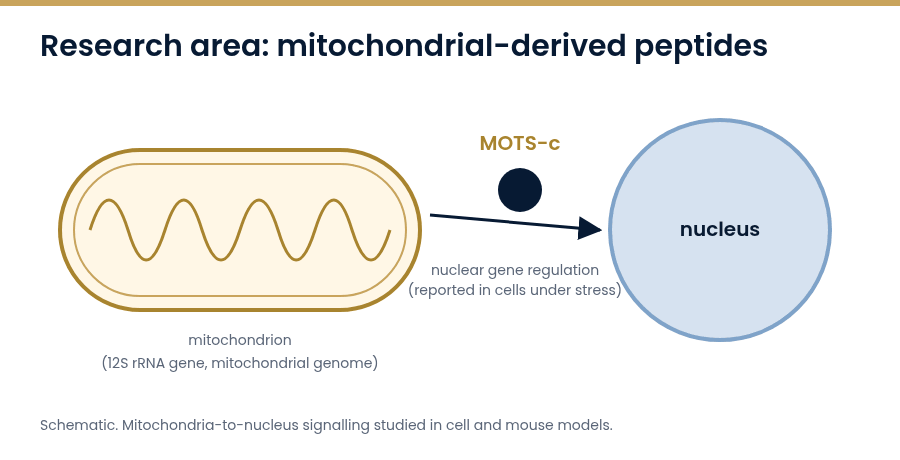
Background. MOTS-c belongs to a class of mitochondrial-derived peptides, which are encoded in the mitochondrial genome rather than the nuclear genome. It was described in 2015 as a peptide encoded by a short open reading frame within the mitochondrial 12S rRNA gene [4].
Studied in:
- Cells and mice (2015): the original report characterised MOTS-c’s effects on metabolic pathways, including AMPK signalling and the folate cycle, in cell and mouse models [4].
- Cells (2018): under metabolic stress in cell culture, MOTS-c was reported to move into the nucleus and regulate the expression of nuclear genes. This is an example of mitochondria-to-nucleus signalling [5].
- Mice of different ages (2021): MOTS-c treatment in young, middle-aged and old mice was reported to alter measures of physical performance, and the authors studied its effects on skeletal muscle gene expression and metabolism [6].
Limitations. Most mechanistic data come from rodent and cell models from a small number of laboratories. Findings in mice cannot be extrapolated to humans.
MOTS-c
Price: 10mg £27.99 · 20mg £42.99 · 40mg £69.99
Made to order: please allow 14–16 days for delivery.
Certificates of Analysis: 10mg (Bio-Analysis Centre), 20mg (report LDA22160992) and 40mg (report LDA22161002). View certificates on our Verification page
SS-31
| Property | Detail |
|---|---|
| Other names | Elamipretide, MTP-131, Bendavia (names used in the literature) |
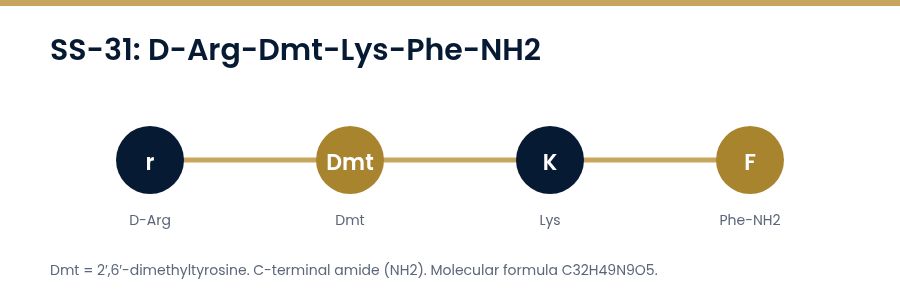
| Sequence | D-Arg-Dmt-Lys-Phe-NH2 (Dmt = 2′,6′-dimethyltyrosine) |
| Molecular formula | C32H49N9O5 |
| Molar mass | approx. 639.8 g/mol |
| Research area | Inner mitochondrial membrane; cardiolipin |
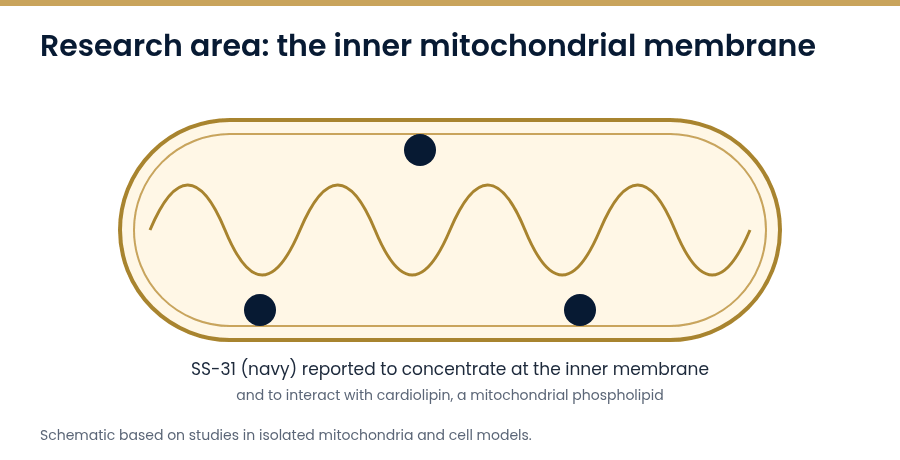
Background. SS-31 is one of the “Szeto–Schiller” (SS) peptides, a family of small, cell-permeable peptides with alternating aromatic and basic amino acids. Zhao and colleagues (2004) reported that SS peptides concentrate at the inner mitochondrial membrane in cell models [7]. Later work characterised SS-31’s interaction with cardiolipin, a phospholipid specific to the inner mitochondrial membrane [8].
Studied in:
- Isolated mitochondria and cell models: studies of SS-31’s localisation and its effects on mitochondrial swelling and oxidative stress measures [7].
- Cardiolipin biophysics: a review of SS-31’s binding to cardiolipin and the reported effects on electron transport chain organisation in experimental systems [8].
- Aged mice: Campbell and colleagues (2019) studied SS-31 in aged mice and reported changes in skeletal muscle redox and mitochondrial measures [9].
Limitations. Laboratory findings in isolated mitochondria and rodents do not establish effects in humans.
SS-31
Price: 10mg £34.99 · 50mg £134.99
Made to order: please allow 14–16 days for delivery.
Certificate of Analysis: 50mg (report LDA22161222). View certificates on our Verification page
FOXO4-DRI
| Property | Detail |
|---|---|
| Type | D-retro-inverso (DRI) peptide: built from D-amino acids with the sequence order inverted, a design used to increase resistance to proteases |
| Target | Interaction between the FOXO4 and p53 proteins |
| Research area | Cellular senescence; senolytics |
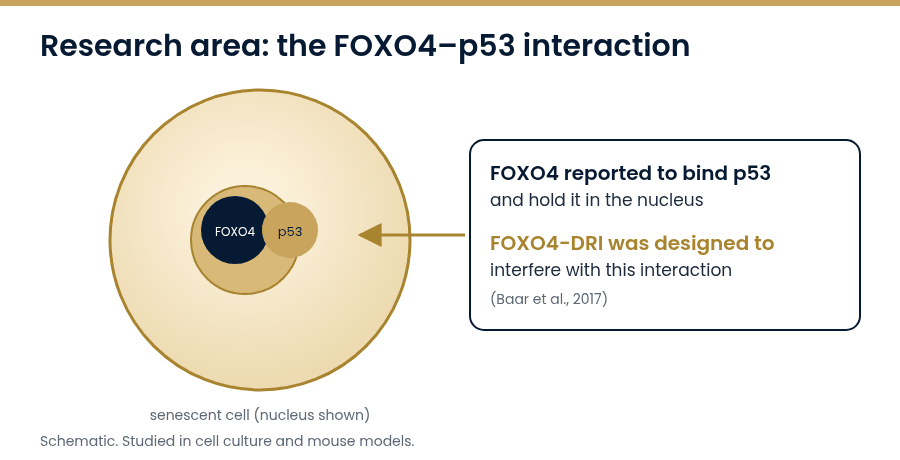
Background. In senescent cells, the transcription factor FOXO4 was reported to bind p53 and hold it in the nucleus. Baar and colleagues (2017) designed FOXO4-DRI to interfere with this interaction [10].
Studied in:
- Cell culture: FOXO4-DRI was reported to cause p53 to leave the nucleus and to selectively induce apoptosis in senescent cells, compared with non-senescent cells [10].
- Mice: the same study examined FOXO4-DRI in mice with chemotherapy-induced (doxorubicin) senescence, in a fast-ageing (XpdTTD/TTD) model and in naturally aged mice. It reported changes in several tissue and physical parameters [10].
Limitations. The primary evidence comes from a single foundational study and follow-up work in animal models. FOXO4-DRI is discussed further in What are senolytics?
Comparison table
| Peptide | Length | Main research area | Main models in the literature | Key reference |
|---|---|---|---|---|
| Epitalon | 4 aa | Telomerase, telomeres | Human cell lines; mice | [1–3] |
| MOTS-c | 16 aa | Mitochondrial-derived peptide signalling | Cells; mice | [4–6] |
| SS-31 | 4 aa (modified) | Inner mitochondrial membrane, cardiolipin | Isolated mitochondria; cells; mice | [7–9] |
| FOXO4-DRI | DRI peptide | Senescent cells (FOXO4–p53) | Cells; mice | [10] |
Research use only. This page summarises published scientific literature for educational purposes. It does not describe the effects of any Corex Vitality™ product. Epitalon, MOTS-c, SS-31 and FOXO4-DRI are supplied for laboratory research use only and are not intended for human or veterinary use, or for the diagnosis, treatment, prevention or cure of any disease or medical condition. We do not provide administration, protocol or usage guidance.
References
- Khavinson VKh, Bondarev IE, Butyugov AA. Epithalon peptide induces telomerase activity and telomere elongation in human somatic cells. Bull Exp Biol Med. 2003;135(6):590-592. PubMed: https://pubmed.ncbi.nlm.nih.gov/12937682/ · DOI: https://doi.org/10.1023/a:1025493705728
- Anisimov VN, Khavinson VKh, Popovich IG, et al. Effect of Epitalon on biomarkers of aging, life span and spontaneous tumor incidence in female Swiss-derived SHR mice. Biogerontology. 2003;4(4):193-202. PubMed: https://pubmed.ncbi.nlm.nih.gov/14501183/ · DOI: https://doi.org/10.1023/a:1025114230714
- Al-Dulaimi S, Thomas R, Matta S, Roberts T. Epitalon increases telomere length in human cell lines through telomerase upregulation or ALT activity. Biogerontology. 2025;26(5):178. PubMed: https://pubmed.ncbi.nlm.nih.gov/40908429/ · DOI: https://doi.org/10.1007/s10522-025-10315-x (Correction: https://doi.org/10.1007/s10522-025-10326-8)
- Lee C, Zeng J, Drew BG, et al. The mitochondrial-derived peptide MOTS-c promotes metabolic homeostasis and reduces metabolic and insulin-receptor signalling. Cell Metab. 2015;21(3):443-454. PubMed: https://pubmed.ncbi.nlm.nih.gov/25738459/ · DOI: https://doi.org/10.1016/j.cmet.2015.02.009
- Kim KH, Son JM, Benayoun BA, Lee C. The mitochondrial-encoded peptide MOTS-c translocates to the nucleus to regulate nuclear gene expression in response to metabolic stress. Cell Metab. 2018;28(3):516-524.e7. PubMed: https://pubmed.ncbi.nlm.nih.gov/29983246/ · DOI: https://doi.org/10.1016/j.cmet.2018.06.008
- Reynolds JC, Lai RW, Woodhead JST, et al. MOTS-c is an exercise-induced mitochondrial-encoded regulator of age-dependent physical decline and muscle homeostasis. Nat Commun. 2021;12(1):470. PubMed: https://pubmed.ncbi.nlm.nih.gov/33473109/ · DOI: https://doi.org/10.1038/s41467-020-20790-0
- Zhao K, Zhao GM, Wu D, et al. Cell-permeable peptide antioxidants targeted to inner mitochondrial membrane inhibit mitochondrial swelling, oxidative cell death, and reperfusion injury. J Biol Chem. 2004;279(33):34682-34690. PubMed: https://pubmed.ncbi.nlm.nih.gov/15178689/ · DOI: https://doi.org/10.1074/jbc.M402999200
- Szeto HH. First-in-class cardiolipin-protective compound as a therapeutic agent to restore mitochondrial bioenergetics. Br J Pharmacol. 2014;171(8):2029-2050. PubMed: https://pubmed.ncbi.nlm.nih.gov/24117165/ · DOI: https://doi.org/10.1111/bph.12461
- Campbell MD, Duan J, Samuelson AT, et al. Improving mitochondrial function with SS-31 reverses age-related redox stress and improves exercise tolerance in aged mice. Free Radic Biol Med. 2019;134:268-281. PubMed: https://pubmed.ncbi.nlm.nih.gov/30597195/ · DOI: https://doi.org/10.1016/j.freeradbiomed.2018.12.031
- Baar MP, Brandt RMC, Putavet DA, et al. Targeted apoptosis of senescent cells restores tissue homeostasis in response to chemotoxicity and aging. Cell. 2017;169(1):132-147.e16. PubMed: https://pubmed.ncbi.nlm.nih.gov/28340339/ · DOI: https://doi.org/10.1016/j.cell.2017.02.031